Solar System Scale Model
Uranus 91 mm 5.2 km 51,000 km 19 AU 2900 million km Neptune 89 mm 8.1 km 50,000 km 30 AU 4500 million km Kuiper belt (incl Pluto) Salt to pebbles 8-15 km <1200 km 30-50 AU 4.5–7.4 billion km Proxima Centauri
Download Solar System Scale Model

Information
Domain:
Source:
Link to this page:
Documents from same domain
Solstice and Equinox (“Suntrack”) Season Model
solar-center.stanford.eduSun Track Model 4 Winter solstice was of particular interest to many pre-technological cultures. Because the Sun rose and set at a very southern/low point, people were concerned that it might continue its southward journey,
NASA’s Solar Dynamics Observatory Data in the Classroom
solar-center.stanford.eduNASA’s Solar Dynamics Observatory . Data in the Classroom. Scott Hildreth, Shannon Lee, Timothy Dave . Chabot Community College, Hayward, CA . A collaborative project between Chabot Community College, the Stanford Solar Center, and
Experimenting with UV Sensitive Beads - Stanford University
solar-center.stanford.eduStanford University Solar Center 1 Experimenting with UV-sensitive Beads By Deborah Scherrer, Stanford Solar Center . Introduction Participants experiment with ultraviolet
Teaching Moon Phases - Stanford University
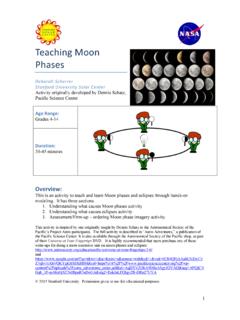
solar-center.stanford.edu4 Their right ear/shoulder = west The ball on a stick will eventually represent the Moon (but don’t pass out the balls yet) c. Ask participants to stand where it is “noon”, then midnight, sunrise, sunset.
The Sun in the Electromagnetic Spectrum
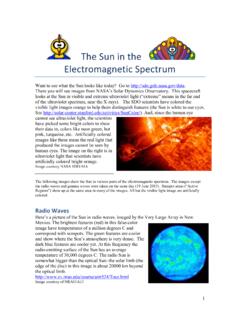
solar-center.stanford.eduThe image shows a portion of the layer of the Sun's atmosphere known as the chromosphere, just above the Sun’s surface. Most of the UV light comes from the sunpot "active regions", where we can sometimes see loops, large prominences rising high above the surface of the Sun. At the north and south poles of the Sun, less UV light is emitted ...
not - Stanford University
solar-center.stanford.eduOur Sun 5 Our Sun – Source of Life A total solar eclipse, as observed from Earth. Image Credit: Alphonse Sterling and the Suntrek website (www.suntrek.org) Used with permission The Sun is our very own star, at the center of our solar system.
Related documents
Scale Model of the Solar System - University of New Mexico
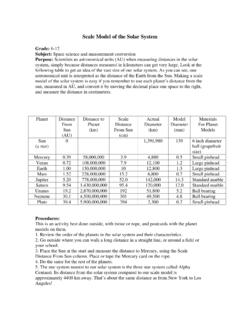
meteorite.unm.eduUranus 144 meters = 288 very small steps or 144 very large steps from Saturn Neptune 163 meters = 326 very small steps or 163 very large steps from Uranus Pluto 140 meters = 280 very small steps or 140 very large steps from Neptune Standards addressed: Content Standards 5-8, Earth and Space Science Content Standard D, Earth in the Solar

Astrodienst Ephemeris Tables
www.astro.comAstrodienst Ephemeris Tables for the year 2014 tropical zodiac contains Sun, Moon, Mercury, Venus, Mars, Jupiter, Saturn, Uranus, Neptune, Pluto, True Node, Moon's ...

Astrodienst Ephemeris Tables
www.astro.comAstrodienst Ephemeris Tables for the year 2019 tropical zodiac contains Sun, Moon, Mercury, Venus, Mars, Jupiter, Saturn, Uranus, Neptune, Pluto, True Node, Moon's ...

Planet Distance Chart - Jet Propulsion Laboratory
www.jpl.nasa.govAnswer Key NASA/JPL Education - Solar System Bead Activity Discover more: www.jpl.nasa.gov/edu Planet Distance Chart . Calculate the …

A Timeline for Planet Formation
www.nasa.govFormation of Uranus and Neptune : Rocky Planet Era ; 100 million : Formation of rocky planets by mergers of 50-100 smaller bodies : Late Heavy Bombardment Era : 600 million ; Migration of Jupiter disrupts asteroid belt sending large asteroids to impact planetary surfaces in the inner solar system. Ocean Era ; 600 million : LHB transports comets

THE EARTH IN THE SOLAR SYSTEM
www.ncert.nic.in7. URANUS-One orbit around sun - 84 years. One spin around axis - 17 hours 14 minutes, number of moons - about 27. 8. NEPTUNE-One orbit around sun - 164 years. One spin on axis-16 hours 7 minutes, number of moons - 13. Inner planets-very close to the sun. They are made up of rocks. Outer Planets - V ery-very far fr om the sun and ar

A Brief History of Mathematics - Simon Fraser University
www.sfu.caThe discovery of Neptune on paper! (1846) (Celestial Mechanics) (Uranus ‘accidentally’ discovered by telescope; William Herschel 1781) ...