Spatio-Temporal Graph Convolutional Networks: A Deep ...
Spatio-Temporal Graph Convolutional Networks: A Deep Learning Framework for TrafÞc Forecasting Bing Yu! 1, Haoteng Yin! 2,3, Zhanxing Zhu 3,4 1 School of Mathematical Sciences, Peking University, Beijing, China 2 Academy for Advanced Interdisciplinary Studies, Peking University, Beijing, China 3 Center for Data Science, Peking University, Beijing, China
Download Spatio-Temporal Graph Convolutional Networks: A Deep ...

Information
Domain:
Source:
Link to this page:
Documents from same domain

Deep Neural Networks for High Dimension, Low …
www.ijcai.orgDeep Neural Networks for High Dimension, Low Sample Size Data Bo Liu, Ying Wei, Yu Zhang, Qiang Yang Hong Kong University of Science and Technology, Hong Kong

Training Feedforward Neural Networks Using …
www.ijcai.orgTraining Feedforward Neural Networks Using Genetic Algorithms David J. Montana and Lawrence Davis BBN Systems and Technologies Corp. 10 Mouiton St.

Learning Feature Engineering for Classification
www.ijcai.orgGiven a set of features and class labels, the classiÞer ... c!T of arityr, an ordered list of features[f i,...,f i+r ! 1] and a usefulness score. ... paradigm for each combination and selects top-useful ones.k In the following section, we describe how LFE learns and

Imaging Time-Series to Improve Classification and Imputation
www.ijcai.orgiis the time stamp and Nis a con-stant factor to regularize the span of the polar coordinate sys-tem. This polar coordinate based representation is a novel way to understand time series. As time increases, correspond-ing values warp among different angular points on the span-ning circles, like water rippling. The encoding map of equa-
Recurrent Neural Network for Text Classification with ...
www.ijcai.orgFigure 2: Three architectures for modelling text with multi-task learning. Motivated by the success of multi-task learning [Caruana, 1997], we propose three multi-task models to leverage super-vised data from many related tasks. Deep neural model is well suited for multi-task learning since the features learned from a task may be useful for ...

Deep Matrix Factorization Models for Recommender Systems
www.ijcai.orgDeep Matrix Factorization Models for Recommender Systems Hong-Jian Xue, Xin-Yu Dai, Jianbing Zhang, Shujian Huang, Jiajun Chen National Key Laboratory for Novel Software Technology; Nanjing University, Nanjing 210023, China
L2,1-Norm Regularized Discriminative Feature Selection …
www.ijcai.orgrithms, e.g., Fisher score [Duda et al., 2001] , robust regres-sion [Nie et al., 2010], sparse multi-output regression [Zhao et al., 2010] and trace ratio [Nie et al., 2008], usually select featuresaccordingto labels of the training data. Because dis-criminative informationis enclosed in labels, supervised fea-
DeepFM: A Factorization-Machine based Neural Network …
www.ijcai.orgDeepFM: A Factorization-Machine based Neural Network for CTR Prediction Huifeng Guo 1, Ruiming Tang2, Yunming Yey1, Zhenguo Li2, Xiuqiang He2 1Shenzhen Graduate School, Harbin Institute of Technology, China 2Noah's Ark Research Lab, Huawei, China 1huifengguo@yeah.net, yeyunming@hit.edu.cn,2ftangruiming, li.zhenguo, hexiuqiangg@huawei.com Abstract Learning …
Detecting Rumors from Microblogs with Recurrent Neural ...
www.ijcai.orgDetecting Rumors from Microblogs with Recurrent Neural Networks Jing Ma,1 Wei Gao,2 Prasenjit Mitra,2 Sejeong Kwon,3 Bernard J. Jansen,2 Kam-Fai Wong,1 Meeyoung Cha3 1The Chinese University of Hong Kong, Hong Kong SAR 2Qatar Computing Research Institute, Hamad Bin Khalifa University, Qatar 3Graduate School of Culture Technology, Korea Advanced …

Time-Aware Multi-Scale RNNs for Time Series Modeling
www.ijcai.orgof genres requires modeling the emotional changes in music, which are controlled by note duration. Therefore, different scales are also needed at different time steps as the notes have different durations at different times [Hu et al., 2019]. Recently, some methods have been proposed to select ap-propriate scales corresponding to each sample ...
Related documents
Sequence to Sequence Learning with Neural Networks
arxiv.orgDeep Neural Networks (DNNs) are extremely powerful machine learning models that achieve ex-cellent performanceon difficult problems such as speech rec ognition[13, 7] and visual object recog-nition [19, 6, 21, 20]. DNNs are powerful because they can perform arbitrary parallel computation for a modest number of steps.
Learning Transferable Features with Deep Adaptation Networks
proceedings.mlr.pressdeep networks, resulting in statistically unboundedrisk for target tasks (Mansour et al., 2009; Ben-David et al., 2010). Our work is primarily motivated by Yosinski et al. (2014), which comprehensively explores feature transferability of deep convolutional neural networks. The method focuses on a different scenario where the learning tasks are ...

“Deep Fakes” using Generative Adversarial Networks (GAN)
noiselab.ucsd.edutwo GAN networks, and other than the loss in the tradi-tional GAN network, it also included a cycle-consistency loss to ensure any input is mapped to a relatively reasonable output. 2. Physical and Mathematical framework The framework we used in this project is a Cycle-GAN based on deep convolutional GANs. 2.1. Generative Adversarial Networks (GAN)
Understanding the difficulty of training deep feedforward ...
proceedings.mlr.pressdeep networks with sigmoids but initialized from unsuper-vised pre-training (e.g. from RBMs) do not suffer from this saturation behavior. Our proposed explanation rests on the hypothesis that the transformation that the lower layers of the randomly initialized network computes initially is
Multifaceted Feature Visualization: Uncovering the ...
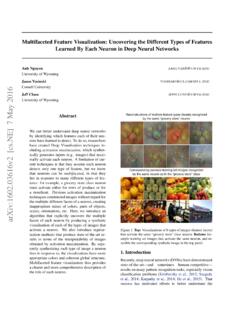
arxiv.orgWe can better understand deep neural networks by identifying which features each of their neu-rons have learned to detect. To do so, researchers have created Deep Visualization techniques in-cluding activation maximization, which synthet-ically generates inputs (e.g. images) that maxi-mally activate each neuron. A limitation of cur-