
Steps for Implementation: Functional Behavior Assessment
National Professional Development Center on Autism Spectrum Disorders Module: Functional Behavior Assessment Functional Behavior Assessment: Steps for Implementation Page 1 of 12 National Professional Development Center on ASD 10/2010 Steps for Implementation: Functional Behavior Assessment Neitzel, J. & Bogin, J. (2008).
Download Steps for Implementation: Functional Behavior Assessment

Information
Domain:
Source:
Link to this page:
Documents from same domain
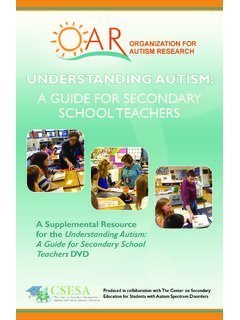
A GUIDE FOR SECONDARY SCHOOL TEACHERS - …
csesa.fpg.unc.eduA Supplemental Resource for the Understanding Autism: A Guide for Secondary School Teachers DVD ORGANIZATION FOR AUTISM RESEARCH UNDERSTANDING AUTISM: A GUIDE FOR SECONDARY

VISUAL SUPPORTS - csesa.fpg.unc.edu
csesa.fpg.unc.eduPicture Exchange Communication System ... •Organizational system - school . Examples of Visual Supports •Script

Overview of Picture Exchange Communication System (PECS)
csesa.fpg.unc.eduThe Picture Exchange Communication System (PECS) was developedat the Delaware Autistic Program (DAP) and was designed to teach young children to communicate in a social context Bondy
Tips for Guardianship and Alternatives - csesa.fpg.unc.edu
csesa.fpg.unc.eduBelow we provide an overview of obtaining guardianship and its alternatives. Refer to your local legal services for more information as it applies to you and your family. You can also learn more with the Special Needs Alliance, which is a national organization comprised of attorneys
Community and School Resource Mapping - csesa.fpg.unc.edu
csesa.fpg.unc.eduIntroduction to Community and School Resource Mapping: Module 1 6 ... component is a critical component of the full CSESA model. Student-centered planning for a youth’s future beyond high school that is built on input from the student, family, and various professionals familiar with the student is important to a young ... course, the student ...
Overview of Time Delay - CSESA
csesa.fpg.unc.eduTime delay is a practice that focuses on fading the use of prompts during instructional activities. This practice is always used in conjunction with prompting procedures such as least-to-most prompting, simultaneous prompting, and graduated guidance.
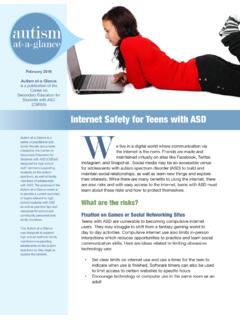
at-a-glance
csesa.fpg.unc.edu• Teach the teen how to block “friends” on social networking sites like Facebook so they know how to get rid of a bully • Encourage the teen to seek out a responsible adult to help them handle the situation Teens with ASD can also engage in cyberbullying without understanding the consequences of their actions.
A GUIDE FOR SECONDARY SCHOOL TEACHERS
csesa.fpg.unc.eduThis guide reviews common characteristics associated with autism and provides teachers with practical tips and strategies for supporting their students with autism in the classroom setting. It is also designed to supplement the Understanding Autism: A Guide for Secondary School Teachers DVD, a training resource developed by
Steps for Implementation: Extinction - University of North ...
csesa.fpg.unc.eduStep 2. Identifying Data Collection Measures and Collecting Baseline Data 1. Teachers/practitioners identify data collection measures to be used to assess the interfering behavior before implementing the intervention. When collecting data for extinction, it is important to focus on the frequency, duration and intensity of the behavior.
Steps for Implementation: Positive Reinforcement
csesa.fpg.unc.eduDuration data are used to record how long a learner engages in a particular behavior. For example, a teacher might collect data on how long a learner with ASD stays in his seat or how long a young child stays engaged in parallel play. Table 3 provides an example duration data collection sheet. Blank data sheets are available in a separate document.
Related documents
Helping Children Make Transitions between Activities
csefel.vanderbilt.edua bell). Teach children expectations such as which shelves hold which blocks. • Minimize the number of transitions during which all children have to do the same thing at the same time (e.g., Do all children have to go to the restroom at the same time? Can some children come over to the rug and get ready for

Helping Children Learn to Manage Their Own Behavior
csefel.vanderbilt.edu• One way to help young children manage their own behavior, allowing teachers to spend more time teaching and less time dealing with occurrences of challenging behavior, is through “self-management.” • Self-management can be used to • Teach children what is expected of them (e.g., tasks they are supposed to do).
BURNOUT AMONG THE COUNSELING PROFESSION: A …
files.eric.ed.govcounselors needs to be on wellness behavior by discussing the variables that can lead to burnout for the emerging counseling professional. Current and future professional counselors face many challenges because of the nature of the work and the role expectations of the counseling professional (Yu, Lee, & Nesbit, 2008).
Evidence-based Classroom Behaviour Management Strategies
files.eric.ed.govChildren’s Services and Skills 2005, section 65, p.15), it was estimated that in the United Kingdom 80 percent of disruptive behaviour was attributable “to poor classroom organization, planning and teaching”. According to the report, British teachers stated behaviours such as talking out-of-turn, and

NEW YORK STATE OFFICE OF CHILDREN AND FAMILY …
ocfs.ny.govchildren. Moderately ill children who require the services of a health care professional but have been approved for inclusion by a health care provider to participate in the program. A child who meets any of the following criteria is defined as “moderately ill”:
2020 Health Behavior Assessment and ... - APA Services
www.apaservices.orgdevelop, health behavior services were used with increasing frequency in outpatient settings for both primary and specialty care, a finding that is supported by Medicare claims data (2002– 2017). For example, in 2002, only 9% of the claims for the Health and Behavior Assessment service (CPT code 96150) were in

Parent’s Guide to Feeding Behavior in Children with Autism
www.autismspeaks.orgBehavior in Children with Autism These materials are the product of on-going activities of the Autism Speaks Autism Treatment Network, a funded program of Autism Speaks. It is supported by cooperative agreement UA3 MC 11054 through the U.S. Department of Health and Human Services, Health Resources and Services Administration, Maternal
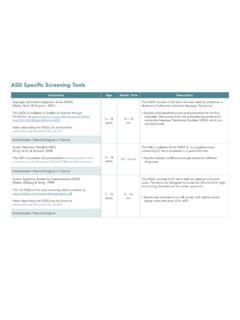
ASD Specific Screening Tools - University of Nebraska ...
www.unl.eduhistory and behavior and the Current Form which focuses on behavior during the most recent three months. • Results are reported using a total score and defined cutoff points. Administrator: Parent/Caregiver Social Responsiveness Scale (SRS) (Constantino & Gruver, 2005) The SRS can be purchased through Western Psychological

THE BEHAVIOR CHANGE FRAMEWORK - United States …
www.usaid.govAccelerator Behavior: Caregivers recognize symptoms of malaria and seek prompt diagnosis and appropriate care. Related Behavior: Accelerate the demand for and appropriate use of malaria-related products and services. Suggested Intervention: (1) Train for self-care, care giving, care seeking for malaria episodes to prevent illness, deaths and other
Policy Statement on Expulsion and Suspension Policies In ...
www2.ed.govSome of these children may have undiagnosed disabilities or behavioral health issues and may be eligible for additional services, but in simply being expelled, they may not receive the evaluations or referrals they need to obtain services. For example, the source of challenging behavior may be communication and language difficulties, skills that