
Steps for Implementation: Functional Behavior Assessment
Module: Functional Behavior Assessment Functional Behavior Assessment: Steps for Implementation Page 3 of 12 National Professional Development Center on ASD 10/2010 d. if the interfering behavior might occur because learners are being asked to demonstrate a skill that they cannot perform (e.g., language/ communication, social).
Download Steps for Implementation: Functional Behavior Assessment

Information
Domain:
Source:
Link to this page:
Documents from same domain
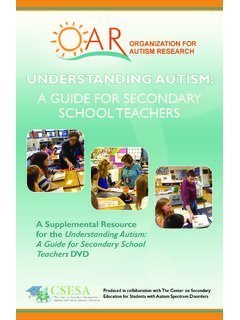
A GUIDE FOR SECONDARY SCHOOL TEACHERS - …
csesa.fpg.unc.eduA Supplemental Resource for the Understanding Autism: A Guide for Secondary School Teachers DVD ORGANIZATION FOR AUTISM RESEARCH UNDERSTANDING AUTISM: A GUIDE FOR SECONDARY

VISUAL SUPPORTS - csesa.fpg.unc.edu
csesa.fpg.unc.eduPicture Exchange Communication System ... •Organizational system - school . Examples of Visual Supports •Script

Overview of Picture Exchange Communication System (PECS)
csesa.fpg.unc.eduThe Picture Exchange Communication System (PECS) was developedat the Delaware Autistic Program (DAP) and was designed to teach young children to communicate in a social context Bondy

Tips for Guardianship and Alternatives - csesa.fpg.unc.edu
csesa.fpg.unc.eduBelow we provide an overview of obtaining guardianship and its alternatives. Refer to your local legal services for more information as it applies to you and your family. You can also learn more with the Special Needs Alliance, which is a national organization comprised of attorneys
Community and School Resource Mapping - csesa.fpg.unc.edu
csesa.fpg.unc.eduIntroduction to Community and School Resource Mapping: Module 1 6 ... component is a critical component of the full CSESA model. Student-centered planning for a youth’s future beyond high school that is built on input from the student, family, and various professionals familiar with the student is important to a young ... course, the student ...
Overview of Time Delay - CSESA
csesa.fpg.unc.eduTime delay is a practice that focuses on fading the use of prompts during instructional activities. This practice is always used in conjunction with prompting procedures such as least-to-most prompting, simultaneous prompting, and graduated guidance.
at-a-glance
csesa.fpg.unc.edu• Teach the teen how to block “friends” on social networking sites like Facebook so they know how to get rid of a bully • Encourage the teen to seek out a responsible adult to help them handle the situation Teens with ASD can also engage in cyberbullying without understanding the consequences of their actions.
A GUIDE FOR SECONDARY SCHOOL TEACHERS
csesa.fpg.unc.eduThis guide reviews common characteristics associated with autism and provides teachers with practical tips and strategies for supporting their students with autism in the classroom setting. It is also designed to supplement the Understanding Autism: A Guide for Secondary School Teachers DVD, a training resource developed by
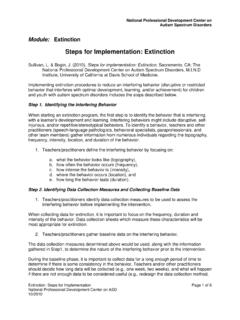
Steps for Implementation: Extinction - University of North ...
csesa.fpg.unc.eduStep 2. Identifying Data Collection Measures and Collecting Baseline Data 1. Teachers/practitioners identify data collection measures to be used to assess the interfering behavior before implementing the intervention. When collecting data for extinction, it is important to focus on the frequency, duration and intensity of the behavior.
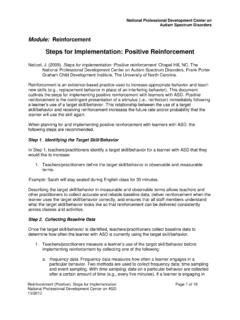
Steps for Implementation: Positive Reinforcement
csesa.fpg.unc.eduDuration data are used to record how long a learner engages in a particular behavior. For example, a teacher might collect data on how long a learner with ASD stays in his seat or how long a young child stays engaged in parallel play. Table 3 provides an example duration data collection sheet. Blank data sheets are available in a separate document.
Related documents
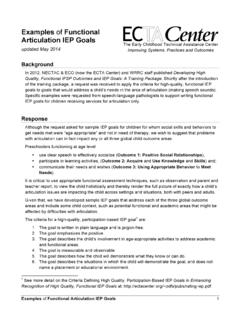
Examples of Functional Articulation IEP Goals
ectacenter.orgQuality, Functional IFSP Outcomes and IEP Goals: A Training Package. Shortly after the introduction of the training package, a request was received to apply the criteria for high-quality, functional IEP goals to goals that would address a child’s needs in the area of articulation (making speech sounds).

Requirements Gathering Questions Page 1 of 2 - UMD
users.umiacs.umd.eduCurrent Needs What department/business requirements will this project/system address? What information do you need from this project/system that you don’t have now? Is any of this data currently captured in any other project/system? Is the data and/or functionality shared by others? Current Problems
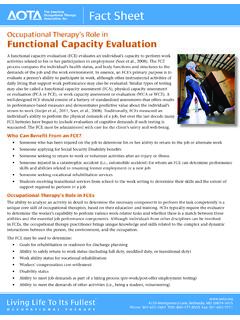
Functional Capacity - AOTA
www.aota.orgA functional capacity evaluation (FCE) evaluates an individual’s capacity to perform work activities related to his or her participation in employment (Soer et al., 2008). The FCE process compares the individual’s health status, and body functions and structures to the demands of the job and the work environment.