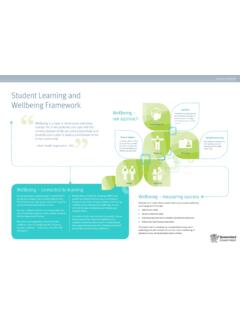
Student Learning and Wellbeing Framework
positive social interactions are promoted, and risk of injury or harm is minimised • developing an approach to wellbeing that supports the collective action of parents, support services and the wider community • demonstrating and communicating positive respectful relationships between staff, students, parents and members of the community
Download Student Learning and Wellbeing Framework

Information
Domain:
Source:
Link to this page:
Documents from same domain

Pedagogical framework - Education Queensland
education.qld.gov.auPedagogical framework and authentic contexts • agreedprocedures for ongoing induction, coaching, mentoring and support in teaching and learning for all staff

Education Adjustment Program (EAP) Handbook
education.qld.gov.auCC-BY 4.0, with the exception of the government coat of arms, logos and images (www.education.qld.gov.au/home/copyr)

Providing the Australian Curriculum in Prep to Year …
education.qld.gov.auRevised July 2018 Providing the Australian Curriculum in Prep to Year 10 in Queensland state schools from 2017 Page 1

Infection Control Guideline - Education Queensland
education.qld.gov.auPage 3 of 29 1. Why do we need an Infection Control Guideline? Infectious diseases can have a significant impact on workplaces through absenteeism, disruption of
Health and Safety Incident Investigation
education.qld.gov.auReviewed May 2018 V3 Uncontrolled when printed Department of Education Organisational Safety and Wellbeing Health and Safety Incident Investigation
Review of educational research - Education …
education.qld.gov.au81 Review of Educational Research March 2007, Vol. 77, No. 1, pp. 81–112 DOI: 10.3102/003465430298487 The Power of Feedback John Hattie and Helen Timperley
Health and Safety Fact Sheet - Safe Handling and …
education.qld.gov.auOrganisational Health Reviewed: January 2012. V3 Department of Education, Training and Employment Uncontrolled when printed SAFE HANDLING & DISPOSAL …

Handling and Disposing of Infectious Waste
education.qld.gov.auOrganisational Health Reviewed: June 2012. V2 Department of Education, Training and Employment Uncontrolled when printed Handling and Disposing of Infectious Waste ...

2018 school calendar for state schools - …
education.qld.gov.auFor more information and the latest version of this calendar, visit There are 199 school days in 2018. Semester 1 2019 commences for teachers on January 24

Mentoring and coaching models - Education …
education.qld.gov.auPeer Coaching Models Information f Listening Skills Listening means hearing and understanding what you are being told. It does NOT mean giving advice, adding detail, or even sharing your own experiences.
Related documents
Inventory of Practices for Promoting Social Emotional ...
csefel.vanderbilt.eduPromoting Social Emotional Competenceis designed to be used by individuals and/or teams to identify training needs and plan a course of action to address those needs related to four general areas: (a) building positive relationships, (b) creating supportive environments, (c) social emotional teaching strategies, and (d)
Young children Develop in an environment of relationships
developingchild.harvard.eduyoung children and enhanced social compe-tence and work skills later in school, which illus-trates the connection between social/emotional development and intellectual growth. The broader quality of the home environment (in-cluding toys, activities, and interactions with-in the family setting) also is strongly related

Promoting Positive Peer Social Interactions
csefel.vanderbilt.eduPromoting Positive Peer Social Interactions Participant PowerPoint Positive Peer Social Interactions • Interactions that take place between peers that are positive in nature and successful for both children involved. Children with Positive Peer Social Interactions Tend to Have: • Positive social and emotional development • Popularity ...
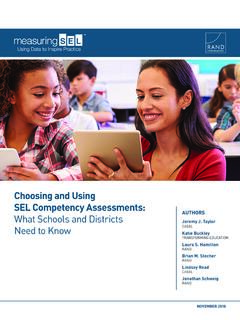
SEL Competency Assessments
measuringsel.casel.org• Positive interactions with adults and peers. ... Social and emotional learning occurs across various stages in an individual’s life. At certain developmental stages, some competencies are more likely to develop than others. ... promoting students’ SEL competencies is a top priority. • Establish a common language for SEL.

Social Emotional Learning in Elementary School
healthyschoolscampaign.orgIn such a framework, schools are intentional about promoting positive school climate; promoting conditions for academic, social, and emotional learning across all school settings (classroom, playground, cafeteria, bus stop, office, etc.); and creating connections to home and community, including afterschool settings.20 From School to the Workplace
RELATIONSHIPS WITH CHILDREN
www.acecqa.gov.auSocial competence To build positive relationships with others, children need to develop ‘social competence’ and the ability to interact with others with care, empathy and respect. Social competence is the foundation that allows children to understand and self-regulate their own emotions and negotiate their interactions with others.
SOCIAL STUDIES KINDERGARTEN TO GRADE 12 - Alberta
education.alberta.capositive attributes and to recognize the evolving nature of individual identities. Race, socio- economic conditions and gender are among various forms of identification that people live with and experience in a variety of ways. Social studies addresses diversity and social
Building Positive Teacher-Child Relationships
challengingbehavior.cbcs.usf.edupositive relationships. Teachers can use a variety of strategies to build positive relationships with children. Teacher behaviors such as listening to children, making eye contact with them, and engaging in many one-to-one, face-to-face interactions with young children promote secure teacher-child relationships.

Social Skills Training (SST) - ed
files.eric.ed.govJournal of Positive Behavior Interventions, 10 (4), 228-242. doi: 10.1177/1098300708319906 *Gonzalez-Lopez, A., & Kamps, D. M. (1997). Social skills training to increase social interactions between children with autism and their typical peers. Focus on autism and other developmental disabilities, 12 (1), 2-14. doi: 10.1177/108835769701200101
Related search queries
Inventory, Promoting Social, Positive, Social, In an environment of relationships, Interactions, Promoting positive, Social interactions, Positive social, Positive interactions, Promoting, RELATIONSHIPS WITH CHILDREN, Social studies, Building Positive Teacher-Child Relationships, Social skills training