
Subacromial Decompression Protocol
The shoulder is a wonderfully complex joint that is made up of the ball and socket connection between ... performing daily exercises to ensure there is proper return of the shoulder’s range of motion and strength. There is a large amount of ... Proprioception *Passive and Active ROM as tolerated in all planes ; Continue as Needed .
Download Subacromial Decompression Protocol

Information
Domain:
Source:
Link to this page:
Documents from same domain
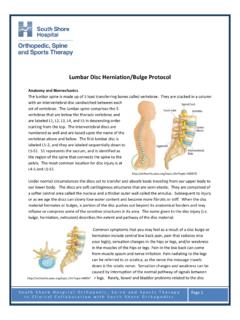
Lumbar Disc Herniation/Bulge Protocol
southshoreorthopedics.comSouth Shore Hospital Orthopedic, Spine and Sports Therapy in Clinical Collaboration with South Shore Orthopedics Page 1 . Lumbar Disc Herniation/Bulge Protocol

SLAP Repair Protocol - South Shore Orthopedics
southshoreorthopedics.comwhether the procedure is open or arthroscopic all patients will likely be home on the same day as surgery. ... Your first post-op visit to the doctor’s office will be approximately 7-10 days after the operation. At this ... Progress strengthening of rotator cuff and shoulder blade muscle groups . Begin to use arm for daily activities in all ...

ACL Non-Operative Protocol - South Shore Orthopedics
southshoreorthopedics.comligament to the knee’s stability is the A nterior Cruciate Ligament (ACL). The ACL attaches from the front part of the tibia to the back part of the femur. The purpose of this ligament is to keep the tibia from sliding forward and rotating on the femur. For this reason, the ACL is most

Knee Arthroscopy (Meniscectomy)
southshoreorthopedics.comKnee Arthroscopy (Meniscectomy) Anatomy and Biomechanics . The knee is a hinge joint at the connection point between the femur and tibia bones. It is held together by several important ligaments. The knee is also cushioned during weight bearing by two cartilaginous discs, called the medial (inside) and lateral (outside) menisci. These menisci
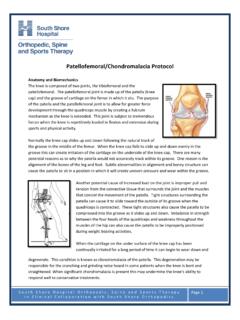
Patellofemoral/Chondromalacia Protocol
southshoreorthopedics.comRehabilitation Philosophy . Physical therapy is often recommended for treatment of pain and dysfunction associated with patellofemoral syndrome and chondromalacia of the patella. The physical therapist will evaluate the patient’s mobility, flexibility and strength with the purpose of determining the underlying cause of the ...
Subacromial Decompression Protocol
southshoreorthopedics.comSubacromial Decompression Protocol . Anatomy and Biomechanics . The shoulder is a wonderfully complex joint that is made up of the ball and socket connection between the humerus (ball) and the glenoid portion of the scapula (socket). The socket portion of the joint is not naturally deep. For this reason, the shoulder is the most

Cervical Radiculopathy - South Shore Orthopedics
southshoreorthopedics.comCervical radiculopathy is a painful condition in which a nerve becomes pinched as it leaves the spinal cord. The pinched nerve is compressed by either herniated disc material or by degenerative bony spurs arising from the neck. 1. The nerves travel into your neck, upper back and arms, and can refer symptoms into these areas. Symptoms ...
SLAP Repair Protocol - South Shore Orthopedics
southshoreorthopedics.comThe glenoid labrum is a fibrocartilage rim that surrounds the edge of the glenoid fossa (socket). ... have the torn labrum repaired. Surgery . Labral repair surgery involves re-anchoring or trimming the torn ... whether the procedure is open or arthroscopic all patients will likely be home on the same day as surgery.
ACL Non-Operative Protocol - South Shore Orthopedics
southshoreorthopedics.comACL Non-Operative Protocol . Anatomy and Biomechanics The knee is a hinge joint connecting the femur and tibia bones. It is held together by several important ligaments. The most important ligament to the knee’s stability is the A nterior Cruciate Ligament (ACL). The ACL attaches from the front part of the tibia to the back part of the femur.
Lumbar Disc Herniation/Bulge Protocol - Orthopedist
southshoreorthopedics.comwith an intervertebral disc sandwiched between each set of vertebrae. The lumbar spine comprises the 5 vertebrae that are below the thoracic vertebrae and are labeled L1, L2, L3, L4, and L5 in descending order starting from the top. The intervertebral discs are numbered as well and are based upon the name of the vertebrae above and below.
Related documents

Patellar Tendon Repair Rehabilitation Guideline
www.sanfordhealth.orgJan 17, 2018 · -Static proprioception training (double to single leg) with perturbation on variable surfaces (rocker board, airex pads, air discs, etc.) & emphasis on proper hip/knee stability and hip strategy. -Observe depth of closed chain quad strengthening avoiding rotation and dynamic valgus stress at knee: Which Includes: -Forward and lateral step ups
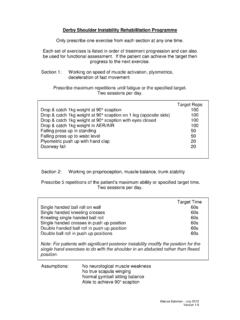
Derby Shoulder Instability Rehabilitation Programme
www.schoudernetwerk.nlDerby Shoulder Instability Rehabilitation Programme Only prescribe one exercise from each section at any one time. Each set of exercises is listed in order of treatment progression and can also be used for functional assessment. If the patient can achieve the target then progress to …
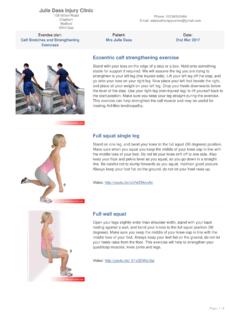
Calf Stretching and Strengthening Exercises
www.stablestherapycentre.comExercises Patient: Mrs Julie Dass Date: 31st Mar 2017 Eccentric calf strengthening exercise Stand with your toes on the edge of a step or a box. Hold onto something stable for support if required. We will assume the leg you are trying to strengthen is your left leg (the injured side). Lift your left leg off the step, and go onto your toes on ...
Rehabilitation Guidelines for Lumbar Spondylolysis ...
www.uwhealth.org• Improve pelvic proprioception • Maintain/ Increase flexibility in key upper/lower body muscles • Re-establish aerobic fitness Precautions • No active or passive lumbar extension ROM Suggested Therapeutic Exercises • Crunches • Double leg bridges • 4 point alternate arm or leg raises • Side lying hip abduction or clam shells