
T he Verb
T he Verb Recognize a verb when you see one. Verbs are a necessary component of all sentences. Verbs have two important functions: Some verbs put stalled subjects into motion while other verbs help to clarify the subjects
Download T he Verb

Information
Domain:
Source:
Link to this page:
Documents from same domain
Fragments – Exercise 1
www.chompchomp.com1 Name Date FRAGMENTS – EXERCISE 1 Directions: Read each short passage that follows. Determine which part is the fragment. Check your answers with the interactive version of the exercise.

Rules for Using Irregular Verbs
www.chompchomp.com1 RULES FOR USING IRREGULAR VERBS Understand the problem. All verbs, whether regular or irregular, have five forms [often called principal parts]. These forms are the infinitive, simple present, simple past, past participle, and

lie irregular verbs
www.chompchomp.com1 RULES FOR USING THE IRREGULAR VERBS LAY AND LIE Understand the problem. Choosing the correct forms of lay and lie is a big challenge. Without a doubt, they are the two most difficult irregular verbs.

The Auxiliary Verb
www.chompchomp.com5 WILL +BE PRESENT PARTICIPLE Use the future progressive tense to indicate an action that will continue in the future. I will be growing broccoli in the backyard this spring.

T he I nfi ni tive
www.chompchomp.comT he I nfi ni tive Recognize an infinitive when you see one. To sneeze, to smash, to cry, to shriek, to jump, to dunk, to read, to eat, to slurp— all of these are infinitives.

R FINDING AND F SENTENCE FRAGMENTS
www.chompchomp.com1 RULES FOR FINDING AND FIXING SENTENCE FRAGMENTS Recognize the difference between a sentence and a fragment. A fragment resembles a sentence in two ways. Both groups of words begin with a
T he Subor dinat e Cl aus e
www.chompchomp.comT he Subor dinat e Cl aus e Recognize a subordinate clause when you see one. A subordinate clause—also called a dependent clause—will begin with a subordinate ...
Name Date W C E 1: THEIR T RE
www.chompchomp.com1 Name Date WORD CHOICE – EXERCISE 1: THEIR, THERE, AND THEY’RE Directions: Fill in the blanks with the appropriate choice—their, there, or they're…

T he G er und
www.chompchomp.comT he G er und Recognize a gerund when you see one. Every gerund, without exception, ends in ing.Gerunds are not, however, all that easy to identify. The problem is that all present participles also end in ing.

T he G er und Phr as e
www.chompchomp.comT he G er und Phr as e Recognize a gerund phrase when you see one. A gerund phrase will begin with a gerund, an ing word, and …
Related documents
Past Tense - David's Homepage
cokdybysme.net1 Past Tense How is the past tense formed in Czech? How can it be translated into English? What complications of past-tense usage need to be noted?

Must and Have to - English for Everyone
englishforeveryone.orgenglish for everyone.org Name_____ Date_____ Must and Have to A modal auxiliary verb is used to modify the mood of a verb.
The Auxiliary Verb
www.chompchomp.com1 THE AUXILIARY VERB Recognize an auxiliary verb when you see one. Every sentence must have a verb.To depict doable activities, writers use action verbs.To describe conditions, writers choose linking verbs. Sometimes an action or condition occurs just once—bang!—and it's over.
Can and Could - EnglishForEveryone.org
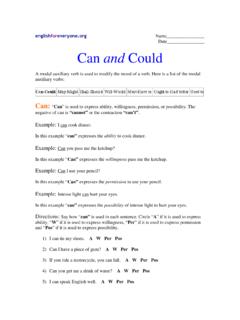
www.englishforeveryone.orgenglish for everyone.org Name_____ Date_____ Can and Could A modal auxiliary verb is used to modify the mood of a verb.
Unit 18: Present Perfect Tense vs. Past Tense
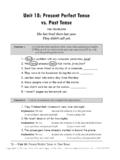
www.prolinguaassociates.comUnit 18: Present Perfect Tense vs. Past Tense • 81. Exercise 8: Write the sentences that your teacher reads. Use the words in the box. The number with each word is the sentence number that the word is in.

Early Morphological Development - speechtherapyct.com
www.speechtherapyct.comEarly Morphological Development Morphology is the aspect of language concerned with the rules governing change in word meaning. Morphological development is analyzed by computing a …

Conjugation of Verbs - The Latin Library
www.thelatinlibrary.comConjugation of Verbs The inflection of a verb is called a Conjugation. Most verb inflections in English have disappeared, although we still distinguish between I go, he goes, etc. Latin, however, retains full inflections for most verbs, the forms of which must be mastered in order to