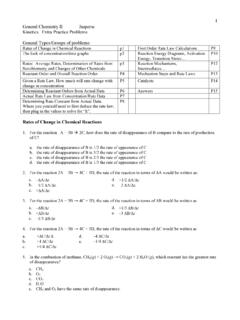
Test1 ch15 Kinetics Practice Problems
Kinetics. Extra Practice Problems General Types/Groups of problems: Rates of Change in Chemical Reactions p1 First Order Rate Law Calculations P9 The look of concentration/time graphs p2 Reaction Energy Diagrams, Activation Energy, Transition States… P10 Rates: Average Rates, Determination of Rates from
Download Test1 ch15 Kinetics Practice Problems

Information
Domain:
Source:
Link to this page:
Documents from same domain
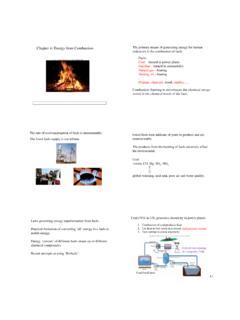
Chapter 4: Energy from Combustion The primary …
web.mnstate.eduChapter 4: Energy from Combustion The primary means of generating energy for human endeavors is the combustion of fuels. Fuels: Coal -burned in power plants Gasoline -burned in automobiles
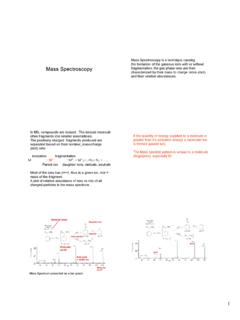
Mass Spectroscopy
web.mnstate.edu1 Mass Spectroscopy Mass Spectroscopy is a technique causing the formation of the gaseous ions with or without fragmentation; the gas phase ions are then

African Environmental Issues - Minnesota State …
web.mnstate.eduAfrican Environmental Issues . Environment in Africa: continuity & change. •Important to consider geological age of Africa & its tropical location. •Both affect
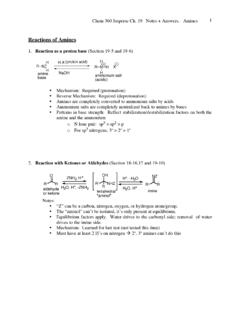
Reactions of Amines - Minnesota State University …
web.mnstate.eduChem 360 Jasperse Ch. 19 Notes + Answers. Amines 1 Reactions of Amines 1. Reaction as a proton base (Section 19-5 and 19-6) RN H H N H R H H X …

Test3 ch17b Buffer-Titration-Equilibrium Practice …
web.mnstate.edu4 Preparation and Recognition of Buffer Systems 14. Which of the following is not a buffer system? A solution containing roughly equal concentrations of _____ a.
Standardization of a Hydrochloric Acid Solution
web.mnstate.eduPage 1 Spring 2011 Standardization of a Hydrochloric Acid Solution The purpose of this experiment is to test your lab technique and examine potential sources of error in

Some Arrow-Pushing Guidelines (Section 1.14)
web.mnstate.eduOrganic Chemistry I Review: Highlights of Key Reactions, Mechanisms, and Principles 1 Some Arrow-Pushing Guidelines (Section 1.14) 1. Arrows follow electron movement.

Recrystallization I 9 Chem 355 Jasperse RECRYSTALLIZATION
web.mnstate.eduRecrystallization I 9 Chem 355 Jasperse RECRYSTALLIZATION Background: Impurities often contaminate organic compounds, whether they have been synthesized in

1. Given the relation R (1 1) (1 3) (1 4) (2 2) (3 1) (3 4 ...
web.mnstate.edu9. For each of the following collections of subsets of A= {1,2,3,4,5}, determine whether of not the collection is a partition. If it is, list the ordered pairs in the equivalence relation determined by the partition.
Gas Chromatograph Gas Chromatography
web.mnstate.eduColumn selection GC: Select a stationary phase that would retain (‘dissolve’) the analytes of interest. Stationary phase polarity ~ analyte polarity; (like dissolves like). Selectivity to individual analytes determines the quality of separation (ability to discern the
Related documents
PHYSICAL PROPERTIES OF ROCK
ceae.colorado.eduproblems associated with the release of sulfuric acid from coal-fired power plants, sulfur dioxide and smoke emissions, nitrogen oxides from vehicle exhaust). Table 1 gives a list of weathering reactions that have been recognized. In general, chemical weathering reaction …
Big-Picture Introductory Conceptual Questions
web.mnstate.eduChemical equilibria. Extra Practice Problems General Types/Groups of problems: ... the rates of the forward and reverse reactions are equal 2. Which of the following is true regarding the concentration of products, for a chemical reaction that is already at

OChem1 Practice Problems - hyperconjugation.com
www.hyperconjugation.comDr. Peter Norris OChem 1 1 Klein Chapter 1 Problems : Review of Gen Chem – Answers 1. “Draw viable structures for molecules with the following molecular formulae.Remember that each atom has a “standard” valence when forming neutral molecules, for example halogens and H are monovalent, O is divalent, N is trivalent, and C is tetravalent.

Balancing Equations Worksheet - 3-13
www.ahschools.usHonors Chemistry Name: _____ Writing and Balancing Equations Worksheet STO.1 Balance a chemical equation. STO.2 Identify the parts of a chemical equation. RXN.1 Describe a chemical reaction using words and symbolic equations. For each of the following problems, write complete chemical equations to describe the chemical

Calculations with Chemical Reactions
www.georgebrown.caCalculations with Chemical Reactions . Calculations with chemical reactions require some background knowledge in basic chemistry concepts. Please, see the definitions from chemistry listed below: Atomic mass– the total mass of protons, neutrons and electrons in a single atom. (Note that atomic mass has no units. It is a relative measure).

predicting products of chemical reactions - practice problems
www.greeleyschools.orgname: suggested answers date: _____ predicting products of chemical reactions - practice problems Directions: Predict the products for, and then balance each of the following chemical reactions: 1. SiI4 + Mg (single replacement) SiI4 + 2Mg 2MgI2 + Si 2. 2Al + 3I2 (synthesis) 2Al + 3I2 2AlI3 3. CuCl2 + KOH (double replacement) CuCl2 + 2KOH Cu(OH)2 + 2KCl

Practice Problems on SN1, SN2, E1 & E2 - Answers
www2.chem.wisc.eduPractice Problems on S N1, S N2, E1 & E2 - Answers 1. Describe the following chemical reactions as S N1, S N2, E1 & E 2. Draw a curved arrow mechanism for each reaction. NaI 3 3 Cl KCN DMSO CN Br NaOH H2O, heat BrH 2O OH I CH3CH2O-Na+ ethanol HI NaSH DMSO HSH Br HO KOH DMSO OTs NaNH2 NH3 TsO NH3 H2N O O CH CH3 TsO