Test1 ch15 Kinetics Practice Problems
Rates of Change in Chemical Reactions p1 First Order Rate Law Calculations P9 The look of concentration/time graphs p2 Reaction Energy Diagrams, Activation Energy, Transition States… P10 Rates: Average Rates, Determination of Rates from Stoichiometry and Changes of Other Chemicals p3 Reaction Mechanisms, Intermediates… P12
Download Test1 ch15 Kinetics Practice Problems

Information
Domain:
Source:
Link to this page:
Documents from same domain
Chapter 4: Energy from Combustion The primary …
web.mnstate.eduChapter 4: Energy from Combustion The primary means of generating energy for human endeavors is the combustion of fuels. Fuels: Coal -burned in power plants Gasoline -burned in automobiles
Mass Spectroscopy
web.mnstate.edu1 Mass Spectroscopy Mass Spectroscopy is a technique causing the formation of the gaseous ions with or without fragmentation; the gas phase ions are then

African Environmental Issues - Minnesota State …
web.mnstate.eduAfrican Environmental Issues . Environment in Africa: continuity & change. •Important to consider geological age of Africa & its tropical location. •Both affect
Reactions of Amines - Minnesota State University …
web.mnstate.eduChem 360 Jasperse Ch. 19 Notes + Answers. Amines 1 Reactions of Amines 1. Reaction as a proton base (Section 19-5 and 19-6) RN H H N H R H H X …

Test3 ch17b Buffer-Titration-Equilibrium Practice …
web.mnstate.edu4 Preparation and Recognition of Buffer Systems 14. Which of the following is not a buffer system? A solution containing roughly equal concentrations of _____ a.
Standardization of a Hydrochloric Acid Solution
web.mnstate.eduPage 1 Spring 2011 Standardization of a Hydrochloric Acid Solution The purpose of this experiment is to test your lab technique and examine potential sources of error in

Some Arrow-Pushing Guidelines (Section 1.14)
web.mnstate.eduOrganic Chemistry I Review: Highlights of Key Reactions, Mechanisms, and Principles 1 Some Arrow-Pushing Guidelines (Section 1.14) 1. Arrows follow electron movement.

Recrystallization I 9 Chem 355 Jasperse RECRYSTALLIZATION
web.mnstate.eduRecrystallization I 9 Chem 355 Jasperse RECRYSTALLIZATION Background: Impurities often contaminate organic compounds, whether they have been synthesized in

1. Given the relation R (1 1) (1 3) (1 4) (2 2) (3 1) (3 4 ...
web.mnstate.edu9. For each of the following collections of subsets of A= {1,2,3,4,5}, determine whether of not the collection is a partition. If it is, list the ordered pairs in the equivalence relation determined by the partition.
Gas Chromatograph Gas Chromatography
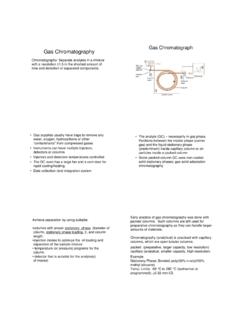
web.mnstate.eduColumn selection GC: Select a stationary phase that would retain (‘dissolve’) the analytes of interest. Stationary phase polarity ~ analyte polarity; (like dissolves like). Selectivity to individual analytes determines the quality of separation (ability to discern the
Related documents
Moles Lab Activities - Virginia Department of Education
www.doe.virginia.govTime: Students will need about 5–10 minutes at each lab station to do initial calculations and measurements. They will need a total of 15–20 minutes to complete all questions, some of which could be completed at home. Application: This activity should be used when introducing elements, chemical symbols, and moles-to-atoms calculations.
Big-Picture Introductory Conceptual Questions
web.mnstate.edub. the rate constants for the forward and reverse reactions are equal c. the time that a particular atom or molecule spends as a reactant and product are equal d. the rate of the forward and reverse reaction e. all of the above are equal 4. A chemical equilibrium may be established by starting a reaction with _____ a.
Elements of Chemical Reaction Engineering
ptgmedia.pearsoncmg.comvii Contents PREFACE xvii ABOUT THE AUTHOR xxxiii CHAPTER 1 MOLE BALANCES 1 1.1 The Rate of Reaction, –r A 4 1.2 The General Mole Balance Equation 8 1.3 Batch Reactors (BRs) 10 1.4 Continuous-Flow Reactors 12 1.4.1 Continuous-Stirred Tank Reactor (CSTR) 12 1.4.2 Tubular Reactor 14 1.4.3 Packed-Bed Reactor (PBR) 18 1.5 Industrial Reactors 22 CHAPTER …
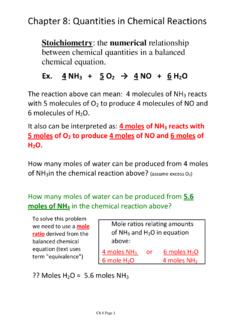
Chapter 8: Quantities in Chemical Reactions
webs.anokaramsey.eduStoichiometry : the numerical relationship between chemical quantities in a balanced chemical equation. Ex. 4NH3 + 5O2 → 4NO + 6H2O The reaction above can mean: 4 molecules of NH 3 reacts with 5 molecules of O 2 to produce 4 molecules of NO and 6 molecules of H 2O. It also can be interpreted as: 4 molesof NH3reacts with 5 molesof O 2to produce 4 molesof NO and 6 …

Pearson Edexcel International GCSE Chemistry
qualifications.pearson.comMay 19, 2016 · (d) The elements in Group 7 have similar chemical reactions because they have the same number of (1) A electrons B electron shells C outer electrons D protons (e) A student wrote these statements about the reactions of the Group 7 elements. • The reactivity of the elements decreases down the group.