
THE 12 COMMON AUTOMATIC THINKING MISTAKES
THE 12 MOST COMMON THINKING MISTAKES (ALSO CALLED AUTOMATIC THOUGHTS OR COGNITIVE DISTORTIONS) Although some negative automatic thoughts are true, many are either untrue or have just a grain of truth. Here are a few common errors. 1. All-or-nothing thinking (also called black-and-white, polarized, or dichotomous
Download THE 12 COMMON AUTOMATIC THINKING MISTAKES

Information
Domain:
Source:
Link to this page:
Documents from same domain

20 QUESTION SELF- ASSESSMENT FOR HEALTHY …
www.dr-jane-bolton.com20 QUESTION SELF- ASSESSMENT FOR HEALTHY BOUNDARIES Dr. Jane Bolton, PsyD, LMFT Psychotherapy and Life Coaching PUT A CHECK IN THE BOX THAT IS MOST ACCURATE Never Rarely Some-

8 STEPS TO INNER CONFLICT RESOLUTION - Dr. …
www.dr-jane-bolton.com8 STEPS TO INNER CONFLICT RESOLUTION . Dr. Jane Bolton, PsyD, LMFT, CC . Psychotherapy and Master Results Life Coaching . Going through these 8 steps can help enormously with internal conflicts.

THE ARTIST’S WAY CREATIVITY TOOL THE …
www.dr-jane-bolton.comTHE ARTIST’S WAY CREATIVITY TOOL: THE MORNING PAGES By Dr. Jane Bolton Psychotherapy and Master Life Coaching What are Morning Pages? “Morning Pages” is a term used by Julia Cameron, author of The Artist’s Way, for a primary creativity tool.

BURNS ANXIETY SCALE - Therapy with Dr. Jane …
www.dr-jane-bolton.com2 25. Sweating not brought on my heat 26. A lump in the throat 27. Trembling or shaking 28. Rubbery or “jelly” legs

PEOPLE- PLEASING PATTERNS ARE LEARNED …
www.dr-jane-bolton.comPEOPLE- PLEASING PATTERNS ARE LEARNED. WHEN NEEDS ARE NOT MET . Dr. Jane Bolton, PsyD, LMFT, CC . Psychotherapy and Master Results Coaching . ALICE MILLER, (1979).THE DRAMA OF THE GIFTED CHILD.

How to Dialogue With Your Inner Child - Dr. Jane …
www.dr-jane-bolton.comHow to Dialogue With Your Inner Child . Dr. Jane Bolton, PsyD, LMFT, CC . Psychotherapy and Master Coaching . What is “dialoguing” with my Inner Child?

AUTOMATIC THOUGHT CHALLENGE SHEET - Dr. Jane Bolton
www.dr-jane-bolton.comAUTOMATIC THOUGHT CHALLENGE WORKSHEET . Dr. Jane Bolton, PsyD, LMFT, CC . Psychotherapy and Master Results Life Coaching . Once you have recognized an automatic thought, you can begin to correct your thinking by challenging

WHAT MAKES ME ANXIOUS? A WORKSHEET
www.dr-jane-bolton.comCircle each item that causes you to feel anxious. To the left of each item you circle, please rank that item from 1 to 10 being very anxious, 5 being quite anxious, and 1 being not anxious at all. Grades Death Complexion/zits Looks/appearance Being liked Being gay Accidents Criticism Mistakes Drugs Diseases War/disasters
Related documents

Critical Thinking and Writing for Nursing Students
www.sagepub.comCritical Thinking and Writing for Nursing Students, Exeter, Learning Matters. Readers are introduced to the process of critical and reflective thinking and the translation of these into coursework that will help them to achieve better grades in nursing courses. Stewart, Raymet, Fatima
REFLECTIVE THINKING AND TEACHING PRACTICES: A …
files.eric.ed.govthinking based on the following characteristics: a) reflection as retrospective analysis, b) reflection as problem solving, c) critical reflection of self, and d) ... 12 As a teacher I know that the mistakes I make can have an influence on the lives of my students.
Development of Creative Thinking Skills of Students ...
files.eric.ed.govTo provide effective thinking skills to students is one of the main objectives of education. Although there have been great changes in the field of education from Socrates to the present day, the ... fields of interest, learning power from the mistakes, adaptability, energetic and happiness could be measured and assessed the creative ...

Positive Thinking - resources
pattowellbeing.weebly.comPositive thinking is a powerful tool that can improve your health, help you manage stress, overcome challenges, and make better choices. Everyone can benefit from improving their positive thinking skills! The idea is that by changing your thinking, you can control your emotions and your actions. Positive thinking skills often start with

Reflective Writing & Thinking
www.utm.utoronto.caReflective writing and thinking is an important part of your university life, personal life, and working life. The ability to reflect on experiences and ... Be honest and admit to making mistakes and successes. Show your understanding of why things happen and what you are going to do to make improvements.

SIX THINKING HATS - Atlantic International University
courses.aiu.eduSix Thinking Hats is a time-tested tool that boosts creative and innovative performance. It provides a framework to focus and broaden thinking by separating out six different ingredients in thinking: white hat--information, yellow hat--benefits, black hat--risk, green hat--creativity, red hat--gut instinct, and blue hat--process.

Thinking Mistakes 4 Kids - Trauma-Focused Cognitive ...
tfcbt.orgCreated by M. Kliethermes, 2009 THE “WHAT ARE YOU THINKING?” TEAM “All or Nothing” Allen (All-or-nothing thinking) “Blaming” Blake (personalization) “Over and Over” Oliver (overgeneralization) “Negative” Nate (mental filter, disqualifying the positive) “Not a Big Deal” Norman (minimization) Allen only sees things in “black and white” or “right or wrong.”

Negative Thinking - MoodCafe
www.moodcafe.co.ukAll-or-Nothing Thinking: seeing things as being either, or. Example: black or white with no shades of grey, success or failure, good or bad. Ignoring the Positives: focusing on the negative in a situation rather than seeing the whole picture. Example: You have done well in a task at work, but you keep focusing on earlier mistakes.
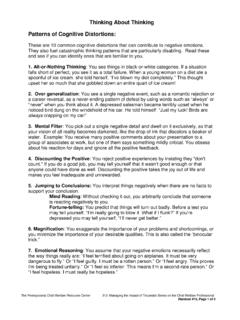
Thinking About Thinking Patterns of Cognitive Distortions
www.pacwrc.pitt.eduThinking About Thinking (continued) The Pennsylvania Child Welfare Resource Center 313: Managing the Impact of Traumatic Stress on the Child Welfare Professional Handout #15, Page 2 of 3 8. “Should statements”: You tell yourself that things should be …