
THE CHROMATIC POLYNOMIAL
the four new graphs we have and so on. The process terminates when all of the remaining graphs are null graphs. Because the Chromatic Function of a null graph is a polynomial (P N n (k) = kn), we see that the Chromatic Function of Gis equal to the sum of a large number of polynomials and must itself be a polynomial. We
Download THE CHROMATIC POLYNOMIAL

Information
Domain:
Source:
Link to this page:
Documents from same domain
THE GLOBAL POSITIONING SYSTEM AND ITS USAGE IN …
www.whitman.eduof the Global Positioning System, then explains how measurements are taken using GPS and how GPS is applied to real situations, and ends with a short discussion on …
Selected Answers
www.whitman.eduAppendix A Selected Answers √ ...
Vector Calculus
www.whitman.edu16 Vector Calculus 16.1 Vector Fields This chapter is concerned with applying calculus in the context of vector fields. A two-dimensional vector field is a function f that maps each point (x,y) in R2 to a two- dimensional vector hu,vi, and similarly a three-dimensional vector field maps (x,y,z) to
ECONOMICS WORKING PAPERS No. 27 - Whitman College
www.whitman.eduWHITMAN COLLEGE ECONOMICS WORKING PAPERS NO. 27. 1 Athabascan Oil Sands Extraction Techniques: An Economic Analysis of Surface Mining versus SAGD I. Introduction With an estimated 173 billion barrels in oil reserves, Alberta's oil sands are the second
An Introduction to Combinatorics and Graph Theory
www.whitman.edu8 Chapter 1 Fundamentals 1.1 Examples Suppose we have a chess board, and a collection of tiles, like dominoes, each of which is the size of two squares on the chess board.
Differential Equations - Whitman College
www.whitman.edu456 Chapter 17 Differential Equations 17.1 First Order l Differentia tions Equa We start by considering equations in which only the first derivative of the function appears. DEFINITION 17.1.1 A first order differential equation is an equation of the form
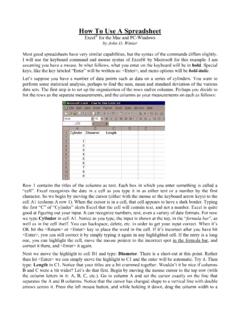
How to Use Excel
www.whitman.eduHow To Use A Spreadsheet Excel® for the Mac and PC-Windows by John D. Winter Most good spreadsheets have very similar capabilities, but the syntax of the commands differs slightly.
Calculus This is the free digital calculus text by David R ...
www.whitman.eduMuch of the mathematics in this chapter will be review for you. However, the examples will be oriented toward applications and so will take some thought. In the (x,y) coordinate system we normally write the. x-axis horizontally, with positive numbers to the right of the origin, and the. y
Introduction Review of Probability - Whitman College
www.whitman.eduMARKOV CHAINS: ROOTS, THEORY, AND APPLICATIONS TIM MARRINAN 1. Introduction The purpose of this paper is to develop an understanding of the theory underlying Markov chains and the applications that they have.
Sequences and Series - Whitman College
www.whitman.edu256 Chapter 11 Sequences and Series and then lim i→∞ 1− 1 2i = 1−0 = 1. There is one place that you have long accepted this notion of infinite sum without really thinking of it as a sum:
Related documents

Tutorial Quick Start Gephi Tutorial
gephi.orgMar 05, 2010 · Nodes position is random at first, so you may see a slighty different representation. 1 D. E. Knuth, The Stanford GraphBase: A Platform for Combinatorial Computing, Addison-Wesley, Reading, MA (1993). * Introduction * Import file * Visualization * Layout * Ranking (color) * Metrics * Ranking (size) * Layout again * Show labels * Community ...
INTRODUCTION MACHINE LEARNING
ai.stanford.edu1.1 Introduction 1.1.1 What is Machine Learning? Learning, like intelligence, covers such a broad range of processes that it is dif- cult to de ne precisely. A dictionary de nition includes phrases such as \to gain knowledge, or understanding of, or skill in, by study, instruction, or expe-
Introduction to Statistical Analysis - Flinders University
ienrol.flinders.edu.au• Introduction to IBM SPSS • Introduction to Statistical Analysis IBM SPSS -Intermediate Level • Understanding Your Data(Descriptive Statistics, Graphs and Custom Tables) • Correlation and Multiple Regression • Logistic Regression and Survival Analysis • Basic Statistical Techniques for Difference Questions

Random Walk: A Modern Introduction
www.math.uchicago.edu9.8.3 Sierpinski graphs 220 9.9 Spanning trees of subsets of Z2 221 9.10 Gaussian free field 230 10 Intersection Probabilities for Random Walks 237 10.1 Long range estimate 237 10.2 Short range estimate 240 10.3 One-sided exponent 243 11 Loop-erased random walk 245 11.1 h-processes 245 11.2 Loop-erased random walk 248 11.3 LERW in Zd 250 11.3 ...
INTRODUCTION TO STATISTICS - KSU
fac.ksu.edu.saCONTENTs Introduction Chapter 1 Basic Concepts in Statistics 1.1 Statistical Concepts 2 1.2 Variables and Type of Data 5 1.3 Sampling Techniques 12 1.4 Observational and Experimental Studies 17 Chapter 2 Organizing and Graphing Data 2.1 Raw Data 32 2.2 Organizing and Graphing Qualitative Data 33 2.3 Organizing and Graphing Quantitative Data 47 Chapter 3 …

An Introduction to GeoGebra - University of Utah
www.math.utah.eduAn Introduction To GeoGebra Creating A Random Line 1. In the Input Line, type in the following, one at a time, pressing Enter after each. m = RandomBetween[-2,2] b = RandomBetween[-5,5] y = m x + b (note space between m and x. You can also use the * to denote multiplication ) 2. Press Ctrl-R or F9 to update line. Things to try...

Statistical Comparisons of Classifiers over Multiple Data Sets
jmlr.orgIntroduction Over the last years, the machine learning community has become increasingly aware of the need for ... friendly graphs. In Section 4 we shall provide some empirical insights into the properties of the tests. 2. Previous Work ... random resampling 11 29 44 32 54 separate subset 5 11 0 13 9 Score function [%] classification accuracy ...