
The Equalizer - ASCD
Carol Ann Tomlinson (Tomlinson, 1999). The Equalizer suggests nine continuums along which the difficulty level of lesson content, process, or product may be located. It can help teachers expand the repertoire of ways they think about varying the challenge level of a specific task. The Equalizer works in the same way that you might adjust
Download The Equalizer - ASCD

Information
Domain:
Source:
Link to this page:
Documents from same domain
Developing Language, Speaking, and Listening …
pdo.ascd.orgCommon Core and Literacy Strategies: English Language Arts > Module 4 > Reading: Developing Language, Speaking, and Listening Skills _____ Developing Language, Speaking, and Listening
The Culturally Responsive Teacher - ASCD
pdo.ascd.orgSuccessfully teaching students from culturally and linguistically diverse backgrounds—espe- ... different subject matters in their everyday set-tings, and their prior knowledge of and experi- ... The Culturally Responsive Teacher . ...
Unpacking Standards - pdo.ascd.org
pdo.ascd.orgThe Common Core Standards and the Understanding by Design® Framework: English Language Arts > Module 2 > Reading: Unpacking Standards _____ ideas, but this use of the phrase is meant to simply signal priorities in general rather
What Is a Classroom Management Model?
pdo.ascd.orgClassroom Management: Managing Challenging Behavior, 2nd Edition > Module 2 > Reading 1: Models and Tools of Classroom Management Interventionist This approach suggests that student development is a product of environmental conditions brought on by intervention in a student’s daily surroundings. This approach can typically be
Key Elements of Differentiated Instruction
pdo.ascd.orgready for a challenge”) Product options that respond to varied interests or learning profiles Varied timelines or check-in points Varied criteria for success (e.g. from novice to professional) Varied audiences (in age, background knowledge, size, etc.) Varied roles in a performance assessment Some choice of questions
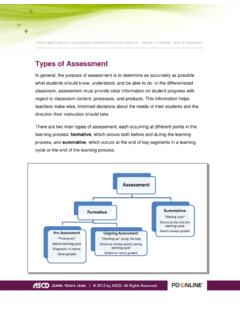
Types of Assessment - ASCD
pdo.ascd.orgformative assessment—pre-assessment and ongoing assessment. -assessment is a type of formative assessment that occurs before a unit of study begins. Whether formal or informal, pre-assessments are never graded. They are purely diagnostic in nature. When pre-assessing for readiness, for example, teachers attempt to find out
Using Formative Assessment to Help English Language …
pdo.ascd.orgWith the implementation of the Common Core State Standards, formative assessment becomes an even more valuable tool for student success. With the slogan of “higher, clearer, and fewer,” the developers of the Common Core are hoping to better prepare students for college or career pursuits (CCSSO, 2010). Further, the end-of-year summative
Using Technology to Differentiate Instruction
pdo.ascd.orgTechnology in Schools: A Balanced Perspective > Module 4 > Reading: Using Technology to Differentiate Instruction _____ The teacher provides opportunities for …
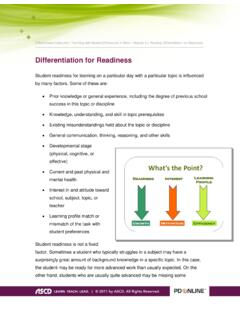
Differentiation for Readiness
pdo.ascd.orgthe vocabulary packet.” This is an example of the teacher providing readiness supports. Rather than handing the vocabulary packet to everyone, she asks students to determine whether or not they need it. Of course, if a student who needs the packet does not pick one up, she is likely to encourage him to do so—or surreptitiously deliver one ...
What Is Performance Assessment? - ASCD
pdo.ascd.orgAssessment: Designing Performance Assessments > Module 2 > Reading: What Is Performance Assessment? _____ presentations. Performance assessment can be used as either a formative or summative tool. For example, a performance assessment built around a complex reasoning task, such as problem solving or decision making, requires the synthesis of ...
Related documents

Estrategias para trabajar con la diversidad en el ... - Terras
www.terras.edu.arPor Carol Ann Tomlinson Editorial Paidós SAICF Buenos Aires (Argentina) Primera edición: 2005 Este material es de uso exclusivamente didáctico. ÍNDICE
Guiding Principle 6: Responsive environments engage learners.
dpi.wi.govTomlinson and Eidson (2003) emphasize the need to include the components of student readiness, student interest, and student learning profile in differentiating instruction. Students’ interests and learning profiles are often tied to their learning styles. Learning Styles The body of research on learning styles has coalesced around the work
Differentiating Instruction in Response to Student ...
files.eric.ed.govCarol Ann Tomlinson, Catherine Brighton, Holly Hertberg, Carolyn M. Callahan, Tonya R. Moon, Kay Brimijoin, Lynda A. Conover, & Timothy Reynolds Both the current school reform and standards movements call for enhanced quality of instruction for all learners. Recent emphases on heterogeneity, special education
![[PDF] Differentiated Instruction PPT](/cache/preview/a/c/8/4/8/c/0/6/thumb-ac848c0658649db8874b31455869b542.jpg)
[PDF] Differentiated Instruction PPT
www.hoodriver.k12.or.usinstruction – Carol Ann Tomlinson Flexible grouping is an opportunity for students to work with a variety of students, through whole group or in many different forms of small groups. The key to flexible grouping is in the name…FLEXIBLE. Students have an opportunity to be in different groups depending on the activity.