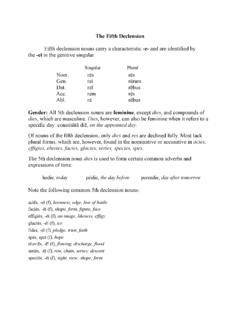
The Fifth Declension
The Fifth Declension Fifth declension nouns carry a characteristic -e- and are identified by the -eī in the genitive singular. Singular Plural Nom. rēs rēs Gen. reī rērum
Download The Fifth Declension

Information
Domain:
Source:
Link to this page:
Documents from same domain
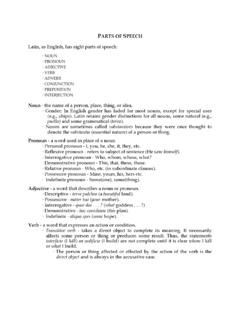
Parts of Speech - The Latin Library
www.thelatinlibrary.comPARTS OF SPEECH Latin, as English, has eight parts of speech: · NOUN · PRONOUN · ADJECTIVE · VERB · ADVERB · CONJUNCTION · PREPOSITION · INTERJECTION Noun - the name of a person, place, thing, or idea.
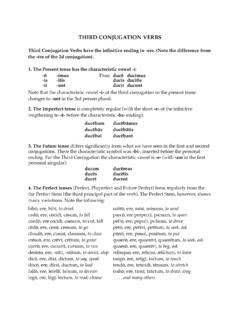
Third Conjugation Verbs - The Latin Library
www.thelatinlibrary.comTHIRD CONJUGATION VERBS Third Conjugation Verbs have the infinitive ending in -ere. (Note the difference from the -ēre of the 2d conjugation).
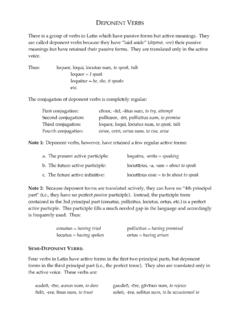
DEPONENT VERBS - The Latin Library
www.thelatinlibrary.comDEPONENT VERBS There is a group of verbs in Latin which have passive forms but active meanings. They are called deponent verbs because they have “laid aside” (dëpönö, -ere) their passive
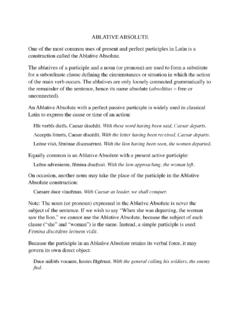
ABLATIVE ABSOLUTE
www.thelatinlibrary.comABLATIVE ABSOLUTE One of the most common uses of present and perfect participles in Latin is a construction called the Ablative Absolute. The ablatives of a participle and a noun (or pronoun) are used to form a substitute
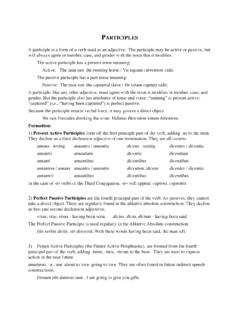
PARTICIPLES - The Latin Library
www.thelatinlibrary.comPARTICIPLES A participle is a form of a verb used as an adjective. The participle may be active or passive, but will always agree in number, case, and gender with the noun that it …
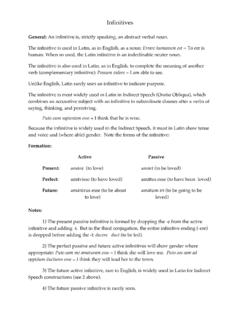
Infinitives - The Latin Library
www.thelatinlibrary.comInfinitives General: An infinitive is, strictly speaking, an abstract verbal noun. The infinitive is used in Latin, as in English, as a noun: Errare humanum est = To err is ...
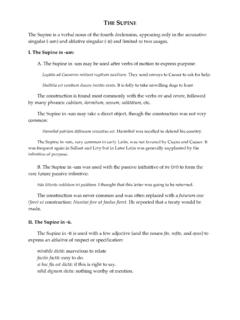
T SUPINE - The Latin Library
www.thelatinlibrary.comTHE SUPINE The Supine is a verbal noun of the fourth declension, appearing only in the accusative singular (-um) and ablative singular (-ü) and limited to two usages.
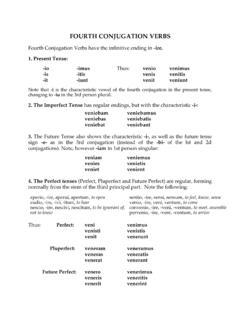
FOURTH CONJUGATION VERBS - The Latin Library
www.thelatinlibrary.comFOURTH CONJUGATION VERBS Fourth Conjugation Verbs have the infinitive ending in -ire. 1. Present Tense:-io-is-it-imus-itis-iunt Thus: venio venis venit venimus
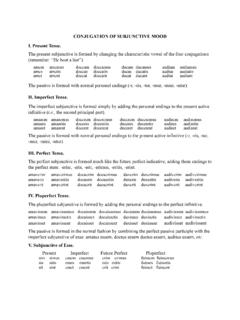
CONJUGATION OF SUBJUNCTIVE MOOD I. Present …
www.thelatinlibrary.comCONJUGATION OF SUBJUNCTIVE MOOD I. Present Tense. The present subjunctive is formed by changing the characteristic vowel of the four conjugations
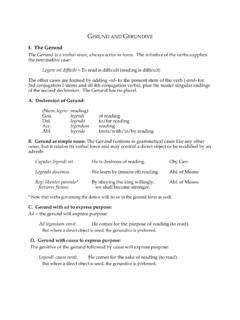
I. The Gerund - The Latin Library
www.thelatinlibrary.comGERUND AND GERUNDIVE I. The Gerund The Gerund is a verbal noun, always active in force. The infintive of the verbs supplies the nominative case: Legere est difficile = To read is difficult (reading is difficult)
Related documents

Alphabet introduction and first lesson - free on the website
www.ruslan.co.ukRuslan 1 Alphabet Introduction 11 RUSLAN RUSSIAN 1 A1 A communicative course for beginners in Russian John Langran and Natalya Veshnyeva Alphabet introduction and first lesson - …

Dactylic Hexameter Verse - The Latin Library
www.thelatinlibrary.comDactylic Hexameter Verse Ancient verse was composed in lines of long or short syllables in different combinations. Dactylic hexameter consists of lines made from six (hexa) feet, each foot containing either a long syllable followed by two short syllables (a dactyl: – ˇ ˇ) or two long syllables (a spondee: – –). The first four feet may either be dactyls or spondees.