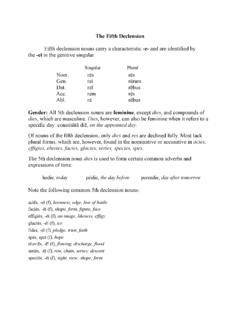
The Fifth Declension
The Fifth Declension Fifth declension nouns carry a characteristic -e- and are identified by the -eī in the genitive singular. Singular Plural Nom. rēs rēs Gen. reī rērum
Download The Fifth Declension

Information
Domain:
Source:
Link to this page:
Documents from same domain
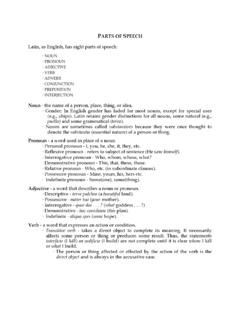
Parts of Speech - The Latin Library
www.thelatinlibrary.comPARTS OF SPEECH Latin, as English, has eight parts of speech: · NOUN · PRONOUN · ADJECTIVE · VERB · ADVERB · CONJUNCTION · PREPOSITION · INTERJECTION Noun - the name of a person, place, thing, or idea.
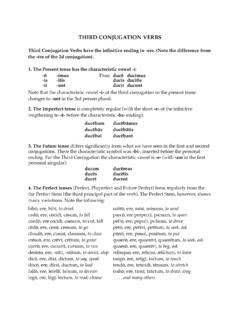
Third Conjugation Verbs - The Latin Library
www.thelatinlibrary.comTHIRD CONJUGATION VERBS Third Conjugation Verbs have the infinitive ending in -ere. (Note the difference from the -ēre of the 2d conjugation).
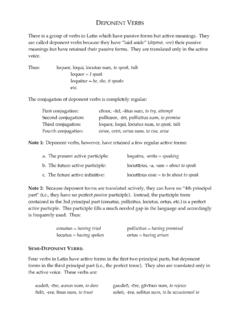
DEPONENT VERBS - The Latin Library
www.thelatinlibrary.comDEPONENT VERBS There is a group of verbs in Latin which have passive forms but active meanings. They are called deponent verbs because they have “laid aside” (dëpönö, -ere) their passive
ABLATIVE ABSOLUTE
www.thelatinlibrary.comABLATIVE ABSOLUTE One of the most common uses of present and perfect participles in Latin is a construction called the Ablative Absolute. The ablatives of a participle and a noun (or pronoun) are used to form a substitute
PARTICIPLES - The Latin Library
www.thelatinlibrary.comPARTICIPLES A participle is a form of a verb used as an adjective. The participle may be active or passive, but will always agree in number, case, and gender with the noun that it …
Infinitives - The Latin Library
www.thelatinlibrary.comInfinitives General: An infinitive is, strictly speaking, an abstract verbal noun. The infinitive is used in Latin, as in English, as a noun: Errare humanum est = To err is ...
T SUPINE - The Latin Library
www.thelatinlibrary.comTHE SUPINE The Supine is a verbal noun of the fourth declension, appearing only in the accusative singular (-um) and ablative singular (-ü) and limited to two usages.
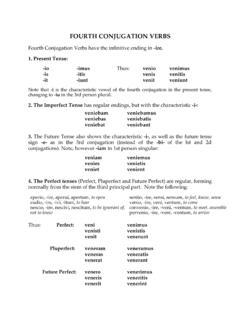
FOURTH CONJUGATION VERBS - The Latin Library
www.thelatinlibrary.comFOURTH CONJUGATION VERBS Fourth Conjugation Verbs have the infinitive ending in -ire. 1. Present Tense:-io-is-it-imus-itis-iunt Thus: venio venis venit venimus
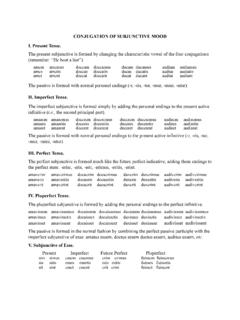
CONJUGATION OF SUBJUNCTIVE MOOD I. Present …
www.thelatinlibrary.comCONJUGATION OF SUBJUNCTIVE MOOD I. Present Tense. The present subjunctive is formed by changing the characteristic vowel of the four conjugations
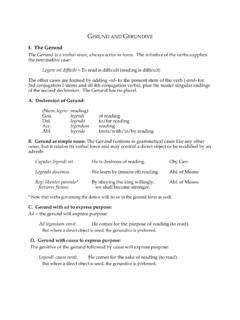
I. The Gerund - The Latin Library
www.thelatinlibrary.comGERUND AND GERUNDIVE I. The Gerund The Gerund is a verbal noun, always active in force. The infintive of the verbs supplies the nominative case: Legere est difficile = To read is difficult (reading is difficult)
Related documents
Parts of Speech - The Latin Library
www.thelatinlibrary.comPARTS OF SPEECH Latin, as English, has eight parts of speech: · NOUN · PRONOUN · ADJECTIVE · VERB · ADVERB · CONJUNCTION · PREPOSITION · INTERJECTION Noun - the name of a person, place, thing, or idea. · Gender: In English gender has faded for most nouns, except for special uses (e.g., ships). Latin retains gender distinctions …
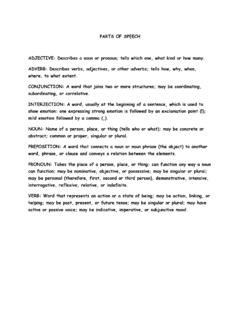
PARTS OF SPEECH ADJECTIVE: Describes a noun or …
www.bucks.educlauses), or compound/complex (two or more independent clauses and one or more dependent clauses. SHOW POSSESSION: The function that allows a word to show ownership; nouns show
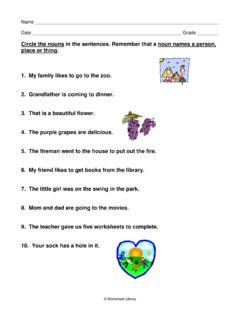
Circle the nouns in the sentences. Remember that …
www.worksheetlibrary.comName _____ Date _____ Grade _____

LO: To revise the different types of noun by finding ...
www.primaryresources.co.ukNouns are the names of things , places or people . Today you are going to look through some text from ‘Titanic’ by Mark Dubrowski, to find

Comma Tip 1
www.chompchomp.com1 COMMA TIP 1 Use a comma to separate an introductory element from the main clause that follows. Main clauses will often have single words, phrases, or other clauses that introduce them. In the table below are common introductory elements.

Nouns quiz - BBC
downloads.bbc.co.ukNouns quiz E3 © BBC 2011 Level A 1. Which word is a noun in this sentence? I decided to catch the bus because I was late. A) catch B) bus C) late
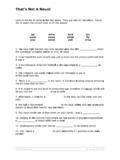
That's Not A Noun! - ESL Lounge
www.esl-lounge.com© esl-lounge.com esl-lounge Premium That's Not A Noun! Look at the list of verbs in the box below. They are also all, incredibly, nouns. Try to select the correct ...

UM ITEM NOUN UI - armyreal.com
www.armyreal.comTitle: DA Form 1300-4, JAN 82 Author: APD Subject: REORDER POINT RECORD Keywords: REORDER POINT RECORD Created Date: 10/6/2005 6:06:55 PM
![9. [noun (place)] ni ikimasu. www.ajalt.org/sj/](/cache/preview/c/a/8/2/d/6/3/0/thumb-ca82d630d73faeb0a28f00f40fe8c579.jpg)
9. [noun (place)] ni ikimasu. www.ajalt.org/sj/
www.ajalt.org[noun (thing)] o tabemasu. Object of verbs like "tabemasu", to eat, "nomimasu", to drink, "mimasu", to see/watch, etc. are indicated by "o". Asa-gohan o tabemasu. (I ...