The Framework for Teaching Evaluation Instrument
50 3 a C O M M U N I C A T I N G W I T H S T U D E N T S 3a Communicating with Students Teachers communicate with students for several independent, but related, purposes. First,
Download The Framework for Teaching Evaluation Instrument

Information
Domain:
Source:
Link to this page:
Documents from same domain

Academic Standards for English Language Arts
static.pdesas.orgAcademic Standards for English Language Arts Grades Pre K–5 March 1, 2014 Pennsylvania Department of Education
Child Abuse Recognition and Reporting Training …
static.pdesas.orgRevised February 2015 1 Child Abuse Recognition and Reporting Training (Section 1205.6 of the Public School Code of 1949) Frequently Asked Questions

Academic Standards for English Language Arts
static.pdesas.orgPENNSYLVANIA CORE STANDARDS English Language Arts Grade 6–12 March 1, 2014 2 INTRODUCTION These standards describe what students should know and be able to do with the English language, prekindergarten through Grade 12.

Academic Standards for Mathematics - pdesas.org
static.pdesas.orgPA CORE STANDARDS Mathematics | P a g e 4 March 1, 2014 The PA Core Standards for Mathematics detail four standard areas: Numbers and Operations, Algebraic Concepts, Geometry, and Measurement,
The Framework for Teaching Evaluation Instrument
static.pdesas.orgThe Framework for Teaching identifies those aspects of a teacher's responsibilities that have been documented through empirical studies and theoretical research as promoting
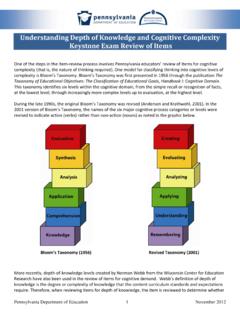
Understanding Depth of Knowledge and Cognitive …
static.pdesas.orgPennsylvania Department of Education 1 November 2012 Understanding Depth of Knowledge and Cognitive Complexity Keystone Exam Review of Items
Depth of Knowledge (DOK) Levels - pdesas.org
static.pdesas.orgLevel One Activities Recall elements and details of story structure, such as sequence of events, character, plot and setting. Conduct basic mathematical
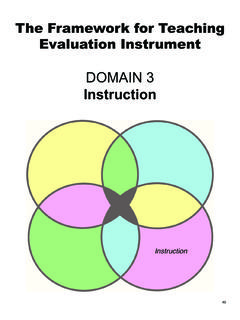
The Framework for Teaching Evaluation Instrument
static.pdesas.org59 3c Engaging Students in Learning —Possible Examples Unsatisfactory Basic Proficient Distinguished Students are able to fill out the lesson
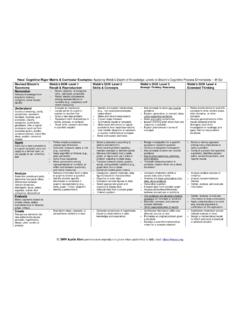
Hess’ Cognitive Rigor Matrix & Curricular Examples ...
static.pdesas.orgHess’ Cognitive Rigor Matrix & Curricular Examples: Applying Webb’s Depth-of-Knowledge Levels to Bloom’s Cognitive Process Dimensions – M-Sci © 2009 Karin ...

Academic Standards for Civics and Government - …
static.pdesas.orgAcademic Standards for Civics and Government June 1, 2009 FINAL Secondary Standards Grades 9,12 US History (1850-Present), World …
Related documents
Tips for Effectively Communicating With a Person Who Has ...
schizophrenia.comDisclaimer: Schizophrenia.com provides information about schizophrenia and other psychiatric disease issues to interested parties. This information is not a guide for patient treatment, nor is it meant to provide a substitute for professional advice about

NoN-Verbal CommuNiCatioN - World Bank
siteresources.worldbank.orgNon-Verbal Communication | CommGAP | 2 • Facial expressions — The most important non-verbal channel for expressing attitudes and emotions to other people is the face (Argyle, 1988).2 Researchers have attempted to categorize facial expres- sions that express emotion and typically agree on six: happiness, surprise, fear, sadness, anger, dis-

Communicating with Children - Response Ability
www.responseability.org© Commonwealth of Australia as represented by the Department of Health and Ageing 2010 About Communicating with Children Communication is an exchange of information ...

Communicating With Cognitively Impaired Patients - - …
www.rn.orgCommunication is simply the sending of a message from one person to another. There are many types and ways of communicating. Communication can be:

SkillPath Seminars invites you to attend Communicating ...
www.skillpath.comWorkshop Outline Enroll on-line at www.skillpath.com or call toll free 1-800-873-7545 Day 1 n Communicating under pressure: How to be poised, calm and effective no matter what • Why being able to think on your feet—

Language, Culture and Learning - University of South Australia
www.tllg.unisa.edu.auLanguage, Culture and Learning 2 • Language is more than just the code: it also involves social practices of interpreting and making meanings

The Body Language - جامعة البحرين
www.uob.edu.bhBody language is nonverbal communication that involves body movement. “Gesturing” can also be termed as body language which is absolutely non-verbal means of communication.
Related search queries
Tips for Effectively Communicating With a Person, Schizophrenia, Non-Verbal Communication, Communicating with Children, Communicating With Cognitively Impaired Patients, Communicating, SkillPath Seminars invites you to attend Communicating, Language, Culture and Learning, Language, The Body Language, Body language, Body