
Theories into Practice
Theories Theorists Focus Implications for practice Developmental (Chapter 2) Piaget Steiner Montessori Gardner The discrete and/or continuous stages of development Educators respond to and plan activities in relation to children’s developmental stages Socio-cultural (Chapter 3) Vygotsky Bruner
Download Theories into Practice

Information
Domain:
Source:
Link to this page:
Documents from same domain

Being intentional - Early Childhood Australia
www.earlychildhoodaustralia.org.au2 Being clear about what we mean by the words we use In early childhood education and care (ECEC), we tend initially to be wary about a term such as ‘intentional teaching’.

Becoming literate - Early Childhood Australia
www.earlychildhoodaustralia.org.au3 You can’t have too many stories ‘Learning to read’ is a big topic for another e-Newsletter, but the foundations of reading lie in story—recounting stories

Health, safety and wellbeing - Early Childhood …
www.earlychildhoodaustralia.org.au2 Healthy lifestyles 'Learning about healthy lifestyles, including nutrition and physical fitness, is integral to wellbeing and self-confidence.’ (DEEWR, 2009a, p. 30; ...

Community engagement - Early Childhood Australia
www.earlychildhoodaustralia.org.au1 NQS PLP e-Newsletter No.47 2012 Community engagement A community is more than just a location, or a collection of individuals who happen to live or work in the same place.

Links between the EYLF, the NQS, and everyday …
www.earlychildhoodaustralia.org.au1 Links between the EYLF, the NQS, and everyday practice Introduction This document aims to demonstrate how a focus on one area of learning—Quality

Rethinking outdoor learning environments
www.earlychildhoodaustralia.org.au1 NQS PLP e-Newsletter No.59 2013 Rethinking outdoor learning environments Part A: Provocations Introduction This e-Newsletter …

Becoming culturally competent—Ideas that …
www.earlychildhoodaustralia.org.au1 NQS PLP e-Newsletter No.65 2013 Becoming culturally competent—Ideas that support practice ‘Cultural competence requires that organisations have a defined
Tracking learning - Early Childhood Australia
www.earlychildhoodaustralia.org.au1 EYLFPLP e-Newsletter No. 26 2011 Tracking learning Setting the scene The ‘hot topic’ over 2011 raised in conversations, on the Forum and Facebook,

Play-based approaches to literacy and numeracy
www.earlychildhoodaustralia.org.au1 NQS PLP e-Newsletter No.66 2013 Play-based approaches to literacy and numeracy Literacy and numeracy are essential skills for all children to develop.
Promoting independence and agency - Early …
www.earlychildhoodaustralia.org.au4 For older children, discussion and debate are important ways that they can contribute to decision-making. For babies and infants that kind of contribution is not possible.
Related documents

“Bad Conspiracy Theorists”
mileswmathis.comDec 21, 2021 · “Bad Conspiracy Theorists” by Miles Mathis Lecturi te salutamus First published December 21, 2021 I will start with a littledivertissement. My undertitle quote means “those who are about to read, we salute you”. You are among the last of a dying breed: the literate person. You DON'T prefer videos,
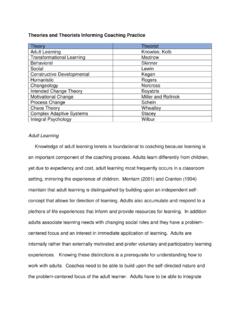
Theories and Theorists Informing Coaching Practice
globalioc.comTheories and Theorists Informing Coaching Practice Theory Theorist Adult Learning Knowles; Kolb Transformational Learning Mezirow Behavioral Skinner Social Lewin Constructive Developmental Kegan Humanistic Rogers Changeology Norcross Intended Change Theory Boyatzis Motivational Change Miller and Rollnick ...
AS and A Level English Language Guide to Theorists
www.ocr.org.ukGuide to Theorists 2 AS and A Level English Language OCR 01 Guide to Theorists This guide signposts towards key theorists whose work may be helpful for students to explore as part of the AS/ A Level English Language course. Please note that this guide is not exhaustive or prescriptive and schools may also want to look at theorists and

Learner Resource 2 Language and gender theorists
www.ocr.org.ukLearner Resource 2 Language and gender theorists Robin Lakoff In 1975, Robin Lakoff published an account of women’s language, which is often cited in discussions about language and gender theory. The book is called Language and Woman’s Place and in an article called Woman’s Language, Lakoff
ACTOR NETWORK THEORY
www.sagepub.comTheorists have also remained faithful to ethnomethodology, acknowledging the built nature of sociotechnical networks and advocating an examination of the taken for granted. Throughout the 1980s, ANT had not coalesced into a single theoretical perspective. Theorists presupposed that advancing a single set of principles was counter to the

The Classical Theorists in Sociology (Marx, Weber, and ...
www.sesync.orgThe three theorists can be considered structuralists, but they focused on different types of structures For Marx, think about factories that convert natural resources into commodities through human labor. For Weber, think about norms, but also …