THERMODYNAMICS
12.3 Zeroth law of Thermodynamics 12.4 Heat, internal energy and work 12.5 First law of thermodynamics 12.6 Specific heat capacity 12.7 Thermodynamic state variables and equation of state 12.8 Thermodynamic processes 12. 9 Heat engines 12.10 Refrigerators and heat pumps 12.11 Second law of thermodynamics 12.12 Reversible and irreversible ...
Download THERMODYNAMICS

Information
Domain:
Source:
Link to this page:
Documents from same domain
11 UnitUnitUnit
www.ncert.nic.in317 Alcohols, Phenols and Ethers Allylic and benzylic alcohols may be primary, secondary or tertiary. (ii) Compounds containing C OHsp2 − bond: These alcohols contain —OH group bonded to a carbon-carbon double bond i.e., to a
Model Question Paper Mathematics Class XII
www.ncert.nic.inModel Question Paper Mathematics Class XII Time Allowed : 3 hours Max: Marks: 100 General Instructions (i) The question paper consists of three parts A, B and C.
Information Brochure and Application Form
www.ncert.nic.inPriority Areas : Fellowship will be given for research pertaining to the following priority areas: Rashtriya Madhyamik Shiksha Abhiyan (RMSA) : This scheme was launched in March, 2009 with the objective to enhance access to secondary education and to improve its quality.

13108 - National Council Of Educational Research …
www.ncert.nic.inForeword What is ‘Education’? What is its primary purpose, and what is not? Which approaches support it, and at which levels of cognition? So many basic questions that many of our ‘trained
Information and Communication Technology
www.ncert.nic.inInformation and Communication Technology for the School System Curricula for ICT in Education Version #1.01 Developed by Central Institute of Educational Technology
fok; lwph - National Council Of Educational …
www.ncert.nic.in2-5 Kku ,oa le> 28 2-5-1 cqfu;knh {kerk,¡ 29 2-5-2 O;ogkj esa Kku 30 2-5-3 le> ds :i 31 2-6 Kku dks fQj ls jpuk 33 2-7 cPpksa dk Kku vkSj LFkkuh; Kku 34

NCERT
www.ncert.nic.inNCERT A Pioneer in Educational Publishing An Enduring Contribution to Improve the Quality of School Education through 1. Attractive Books …
Syllabus for Bachelor of Education (B. Ed.) …
www.ncert.nic.inSyllabus for Bachelor of Education (B. Ed.) Programme DEPARTMENT OF TEACHER EDUCATION National Council of Educational Research and Training Sri Aurobindo Marg, New Delhi – 110 016
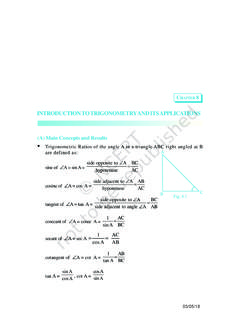
INTRODUCTION TO TRIGONOMETRY AND ITS …
www.ncert.nic.inINTRODUCTION TO TRIGONOMETRY AND ITS APPLICATIONS 89 • The ‘line of sight’ is the line from the eye of an observer to the point in the object viewed by the observer. ...
MODULE 4: UNDERSTANDING ADOLESCENCE …
www.ncert.nic.in4 Please remember to provide feedback at the end of this module 2. Do you think that Robin can be a good football player and that the coach should give him
Related documents
FLUID MECHANICS TUTORIAL 9 COMPRESSIBLE FLOW
www.freestudy.co.ukYou should already be familiar with the theory of work laws in closed systems. You should know that the area under a pressure-volume diagram for a reversible expansion or compression gives the work done during the process. In thermodynamics there are two forms of energy transfer, work (W) and heat (Q). By
HEAT AND MASS TRANSFER - UPM
webserver.dmt.upm.es• A temperature increase in a closed system is not necessarily due to a heat input; it can be due to a work input (e.g. ∆E=mc∆T=W for Q=0 in (1)), either with dissipation (e.g. internal stirring), or without (isentropic compression). • The First Law (1) shows that, for a steady state without work exchange,the heat loss by a system
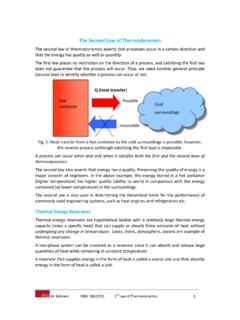
Second Law of Thermodynamics - Simon Fraser University
www.sfu.caThe second law of thermodynamics asserts that processes occur in a certain direction and that the ... commonly used engineering systems, such as heat engines and refrigerators etc. ... (closed system).
UNIT 61: ENGINEERING THERMODYNAMICS
www.freestudy.co.uk2. THE FIRST LAW OF THERMODYNAMICS When you have completed section two, you should be able to explain and use the following terms. The First Law of Thermodynamics. Closed systems. The Non-Flow Energy Equation. Open systems. The Steady Flow Energy Equation. 2.1 THERMODYNAMIC SYSTEMS
3 CHEMICAL THERMODYNAMICS
www.geo.utexas.eduThermodynamics is the study of energy in systems, and the distribution of energy among components. In chemical systems, it is the study of chemical potential, reaction potential, reaction direction, and reaction extent 3.2.1 First Law of Thermodynamics: dU=dq + dw where U is the internal energy, q is the heat transferred to a system from the
Thermodynamics Fundamentals for Energy Conversion …
esc.fsu.eduThis law is the basis of temperature measurement. First Law of Thermodynamics: The change in internal energy of a closed system is equals to the heat added to the system (or absorbed from the environment) minus the work done by the system (or on the environment). This law is a consequence of conservation of energy.
THERMODYNAMICS
ncert.nic.in2. Closed System In a closed system, there is no exchange of matter, but exchange of energy is possible between system and the surroundings [Fig. 6.2 (b)]. The presence of reactants in a closed vessel made of conducting material e.g., copper or steel is an example of a closed system. Fig. 6.2 Open, closed and isolated systems.
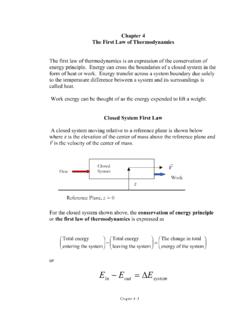
Chapter 4 The First Law of Thermodynamics
resources.saylor.orgThe First Law of Thermodynamics The first law of thermodynamics is an expression of the conservation of energy principle. Energy can cross the boundaries of a closed system in the form of heat or work. Energy transfer across a system boundary due solely to the temperature difference between a system and its surroundings is called heat.
THERMODYNAMICS, HEAT TRANSFER, AND FLUID FLOW …
sites.ntc.doe.gov1.25 STATE the Second Law of Thermodynamics. 1.26 Using the Second Law of Thermodynamics, DETERMINE the maximum possible efficiency of a system. 1.27 Given a thermodynamic system, CONDUCT an analysis using the Second Law of Thermodynamics. 1.28 Given a thermodynamic system, DESCRIBE the method used to determine: a. The …
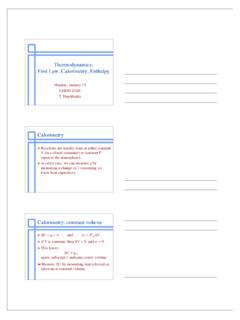
Thermodynamics: First Law, Calorimetry, Enthalpy Calorimetry
www.chem.tamu.eduThermodynamics: First Law, Calorimetry, Enthalpy Monday, January 23 CHEM 102H T. Hughbanks Calorimetry Reactions are usually done at either constant V (in a closed container) or constant P (open to the atmosphere). In either case, we can measure q by measuring a change in T (assuming we know heat capacities). Calorimetry: constant volume