Third Grade
the transformed environment, and some die. Students are able to determine the effects of balanced and unbalanced forces on the motion of an object and the cause and effect relationships of electric or magnetic interactions between two objects not in contact with each other.
Download Third Grade

Information
Domain:
Source:
Link to this page:
Documents from same domain
Appendix G Crosscutting Concepts - …
www.nextgenscience.orgApril 2013 NGSS Release Page 1 of 17 Appendix G – Crosscutting Concepts Crosscutting concepts have value because they provide students with connections
High School Earth and Space Sciences - …
www.nextgenscience.orgHigh School Earth and Space Sciences . Students in high school continue to develop their understanding of the three disciplinary core ideas in the Earth and Space Sciences.

Preparing Students for a Lifetime of Success
www.nextgenscience.orgachievement in grades K–2. A quality science education can help expand opportunities for all students. The science standards complement English/ Language Arts and mathematics standards, ... Next Generation Science Standards Grade K-2 …
APPENDIX F Science and Engineering Practices in …
www.nextgenscience.orgApril 2013 NGSS Release Page 1 of 33 APPENDIX F – Science and Engineering Practices in the NGSS A Science Framework for K-12 Science Education provides the blueprint for developing the Next
Key Definitions - nextgenscience.org
www.nextgenscience.orgApril 2013 NGSS Release Page 1 of 7 APPENDIX I – Engineering Design in the NGSS The Next Generation Science Standards (NGSS) represent a commitment to integrate ...
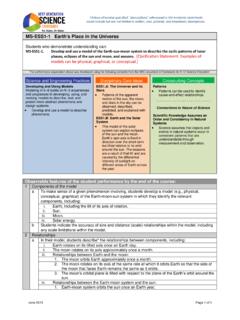
MS-ESS1-1 Earth's Place in the Universe
www.nextgenscience.orgaround the sun, for a majority of time during an Earth month, the moon is not in a position to block solar energy from reaching Earth, and Earth is not in a position to block solar energy from reaching the moon.
Science Professional Learning Standards - nextgenscience.org
www.nextgenscience.orgScience Professional Learning Standards: A Project of the Council of State Science Supervisors Brett Moulding (UT) Bill Penuel (CO) Our Effort •A project of the Council of State Science Supervisors to update the NSES Standards for Professional Learning –Representatives from three states and the
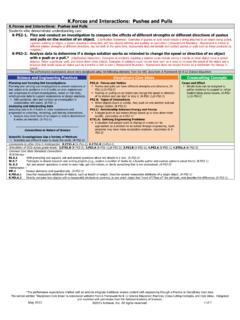
K.Forces and Interactions: Pushes and Pulls
www.nextgenscience.orgK.Forces and Interactions: Pushes and Pulls *The performance expectations marked with an asterisk integrate traditional science content with engineering through a Practice or Disciplinary Core Idea.

Kindergarten Topic Model - Bundle 1 Pushes and Pulls This ...
www.nextgenscience.orgKindergarten Topic Model - Bundle 1 Pushes and Pulls . This is the first bundle of the Topic Model. Each bundle has connections to the other bundles in the course, as shown in the
APPENDIX F Science and Engineering Practices in the NGSS
www.nextgenscience.orgApril 2013 NGSS Release Page 1 of 33 APPENDIX F – Science and Engineering Practices in the NGSS A Science Framework for K-12 Science Education provides the blueprint for developing the Next Generation Science Standards (NGSS). The Framework expresses a vision in science education that requires students to operate at the nexus of three dimensions of learning: Science and Engineering
Related documents
Science Content Standards
sde.idaho.govLS1-K-2. Use classification supported by evidence to differentiate between living and non-living items. • Further Explanation: Use chart or Venn diagram to sort objects or pictures into living and not-living items. Supporting Content LS1.C: Organization for Matter and Energy Flow in Organisms • All animals need food in order to live and grow.

The 10 elements of agroecology - Home | Food and ...
www.fao.orgIt seeks to optimize the interactions between plants, animals, humans and the environment while taking into consideration the social aspects that need to be addressed for a sustainable and fair food system. Agroecology is not a new invention. It can be identified in scientific literature
CHAPTER15 Our Environment - NCERT
ncert.nic.inAll organisms such as plants, animals, microorganisms and human beings as well as the physical surroundings interact with each other and maintain a balance in nature. All the interacting organisms in an area together with the non-living constituents of the environment form an ecosystem. Thus, an ecosystem consists of biotic components

INTERACTIONS BETWEEN ORGANISMS . AND …
www.d.umn.eduINTERACTIONS BETWEEN ORGANISMS . AND ENVIRONMENT 2·1 FUNCTIONAL RELATIONSHIPS An understanding of the relationships between an organism and its environment can be attained only when the environmental factors that can be experienced by the organism are considered. This is difficult because it is first necessary for the
Lecture 1 – Introduction to Ecology
dspace.mit.eduabundance of organisms and the interactions among them, and the study of how these organisms in turn mediate the transport and transformation of energy and matter in the biosphere (i.e., the study of the design of ecosystem structure and function).” The goal of ecology is to understand the principles of operation of natural systems and to
Part I. Introduction Chapter 1. What is Human Ecology ...
www.des.ucdavis.edusity. We often say that it adapts organisms to the environment that they live in. Then, we need to think about individuals of a population interacting with each other as well as the outside environment. The evolution and ecology of social interactions is often called socio-

CHAPTER 2 Interactions in Ecosystems - Miss S. Harvey
missharvey.weebly.comenvironment in which the organisms live. Factors such as the introduction of a new species or a temperature change would have a huge impact on the kelp bed community.An ecosystem is simply a convenient way to look at interactions between the living and the non-living things in an area.It is not defined by size or complexity.It could

Diversity is not only a characteristic of living organisms ...
www.ncert.nic.inwhich studies the interactions among organisms and between the organism and its physical (abiotic) environment. Ecology is basically concerned with four levels of biological organisation – organisms, populations, communities and biomes. In this chapter we explore ecology at organismic and population levels. 13.1 ORGANISM AND ITS ENVIRONMENT
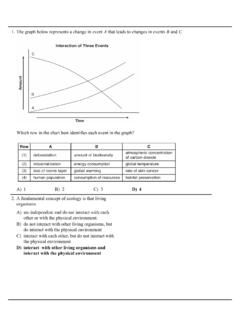
1.The graph below represents a change in event A that ...
www.scarsdaleschools.k12.ny.usA)The interactions between other organisms would stop immediately. B)The functions carried out by these organisms would no longer be necessary. C)The ecosystem would remain stable. D)The ecosystem would become less stable. 30.The chart below shows the environmental functions that some organisms perform in a stable ecosystem.