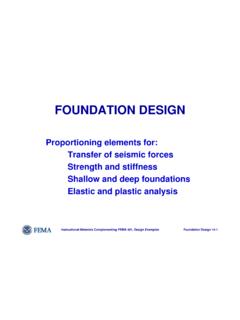
Topic 14 - Foundation Design - Memphis
#4 spiral at 11 inch pitch (6) #5 #4 spiral at 7.5 inch pitch (6) #5 #4 spiral at 3.75 inch pitch 4" pile embedment Section A Section B Section C C B A 21'-0" 23'-0" 6'-4" •Site Class C •Larger amounts where moments and shears are high •Minimum amounts must extend beyond theoretical cutoff points •“Half” spiral for 3D
Download Topic 14 - Foundation Design - Memphis

Information
Domain:
Source:
Link to this page:
Documents from same domain
Chapter 11 SEISMIC DESIGN CRITERIA - Civil …
www.ce.memphis.eduP1: JsY ASCE003-11.tex ASCE003/SIE-v1.cls September 29, 2005 17:5 Chapter 11 SEISMIC DESIGN CRITERIA 11.1 GENERAL 11.1.1 Purpose. Chapter 11 presents criteria for the design and
Chapter 6. Compression Reinforcement - Flexural …
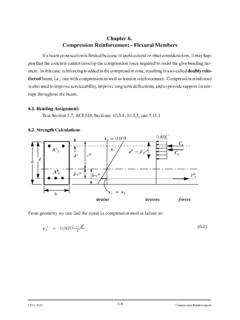
www.ce.memphis.eduCIVL 4135 118 Compression Reinforcement Chapter 6. Compression Reinforcement - Flexural Members Ifabeamcrosssectionislimitedbecauseofarchitecturalorotherconsiderations,itmayhap-

Review of Engineering Fundamentals - University …
www.ce.memphis.eduReview of Engineering Fundamentals CIVL 4197. Course Format ... FE Chemical 853 77% FE Civil 4,874 70% FE Electrical & Computer 1,217 …
ASCE Requirements for Citations f13 - Civil …
www.ce.memphis.eduASCE Requirements for Citations Books Feld, J. and Carper, K. (1997). Construction Failure, 2nd Ed., Wiley, New York. Book references must include author, book title, publisher, and the publisher’s
2 - Aggregate Gradation and Sampling - Civil …
www.ce.memphis.eduCIVL 3137 3 Gradation Analysis percent coarser or percent retained percent finer or percent passing
BEAM DESIGN - University of Memphis
www.ce.memphis.edu6 2. SHEAR DESIGN IN FLAT PLATES AND FLAT SLABS When two-way slabs are supported directly by columns, as in flat slabs and flat plates, or when slabs carry concentrated loads, as in footings, shear near the columns is of critical
Curing Concrete, Chapter 12 - The University of …
www.ce.memphis.edu221 Chapter 12 Curing Concrete 3. Methods that accelerate strength gain by supplying heat and additional moisture to the concrete. This is usually accomplished with live steam, heating coils,
AAA CE4135 ver2 - Civil Engineering
www.ce.memphis.eduCIVL 4135 Chapter 1. Introduction • 2 A problem unique to the design of reinforced concrete structures is the need to detail each member throughout.
Aggregates for Concrete - Department of Civil …
www.ce.memphis.eduT 27). The range of particle sizes in aggregate is illustrated in Fig. 5-4. The aggregate particle size is determined by using wire-mesh sieves with square openings.
Aggregate Specifications - The University of …
www.ce.memphis.eduCIVL 3137 125 Specifications TDOT Specs for Concrete Fine Aggregate Percent Passing by Weight 3/8 in. (9.5 mm) 100 No. 4 (4.75 mm) 95 ‐ 100
Related documents
The Calculusof Variations - University of Minnesota
www-users.cse.umn.educurves: straight line segments parallel to the center line; arcs of circles orthogonal to the center line; and spiral helices, the latter illustrated in Figure 2. Similarly, the geodesics on a sphere are arcs of great circles. In aeronautics, to minimize distance flown, airplanes follow geodesic circumpolar paths around the globe.

DESIGN MANUAL, PART 2 HIGHWAY DESIGN
cdn.ymaws.comTable of Contents Publication 13M (DM-2) 2015 Edition - Change #1 TOC - 1 DESIGN MANUAL, PART 2 HIGHWAY DESIGN. TABLE OF CONTENTS . CHAPTER SUBJECT PAGE. CHAPTER 1 GENERAL DESIGN

Design of Horizontal Curves - UGPTI
www.ugpti.orgFor non-spiral curves, the NDDOT places 2/3 of the runoff on the tangent, and 1/3 of the runoff on the curve. Runout. Runoff ...

Railway Alignment Design and Geometry - University of …
web.engr.uky.eduSpiral Transition Curves TS (Tangent to Spiral) SC (Spiral to Curve) Railways use the higher length of two formulae: •To limit unbalanced lateral acceleration acting on passengers to 0.03 g per second: L = 1.63 E u V E u = unbalanced elevation (in.) •To limit track twist to 1 inch in 62 feet: L = 62 E a E a = actual elevation (in.)

Geometric Design Guide for Canadian Roads Figure 2.1.4.12 ...
www.tac-atc.caincluded are the spiral parameters applicable to rural and high speed urban roadways (spiral parameters will be addressed later in this Section). These values are illustrated in Tables 2.1.2.5 to 2.1.2.7 and are based on relationships presented in a 1974 publication 31. Urban Roadways: Design Domain Technical Foundation
Engineering Curves I
www.it.griet.ac.inEngineering Curves – II 1. Classification 2. Definitions 3. Involutes - (five cases) 4. Cycloid 5. Trochoids – (Superior and Inferior) 6. Epic cycloid and Hypo - cycloid 7. Spiral (Two cases) 8. Helix – on cylinder & on cone 9. Methods of drawing Tangents and Normals (Three cases)
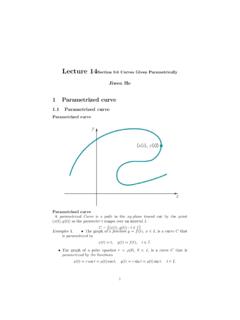
Lecture 14 - UH
www.math.uh.eduSection 9.6 Curves Given Parametrically Jiwen He 1 Parametrized curve 1.1 Parametrized curve Parametrized curve Parametrized curve A parametrized Curve is a path in the xy-plane traced out by the point (x(t),y(t)) as the parameter t ranges over an interval I. C = (x(t),y(t)) : t ∈ I Examples 1.

13.1 Vector Functions and Space Curves
www.usna.eduSpace curves are inherently more difficult to draw by hand than plane curves; for an accurate representation we need to use technology. For instance, Figure 7 shows a computer-generated graph of the curve with parametric equations x = (4 + sin 20t) cos t y = (4 + sin 20t) sin t z = cos 20t It’s called a toroidal spiral because it lies on a ...