Translating Embeddings for Modeling Multi-relational Data
The embeddings take values in Rk (kis a model hyperparameter) and are denoted with the same letters, in boldface characters. The basic idea behind our model is that the functional relation induced by the ‘-labeled edges corresponds to a translation of the embeddings, i.e. we want
Download Translating Embeddings for Modeling Multi-relational Data

Information
Domain:
Source:
Link to this page:
Documents from same domain
Generative Adversarial Imitation Learning
proceedings.neurips.ccnetworks [8], a technique from the deep learning community that has led to recent successes in modeling distributions of natural images: our algorithm harnesses generative adversarial training to fit distributions of states and actions defining expert behavior. We test our algorithm in Section 6, where
Prototypical Networks for Few-shot Learning
proceedings.neurips.cc˚: RD!RMwith learnable parameters ˚. Each prototype is the mean vector of the embedded support points belonging to its class: c k= 1 jS kj X (x i;y i)2S k f ˚(x i) (1) Given a distance function d: R M R 
Inductive Representation Learning on Large Graphs
proceedings.neurips.ccnode classification, clustering, and link prediction [11, 28, 35]. ... (e.g., citation data with text attributes, biological data with functional/molecular markers), our approach can also make use of structural features that are present in all graphs (e.g., node degrees). ... through theoretical analysis, that GraphSAGE is capable of learning ...
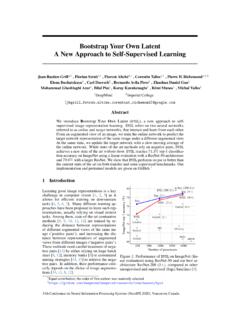
Bootstrap Your Own Latent A New Approach to Self ...
proceedings.neurips.ccmining strategies [14, 15] to retrieve the nega-tive pairs. In addition, their performance criti-cally depends on the choice of image augmenta- ... to prevent collapsing while preserving high performance. To prevent collapse, a straightforward solution …
Spatial Transformer Networks - NeurIPS
proceedings.neurips.ccConvolutional Neural Networks define an exceptionally powerful class of models, ... localisation, semantic segmentation, and action recognition tasks, amongst others. ... can take any form, such as a fully-connected network or a convolutional network, but should include a final regression layer to produce the transformation ...
Semi-supervised Learning with Deep Generative Models
proceedings.neurips.ccapproximately invariant to local perturbations along the manifold. The idea of manifold learning ... We show for the first time how variational inference can be brought to bear upon the prob- ... probabilities are formed by a non-linear transformation, with parameters , of a set of latent vari-ables z. This non-linear transformation is ...
Unsupervised Learning of Visual Features by Contrasting ...
proceedings.neurips.ccpseudo-labels to learn visual representations. This method scales to large uncurated dataset and can be used for pre-training of supervised networks [7]. However, their formulation is not principled and recently, Asano et al. [2] show how to cast the pseudo-label assignment problem as an instance of the optimal transport problem.

PyTorch: An Imperative Style, High-Performance Deep ...
proceedings.neurips.ccFacebook AI Research benoitsteiner@fb.com Lu Fang Facebook lufang@fb.com Junjie Bai Facebook jbai@fb.com Soumith Chintala Facebook AI Research soumith@gmail.com Abstract Deep learning frameworks have often focused on either usability or speed, but not both. PyTorch is a machine learning library that shows that these two goals
Visualizing the Loss Landscape of Neural Nets
proceedings.neurips.cctask that is hard in theory, but sometimes easy in practice. Despite the NP-hardness of training general neural loss functions [3], simple gradient methods often find global minimizers (parameter configurations with zero or near-zero training loss), even when data and labels are randomized before training [43].
InfoGAN: Interpretable Representation Learning by ...
proceedings.neurips.ccof the digit (0-9), and chose to have two additional continuous variables that represent the digit’s angle and thickness of the digit’s stroke. It would be useful if we could recover these concepts without any supervision, by simply specifying that an MNIST digit is generated by an 1-of-10 variable and two continuous variables.
Related documents

Self-Supervised Learning - Stanford University
cs229.stanford.edu1.Start with randomly initialized word embeddings. 2.Move sliding window across unlabeled text data. 3.Compute probabilities of center/context words, given the words in the window. 4.Iteratively update word embeddings via stochastic gradient descent . [Mikolov et al., 2013] 18

Sentence-BERT: Sentence Embeddings using Siamese BERT …
aclanthology.orgrive sentence embeddings from BERT. To bypass this limitations, researchers passed single sen-tences through BERT and then derive a fixed sized vector by either averaging the outputs (similar to average word embeddings) or by using the output of the special CLS token (for example:May et al. (2019);Zhang et al. Qiao et al. )).
![arXiv:1606.04640v1 [cs.CL] 15 Jun 2016](/cache/preview/c/6/2/4/d/b/b/2/thumb-c624dbb20af847e00fda2633eb9f7f1e.jpg)
arXiv:1606.04640v1 [cs.CL] 15 Jun 2016
arxiv.orgsentence embeddings from unlabeled data, like we do, it is a natural baseline to consider. Both methods are trained on the Toronto Book Corpus, the same corpus used to train Siamese CBOW. We should note that as we use skip-thought vectors as trained by Kiros et al. (2015),
![A arXiv:2108.00154v1 [cs.CV] 31 Jul 2021](/cache/preview/5/1/4/3/3/e/9/d/thumb-51433e9dee8472b1576151350bb9b5bc.jpg)
A arXiv:2108.00154v1 [cs.CV] 31 Jul 2021
arxiv.orgNevertheless, the position of embeddings also contains important information. To make the model aware of this, many different position represen-tations of embeddings (Vaswani et al., 2017; Dosovitskiy et al., 2021) are proposed, wherein relative position bias (RPB) (Shaw et al., 2018) is one of them. For RPB, each pair of embeddings has a bias

An Introduction to Locally Linear Embedding
cs.nyu.eduThe embeddings discovered by LLE are easiest to visualize for intrinsically two dimensional manifolds. In Fig. 1, for example, theinput to LLE consisted 546 7 data points sampled off the S-shapedmanifold. The resulting embedding shows how the algorithm, using 8 :9 neighbors per data point, successfully unraveled the underlying two dimensional ...
CHAPTER Vector Semantics and Embeddings
web.stanford.eduembeddings hypothesis by learning representations of the meaning of words, called embeddings, directly from their distributions in texts. These representations are used in every nat-ural language processing application that makes use of meaning, and the static em-beddings we introduce here underlie the more powerful dynamic or contextualized
X-VECTORS: ROBUST DNN EMBEDDINGS FOR SPEAKER …
www.danielpovey.comter training, embeddings are extracted from the affine component of layer segment6. Excluding the softmax output layer and segment7 (because they are not needed after training) there is a total of 4.2 million parameters. 2.4. PLDA classifier