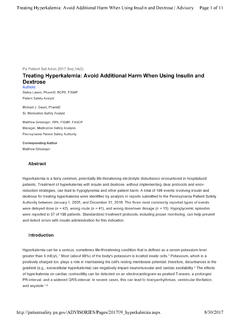
Treating Hyperkalemia: Avoid Additional Harm When Using ...
hyperkalemia, potassium, elevated potassium, high potassium, and critical potassium. The query also searched the drug-name fields of medication errors and adverse drug reactions (the two event categories that have discrete
Download Treating Hyperkalemia: Avoid Additional Harm When Using ...

Information
Domain:
Source:
Link to this page:
Documents from same domain
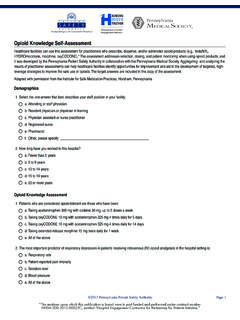
Opioid Knowledge Self-Assessment
patientsafety.pa.govOpioid Knowledge Self-Assessment Healthcare facilities can use this assessment for practitioners who prescribe, dispense, and/or administer opioid products ...
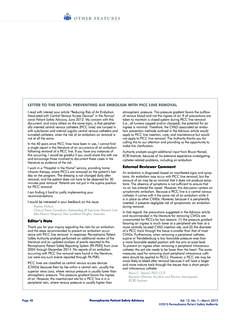
Letter to the Editor: Preventing Air Embolism with PICC ...
patientsafety.pa.govletter to the editor: preventing air embolism with picc line removal I read with interest your article “Reducing Risk of Air Embolism Associated with Central Venous Access Devices” in the Pennsyl-
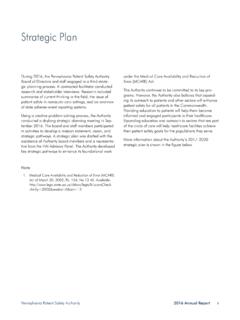
Strategic Plan 2017-2020 - Patient Safety Authority
patientsafety.pa.govStrategic Plan During 2016, the Pennsylvania Patient Safety Authority Board of Directors and staff engaged in a third strate- ... Strategic Plan 2017–2020 VISION Safe healthcare for all patients MISSION Improve the quality of healthcare in Pennsylvania by collecting and
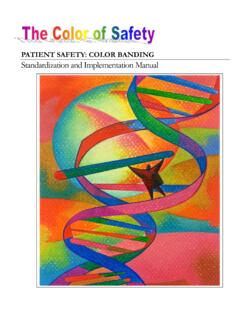
PATIENT SAFETY: COLOR BANDING Standardization and ...
patientsafety.pa.govColor-banding policy will need to be reviewed and approved. Hospitals need to review their respective forms for need of modifications (pt. ed, assessments, etc.) ... • Color Code – Intent of Specific Colors • Authority for Application of band • Process for Band Confirmation • Inter-Dept./Agency Communication
Confirming Feeding Tube Placement: Old Habits Die Hard
patientsafety.pa.govMore Reliable Methods to Verify Feeding Tube Placement Radiographic Confirmation of Nasogastric Tube Placement The gold standard for nasogastric feeding tube placement is radiographic confirmation with a chest x-ray. pretations by nonradiologists: The gold standard for nasoenteric feeding tube placement is radiographic confir-
The Beers Criteria: Screening for Potentially ...
patientsafety.pa.govhepatic clearance of many drugs, such as diazepam, amitriptyline, and chlordiazepoxide, carried out by the cytochrome P-450 system often diminishes with age. Overall, the clearance of drugs metabolized by the liver is typically decreased 30 to 40% in the elderly. Renal size and renal blood flow also decrease signifi-cantly with age.
Safety in Using Promethazine (Phenergan)
patientsafety.pa.gov©2007 Pennsylvania Patient Safety Authority Page 1 Produced by ECRI Institute & ISMP under contract to the Patient Safety Authority Patient Safety Advisory F irst approved by the U.S. Food and Drug Ad-ministration (FDA) in 1951, promethazine (Phenergan) is a medication in common use today. However, despite its familiarity, its use is not with-
PATIENT SAFETY AUTHORITY AND DEPARTMENT OF HEALTH
patientsafety.pa.gov12. A mid-procedure change in the plan of care in response to new information discovered during the procedure does not constitute an injury. 13. Additional healthcare services: a. Healthcare services provided to prevent an injury from occurring are excluded from this term for the purpose of Serious Event determinations. b.
Brochure Medical Records - Pennsylvania Patient Safety ...
patientsafety.pa.govrecord. In the future, when medi-cal records are requested by other providers, your provider must include his denial of your request to amend the medical record as well a copy of your statement of disagreement. It should not take more than 90 days to amend your medical records. If the request is accepted,
Retained Surgical Items: Events and Guidelines Revisited
patientsafety.pa.govand the Association of periOperative Registered Nurses published guidance for preventing RSIs, including minimizing distractions and participating in team-work training. The Joint Commission speaks to the role of weak or absent organizational leadership as reasons for the continuance of RSIs. (Pa Patient Saf Advis 2017 Mar;14[1]:27-35.)
Related documents

Management of severe hyperkalemia - EMCrit
emcrit.orgHyperkalemia In general, the initial treatment of se-vere hyperkalemia is independent of the cause of the disturbance, whereas the ra-tional therapy of chronic hyperkalemia depends on an understanding of its pathogenesis. In considering when hyperkalemia constitutes an emergency, several points should be kept in mind. First, the elec-

Alcohol’s Impact on Kidney Function
pubs.niaaa.nih.govincluded enlarged and altered cells in the kidney tubules. In another study, Van Thiel and colleagues (1977) compared kidney structure and func-tion in alcohol-fed and control rats.

Best Practices in Managing Table 3. 6 HYPERKALEMIA
www.kidney.orgHyperkalemia is often asymptomatic, but patients may complain of nonspecific symptoms such as palpitations, nausea, muscle pain, weakness, or paresthesia. Moderate and especially severe hyperkalemia can lead to cardiotoxicity, which can be fatal. The cause of hyperkalemia has to be determined to prevent future episodes. 14 Emergency diagnostic

Best Practices in Managing Table 3. 6 HYPERKALEMIA
www.kidney.orgHyperkalemia is often asymptomatic, but patients may complain of nonspecific symptoms such as palpitations, nausea, muscle pain, weakness, or paresthesia. Moderate and especially severe hyperkalemia can lead to cardiotoxicity, which can be fatal. The cause of hyperkalemia has to be determined to prevent future episodes.