Treatment for Alcohol Problems
shown to increase abstinence and reduce heavy drinking. Those taking the medication also reported fewer alcohol cravings and improved mood and sleep. • problem drinking, particularly among those with a certain genetic makeup that appears to …
Download Treatment for Alcohol Problems

Information
Domain:
Source:
Link to this page:
Documents from same domain
Alcohol Screening and Brief Intervention for Youth
www.niaaa.nih.govAlcohol Screening and Brief Intervention for Youth | A Practitioner’s Guide. Positive screens become manageable. This Guide’s tools will take much of the mystery out of intervening with your patients who are . drinking, allowing you to proceed within a clinical framework of lower, moderate, or highest . risk (see page 11).

QUICK GUIDE FOR GRANT APPLICATIONS
www.niaaa.nih.govQUICK GUIDE FOR GRANT APPLICATIONS Revised September 2010 INTRODUCTION The guide is organized according to the major sections of the SF 424 (or PHS398)
Alcohol Use Disorder: A Comparison Between DSM-IV and …
www.niaaa.nih.govAlcohol Use Disorder: A Comparison Between DSM–IV and DSM–5 In May 2013, the American Psychiatric Association issued the fifth edition of the Diagnostic and Statistical Manual of Mental Disorders (DSM–5). Although there is considerable overlap between DSM–5 and DSM–IV, the prior edition, there are several important differences:
Alcohol Facts and Statistics Fact Sheet
www.niaaa.nih.govNational Institute on Alcohol Abuse and Alcoholism https://www.niaaa.nih.gov • 301–443–3860 Alcohol Facts and Statistics Alcohol Use in the United States: » Prevalence of Drinking: According to the 2018 National Survey on Drug Use and Health (NSDUH), 86.3 percent of people ages 18 or older reported that they drank alcohol at some
Understanding Alcohol Use Disorder Fact Sheet
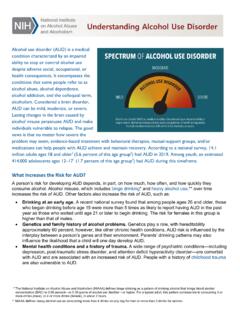
www.niaaa.nih.govAlcohol use disorder (AUD) is a medical condition characterized by an impaired ability to stop or control alcohol use despite adverse social, occupational, or health consequences. It encompasses the conditions that some people refer to as alcohol abuse, alcohol dependence, alcohol addiction, and the colloquial term, alcoholism.
Fetal Alcohol Exposure
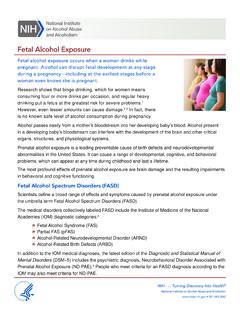
www.niaaa.nih.govabnormalities in the United States. It can cause a range of developmental, cognitive, and behavioral problems, which can appear at any time during childhood and last a lifetime. The most profound effects of prenatal alcohol exposure are brain damage and the resulting impairments in behavioral and cognitive functioning.
Underage Drinking - National Institute on Alcohol Abuse ...
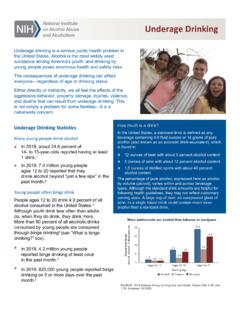
www.niaaa.nih.govDrinking can lead to poor decisions about taking risks, including unsafe sexual behavior, drinking and driving, and aggressive or violent behavior. Increases the risk of physical and sexual assault Underage binge drinking is associated with anincreased likelihood of …

Alcohol Use in the United States
www.niaaa.nih.govConsequences of Underage Alcohol Use: • Research indicates that alcohol use during the teenage years could interfere with normal adolescent brain development and increase the risk of developing AUD. In addition, underage drinking contributes to a range of acute consequences, including injuries, sexual assaults,
Tratamiento del alcoholismo
www.niaaa.nih.govde consumo de alcohol a través del asesoramiento. Son conducidos por profesionales de la salud y están respaldados por estudios que demuestran que pueden resultar beneficiosos. Medicamentos. Actualmente, existen tres medicamentos aprobados en Estados Unidos para ayudar a las personas a dejar o reducir el consumo de alcohol y prevenir la recaída.
Rethinking Drinking - Alcohol and Your Health
www.niaaa.nih.govat increased susceptibility to short- and long-term alcohol-related consequences, including liver disease, cardiovascular disease, neurotoxicity, and alcohol-related memory blackouts, compared to men. One reason for this is that alcohol resides predominantly in body water, and pound for pound, women have less water in their bodies than men.
Related documents

Interagency Guideline on Prescribing Opioids for Pain
www.agencymeddirectors.wa.govMar 09, 2015 · Interagency Guideline on Prescribing Opioids for Pain Developed by the Washington State Agency Medical Directors’ Group (AMDG) in collaboration with …

ASI-MV Worksheets & Handouts
www.asi-mvconnect.comRP-12 Managing Cravings: Tricks and Tools RP-13 My Craving Triggers RP-14 Protracted Withdrawal RP-15 Abstinence Violation Effect RP-16 Seemingly Irrelevant Decisions RP-17 My Relapse Attitudes RP-18 Managing My Relapse Thinking RP-19 Think Your Way Out of Using RP-20 Assessing Your Lifestyle RP-21 Leisure Activity Exercise

Contingency Management Strategies and Ideas
ibr.tcu.eduabstinence, session attendance, work toward vocational, social, or educational goals) by giving reinforcement when such behaviors are performed or by withholding reinforcement when such behaviors are abandoned (e.g., drinking/using drugs, not keeping appointments). This idea of using reinforcement and consequences to shape behavior is known as

Managing Holiday Stress and Growing In Recovery
www.peggyferguson.comManaging Holiday Stress and Growing In Recovery By Peggy L. Ferguson, Ph.D. The "Holidays" present unique opportunities to develop and practice new living skills in recovery. Most people experience an increase in stress around the holidays for a variety of reasons. This increase in stress brings about the proverbial blessing of an opportunity

Heart failure: Managing newly diagnosed and …
mm.wirral.nhs.ukabstinence, annual flu vaccine x 1 creatinine required. NB eplerenone • Give heart failure information leaflet to patient or family /carer Fluid balance: 1. Fluid restriction 1-2 litres in 24 hours 2. Salt restricted diet 3. Start loop diuretics e.g. furosemide 40mg od or increase and titrate according to symptoms. If required slow
Relapse Prevention - National Institutes of Health
pubs.niaaa.nih.govThe Abstinence Violation Effect. A crit-ical difference exists between the first violation of the abstinence goal (i.e., an initial lapse) and a return to uncon-trolled drinking or abandonment of the abstinence goal (i.e., a full-blown relapse). Although research with vari-ous addictive behaviors has indicated that a lapse greatly increases the ...

Client’s Handbook: Matrix Intensive Outpatient Treatment ...
store.samhsa.govOr, please call SAMHSA at 1-877-SAMHSA-7 (1-877-726-4727) (English and Español). Recommended Citation Center for Substance Abuse Treatment. Client’s Handbook: Matrix Intensive Outpatient Treatment for People
Managing Flares - Crohn's & Colitis Foundation
www.crohnscolitisfoundation.orgManaging flares You cannot completely prevent flare-ups of . Crohn’s disease or ulcerative colitis. However, in addition to taking your medications regularly and eating a well balanced diet, the following tips are recommended to help you manage your disease during flares and remission: • See your doctor regularly. Remember that
Psychosocial Rehabilitation Program Group Descriptions
www.pioneercenter.orgPsychosocial Rehabilitation Program Group Descriptions 12 Step Recovery: An introduction to 12-step recovery and abstinence-based living.Group members will receive education about each of the twelve steps and what “working them” looks like.
Facilitator Quick-Start Manual - SMART Recovery
www.smartrecovery.orgManaging Thoughts, Feelings, and Behaviors 4. Living a Balanced Life ... claiming that abstinence is the only way, but we have found that with commitment and the practice of our program, abstinence can be a safer, easier and more effective goal. In summary