Treatment for Alcohol Problems
Options for Treatment . When asked how alcohol problems are treated, people commonly think of 12-step programs or 28-day inpatient rehab, but may have dificulty naming other options. In fact, there are a variety of treatment methods currently available, thanks to signiicant advances in the ield over the past 60 years.
Download Treatment for Alcohol Problems

Information
Domain:
Source:
Link to this page:
Documents from same domain
Alcohol Screening and Brief Intervention for Youth
www.niaaa.nih.govAlcohol Screening and Brief Intervention for Youth | A Practitioner’s Guide. Positive screens become manageable. This Guide’s tools will take much of the mystery out of intervening with your patients who are . drinking, allowing you to proceed within a clinical framework of lower, moderate, or highest . risk (see page 11).

QUICK GUIDE FOR GRANT APPLICATIONS
www.niaaa.nih.govQUICK GUIDE FOR GRANT APPLICATIONS Revised September 2010 INTRODUCTION The guide is organized according to the major sections of the SF 424 (or PHS398)
Alcohol Use Disorder: A Comparison Between DSM-IV and …
www.niaaa.nih.govAlcohol Use Disorder: A Comparison Between DSM–IV and DSM–5 In May 2013, the American Psychiatric Association issued the fifth edition of the Diagnostic and Statistical Manual of Mental Disorders (DSM–5). Although there is considerable overlap between DSM–5 and DSM–IV, the prior edition, there are several important differences:
Alcohol Facts and Statistics Fact Sheet
www.niaaa.nih.govNational Institute on Alcohol Abuse and Alcoholism https://www.niaaa.nih.gov • 301–443–3860 Alcohol Facts and Statistics Alcohol Use in the United States: » Prevalence of Drinking: According to the 2018 National Survey on Drug Use and Health (NSDUH), 86.3 percent of people ages 18 or older reported that they drank alcohol at some
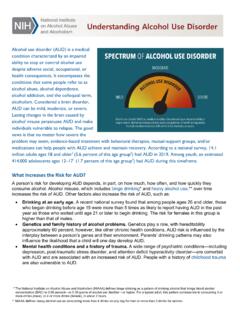
Understanding Alcohol Use Disorder Fact Sheet
www.niaaa.nih.govAlcohol use disorder (AUD) is a medical condition characterized by an impaired ability to stop or control alcohol use despite adverse social, occupational, or health consequences. It encompasses the conditions that some people refer to as alcohol abuse, alcohol dependence, alcohol addiction, and the colloquial term, alcoholism.
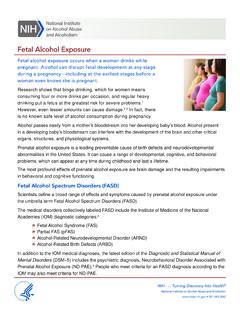
Fetal Alcohol Exposure
www.niaaa.nih.govabnormalities in the United States. It can cause a range of developmental, cognitive, and behavioral problems, which can appear at any time during childhood and last a lifetime. The most profound effects of prenatal alcohol exposure are brain damage and the resulting impairments in behavioral and cognitive functioning.
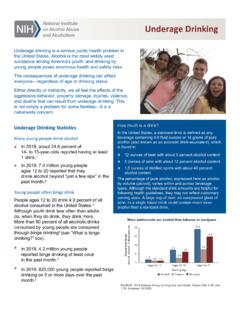
Underage Drinking - National Institute on Alcohol Abuse ...
www.niaaa.nih.govDrinking can lead to poor decisions about taking risks, including unsafe sexual behavior, drinking and driving, and aggressive or violent behavior. Increases the risk of physical and sexual assault Underage binge drinking is associated with anincreased likelihood of …

Alcohol Use in the United States
www.niaaa.nih.govConsequences of Underage Alcohol Use: • Research indicates that alcohol use during the teenage years could interfere with normal adolescent brain development and increase the risk of developing AUD. In addition, underage drinking contributes to a range of acute consequences, including injuries, sexual assaults,
Tratamiento del alcoholismo
www.niaaa.nih.govde consumo de alcohol a través del asesoramiento. Son conducidos por profesionales de la salud y están respaldados por estudios que demuestran que pueden resultar beneficiosos. Medicamentos. Actualmente, existen tres medicamentos aprobados en Estados Unidos para ayudar a las personas a dejar o reducir el consumo de alcohol y prevenir la recaída.
Rethinking Drinking - Alcohol and Your Health
www.niaaa.nih.govat increased susceptibility to short- and long-term alcohol-related consequences, including liver disease, cardiovascular disease, neurotoxicity, and alcohol-related memory blackouts, compared to men. One reason for this is that alcohol resides predominantly in body water, and pound for pound, women have less water in their bodies than men.
Related documents
Medication for the Treatment of Alcohol Use Disorder: A ...
store.samhsa.govoften have physical and social problems related to their alcohol use. Problems with alcohol influence the incidence, course, and treatment of many other medical and psychiatric conditions. 2 . Yet, of the 18.0 million people who met the criteria for alcohol dependence or abuse in 2013, only a small subset (1.4 million) received

Medications for the Treatment of Alcohol Use Disorder
www.healthquality.va.govalcohol use disorder. It uses medication, in combination with counseling and behavior therapies, to treat alcohol use disorder and sustain recovery. Medication can help to: Regain a stable state of mind, free from alcohol-induced highs and lows Provide freedom from thinking about alcohol all the time Reduce problems of craving
Adolescent Screening, Brief Intervention, and Referral to ...
www.masspartnership.comtreatment for alcohol and other drug use into routine adolescent visits. For more information about specific drugs (including prescription medications that can be abused), commonly-used names, and health ... problems related to their drinking,6 such as interference with work,

A brief guide to the Assessment and Treatment of Alcohol ...
www.mhc.wa.gov.au• presenting problems and reasons for seeking treatment • treatment goals and motivation to change • past alcohol and other drug treatment history • drinking history timeline: – age started drinking, first problems, first dependent – amount drunk in standard drinks in the last 24 hours and over the last week
The Treatment Plan
www.sagepub.comThe treatment team will continue to develop the problem list as the patient moves through treatment. New problems will come up and be added or modified as conditions change. The problem list and treatment plan must be fluid. The list changes throughout treatment as different problems come up and others are resolved. How to Develop a Problem List

Treatment Planning for Substance Use Disorders
www.swmbh.orgcustomer needs treatment. •Look at the most significant issues present in the customer’s life (substance use will show up as primary and secondary problems may also surface, such as, ADHD, impulsivity, anxiety). •Identify the problems that are most acute or troubling to the customer’s functioning and balance this with what is