
Understanding deep learning requires rethinking …
for multiple standard achitectures is largely unaffected by this transformation of the labels. This ... Figure 1: Fitting random labels and random pixels on CIFAR10. (a) shows the training loss of various experiment settings decaying with the training steps. …
Download Understanding deep learning requires rethinking …

Information
Domain:
Source:
Link to this page:
Documents from same domain
![arXiv:0706.3639v1 [cs.AI] 25 Jun 2007](/cache/preview/4/1/3/9/3/1/4/b/thumb-4139314b93ef86b7b4c2d05ebcc88e46.jpg)
arXiv:0706.3639v1 [cs.AI] 25 Jun 2007
arxiv.orgarXiv:0706.3639v1 [cs.AI] 25 Jun 2007 Technical Report IDSIA-07-07 A Collection of Definitions of Intelligence Shane Legg IDSIA, Galleria …
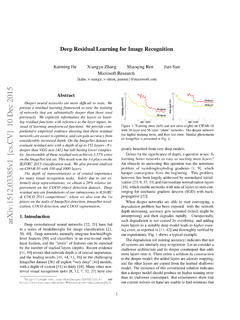
Deep Residual Learning for Image Recognition - …
arxiv.orgDeep Residual Learning for Image Recognition Kaiming He Xiangyu Zhang Shaoqing Ren Jian Sun Microsoft Research fkahe, v-xiangz, v-shren, jiansung@microsoft.com
![arXiv:1301.3781v3 [cs.CL] 7 Sep 2013](/cache/preview/4/d/5/0/4/3/4/0/thumb-4d504340120163c0bdf3f4678d8d217f.jpg)
arXiv:1301.3781v3 [cs.CL] 7 Sep 2013
arxiv.orgFor all the following models, the training complexity is proportional to O = E T Q; (1) where E is number of the training epochs, T is the number of …
![@google.com arXiv:1609.03499v2 [cs.SD] 19 Sep 2016](/cache/preview/c/3/4/9/4/6/9/b/thumb-c349469b499107d21e221f2ac908f8b2.jpg)
@google.com arXiv:1609.03499v2 [cs.SD] 19 Sep 2016
arxiv.orgwhere 1 <x t <1 and = 255. This non-linear quantization produces a significantly better reconstruction than a simple linear quantization scheme. …
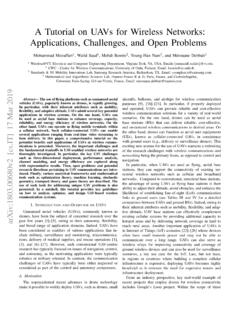
A Tutorial on UAVs for Wireless Networks: …
arxiv.orgA Tutorial on UAVs for Wireless Networks: Applications, Challenges, and Open Problems Mohammad Mozaffari 1, ... to UAVs in wireless communications is the work in …
Adversarial Generative Nets: Neural Network …
arxiv.orgAdversarial Generative Nets: Neural Network Attacks on State-of-the-Art Face Recognition Mahmood Sharif, Sruti Bhagavatula, Lujo Bauer Carnegie Mellon University
Massive Exploration of Neural Machine Translation ...
arxiv.orgMassive Exploration of Neural Machine Translation Architectures Denny Britzy, Anna Goldie, Minh-Thang Luong, Quoc Le fdennybritz,agoldie,thangluong,qvlg@google.com Google Brain
Mastering Chess and Shogi by Self-Play with a …
arxiv.orgMastering Chess and Shogi by Self-Play with a General Reinforcement Learning Algorithm David Silver, 1Thomas Hubert, Julian Schrittwieser, Ioannis Antonoglou, 1Matthew Lai, Arthur Guez, Marc Lanctot,1
Going deeper with convolutions - arXiv
arxiv.orgGoing deeper with convolutions Christian Szegedy Google Inc. Wei Liu University of North Carolina, Chapel Hill Yangqing Jia Google Inc. Pierre Sermanet
Andrew G. Howard Menglong Zhu Bo Chen Dmitry ...
arxiv.orgMobileNets: Efficient Convolutional Neural Networks for Mobile Vision Applications Andrew G. Howard Menglong Zhu Bo Chen Dmitry Kalenichenko Weijun Wang Tobias Weyand Marco Andreetto Hartwig Adam
Related documents

Differentiated Instruction Strategies
cnweb.cn.eduthis for true and false, multiple choice, almost anything. This is a very simple assessment tool. Speedometer: Students move crossed arms from being together to apart to show how much they ... writing random things that relate to one topic. They can write it big, small, crooked, or anything.
MULTIPLE REGRESSION BASICS - New York University
people.stern.nyu.eduMultiple regression: Yi = β0 + β1 (x1)i + β2 (x2)i + β3 (x3)i + … + βK (xK)i + εi The coefficients (the β’s) are nonrandom but unknown quantities. The noise terms ε1, ε2, ε3, …, εn are random and unobserved. Moreover, we assume that these ε’s are
Signals, Systems and Inference, Chapter 9: Random Processes
ocw.mit.eduFIGURE 9.2 Real izat ons of the random process X(t) can be thought of as a family of jointly distributed random variables indexed by t (or n in the DT case). A full probabilistic characterization of this collection of random variables would require the joint PDFs of multiple samples of the signal, taken at arbitrary times: a X(t) = x (t)b

Type I and Type II errors
www.stat.berkeley.edurandom variable, and S, T, U, and V are all unobservable random variables. The false discovery rate (FDR) is given by ( ) ( ) V V E E V S R = + and one wants to keep this value below a threshold α: The Simes procedure ensures that its expected value ( ) V E R is less than a given α (Benjamini and Hochberg 1995).