
Understanding Poverty Ruby Payne - aha! Process - Poverty ...
Generational poverty and situa-tional poverty are different. Generational poverty is defined as being in poverty for two generations or longer. Situational poverty exists for a shorter time is caused by circum-stances like death, illness, or divorce. This framework is based on pat-terns. All patterns have exceptions. An individual bring with them
Download Understanding Poverty Ruby Payne - aha! Process - Poverty ...

Information
Domain:
Source:
Link to this page:
Documents from same domain
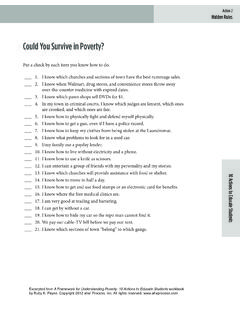
Could You Survive in Poverty? - aha! Process
www.ahaprocess.comExcerpted from A Framework for Understanding Poverty: 10 Actions to Educate Students workbook by Ruby K. Payne. Copyright 2012 aha! Process, Inc. All rights reserved. www.ahaprocess.com
Bridges Out of Poverty - aha! Process
www.ahaprocess.com1 Bridges Out of Poverty Study Guide Based on Bridges Out of Poverty: Strategies for Professionals and Communities by Ruby K. Payne, Ph.D., Philip E. DeVol, and Terie Dreussi Smith
Using the Hidden Rules of Class to Create …
www.ahaprocess.comCopyright 2004 aha! Process, Inc. www.ahaprocess.com 1 Using the Hidden Rules of Class to Create Sustainable Communities Philip E. DeVol
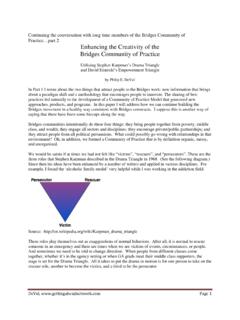
Continuing the conversation with long time members of the ...
www.ahaprocess.comthe Drama Triangle, is quoted on the cover of Emerald’s book stating, “The Empowerment Triangle is a highly original and effective escape from the Drama Triangle.” The paradigm shift called for by Emerald is the same paradigm found in the methodology of Bridges and
12 Thinking Tools for Bridges Out of Poverty Initiatives
www.ahaprocess.comBridges Initiative Bridges Out of Poverty workshops are known for changing the way people think about poverty and economic class. People have “aha” moments that deepen into insights that are so powerful that there is no going back to their old way of thinking.
Could You Survive in Poverty? - aha! Process
www.ahaprocess.comI fl y in my own plane, the company plane, or fi rst class. 9. I know how to enroll my children in the preferred private schools. 10. I know how to host the parties that “key” people attend. 11. I am on the boards of at least two charities. 12. I contribute to at least four or fi ve political campaigns. 13.
Related documents
Poverty and Education: Finding the Way Forward
www.ets.orgThe official poverty rate, first adopted in 1969, identified 46.2 million Americans (15 percent of the population) in poverty in 2011. There was little change in the poverty rate from 2010, after three years of consecutive increases. Poverty rates for subgroups of the population differ widely.
Indicators of Poverty & Hunger - United Nations
www.un.orgAbsolute Poverty threshold is equal to 2 or more severe deprivations of basic human need Proposed Operational Definitions of Deprivation of Basic Human Need for Youth 1) Food Deprivation– Body ...
Vulnerability to Poverty in the Philippines: An ...
pidswebs.pids.gov.ph1 Poverty lines represent the minimum (per capita) income required by a household to meet its food and other non-food basic needs. The food component of the poverty line (also called the food threshold) is estimated for urban and rural areas of each province by putting a cost to representative one-day food menus.
National Poverty Lines - Statistics South Africa
www.statssa.gov.zaPoverty line 2019 line values Food poverty line (FPL) 561 Lower-bound poverty line (LBPL) 810 Upper-bound poverty line (UBPL) 1 227 The national poverty lines were constructed using the cost-of-basic-needs approach which links welfare to the consumption of goods and services. The lines contain both food and non-food components of
The Impact of Poverty on African American Children in the ...
files.eric.ed.govCosts for rent, housing, food, clothing, and utilities increase yearly. Individuals in poverty may rely on food pantries and donated clothing from places, such as Goodwill or the Salvation Army (Wight, Chau, & Aratani, 2010). One of the earliest explanations for poverty was that it was caused by genetics.
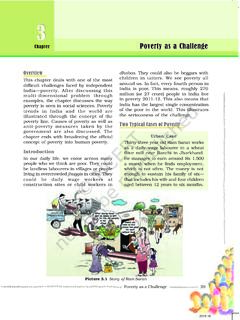
Chapter Poverty as a Challenge
ncert.nic.inPoverty as a Challenge 29 Overview ... needs. What is necessary to satisfy basic needs is different at different times and ... present formula for food requirement while estimating the poverty line is based on the desired calorie requirement. Food …
THE IMPACT OF POVERTY ON PREGNANT WOMEN
www.beststart.orgAccess to good affordable food makes more difference to what women eat than education about nutrition (Wilkinson & Marmot, 1998), Many pregnant women who live in poverty report that food expenses come last in the monthly budget. Impact of poverty on pregnant women – what every manager needs to know There are many factors that contribute
POVERTY BRIEF – UNDERSTANDING POVERTY
www.shareweb.ch– the poverty line (Ravallion, 2010) – are classified as poor. Over the last decades, this economic definition of poverty has been complemented by other approaches to conceptualise poverty: basic needs approach, capa-bilities approach, human development approach and multidimensional poverty approach (Handley et al., 2009).
Educating Students Who Live In Poverty (PDF)
www2.ed.govthirds of people living in poverty are working 1.7 jobs. Education. Youth living in poverty are the least likely to become educated in our nation. Some schools struggle to address the needs of people in poverty and help them to succeed. Academic achievement numbers are low for the children of families who struggle to meet their basic needs.