
Download Unit 1: Polynomials

Information
Domain:
Source:
Link to this page:
Documents from same domain

Lab 13 Qualitative Analysis of Cations and Anions
www.doctortang.comAP Chemistry Lab #13 Page 1 of 8. Lab #13: Qualitative Analysis of Cations and Anions Objectives: 1. To understand the rationale and the procedure behind the separation for various cations and anions.

Chapter 01 Linear and Quadratic Functions Notes …
www.doctortang.comPreCalculus Chapter 1: Linear and Quadratic Functions Copyrighted by Gabriel Tang B.Ed., B.Sc. Page 7.
Lab 08 Chemical Equilibrium - doctortang.com
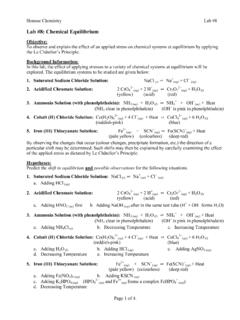
www.doctortang.comHonour Chemistry Lab #8 Page 1 of 4. Lab #8: Chemical Equilibrium Objective: To observe and explain the effect of an applied stress on chemical systems at equilibrium by applying

Chapter 09 Stoichiometry Notes (answers) - doctortang.com
www.doctortang.com9.3: Stoichiometry of Cars Air-Bag Chemistry: - solid sodium azide (NaN3), an unstable substance, can decompose given enough initial energy into sodium metal and nitrogen gas. Hence allowing the airbag to inflate quickly. ... Chapter 09 Stoichiometry Notes (answers)
Unit 5: Vectors - doctortang.com
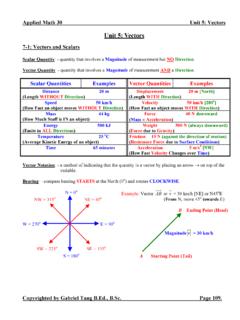
www.doctortang.comUnit 5: Vectors Applied Math 30 Page 110. Copyrighted by Gabriel Tang B.Ed., B.Sc.

Lab 09 Weak Acid and Strong Base Titration - doctortang.com
www.doctortang.comHonour Chemistry Lab #9 Page 2 of 4. Aspirin as a Weak Acid Aspirin is a weak acid with a Ka = 3.27 × 10 −4.The chemical structures of the acid and its conjugate base are as

HONOUR CHEMISTRY (Semester 1): FINAL EXAM (Practice Test)
www.doctortang.comPage 4 of 9. I. 0.20 mol of solute in 5.0 L of solution II. 0.50 mol of solute in 2.0 L of solution III. 3.0 mol of solute in 15 L of solution IV. 1.0 mol of solute in 3.0 L of solution The most dilute solution is A. III B. IV C. I D. II 29. Materials used in the titration between a known concentration acid and an unknown concentration of
Related documents

Algebra 1 Unit 3A Notes: Quadratic Functions - Factoring ...
aikfoundations.weebly.comAlgebra 1 Unit 3A: Factoring & Solving Quadratic Equations Notes 8 Day 3 – Factor Trinomials with a ≠1 In the previous lesson, we factored polynomials for which the coefficient of the squared term, “a” was always 1. Today we will focus on examples for which a ≠ 1. Looking for Patterns

MATHEMATICS (51)
cisce.orgSUB-UNIT UNIT NO. NAME OF THE UNIT NAME OF THE SUB-UNIT . 1. Commercial Mathematics (Complete Unit) 2. Algebra (vii)rdinateCo-o Geometry 2. Algebra (i) Linear Inequations (ii) Quadratic Equations in one variable (iii) Ratio and Proportion (iv) Factorisation of polynomials (v) Matrices (vi) Arithmetic Progression. 3. Geometry (b) Circles; 3 ...

Linear Transformations and Polynomials
cseweb.ucsd.eduFrom this theorem and the fact that the ring of polynomials is commuta-tive, it should be clear that any two polynomials in the operator T (or matrix A) also commute. This discussion is easily generalized as follows. Let A be any algebra over F with unit element e, and let f = aà + aèx + ~ ~ ~ + añxn be any polynomial in F[x].
18.03 LECTURE NOTES, SPRING 2014 - MIT Mathematics
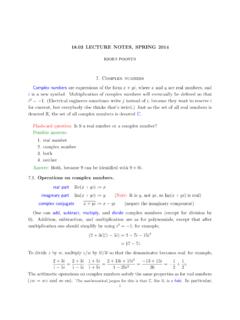
math.mit.eduSince real polynomials are special cases of complex polynomials, the fundamental theorem of algebra applies to them too. For real polynomials, the non-real roots can be paired o with their complex conjugates. Example 7.2. The degree 3 polynomial z3 +z2 z+15 factors as (z+3)(z 1 2i)(z 1+2i), so it has three distinct roots: 3, 1 + 2i, and 1 2i.

Algebra 2 Polynomial Unit Notes Packet completed
mfhs.bie.eduCP A2 Unit 3 (chapter 6) Notes nth d ree Quintic Polynomial of n terms non-ma Polynomial Linear Binomial Polynomial: The Basics Monomial of Terms D ree I nere are special names we give to polynomials according to their degree and number of terms. Degree of a Polynomial: the greatest value of the sum of all exponents of each monomial.
POLYNOMIALS - NCERT
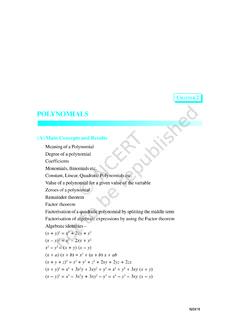
ncert.nic.inPOLYNOMIALS 19 2. Determine the degree of each of the following polynomials : (i) 2x – 1 (ii) –10 (iii) x3 – 9x + 3x5 (iv) y3 (1 – y4) 3. For the polynomial 3 2 17 –– 6 52 xx ++ xx2, write (i) the degree of the polynomial (ii) the coefficient of x3 (iii) the coefficient of x6 (iv) the constant term 4. Write the coefficient of x2 in ...
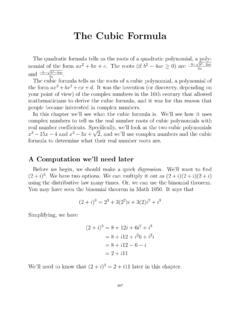
The Cubic Formula - University of Utah
www.math.utah.eduThe cubic formula tells us the roots of polynomials of the form ax3 +bx2 + cx + d. Equivalently, the cubic formula tells us the solutions of equations of the form ax3 +bx2 +cx+d =0. In the chapter “Classification of Conics”, we saw that any quadratic equa-tion in two variables can be modified to one of a few easy equations to un-derstand.

Unit 3 (Ch 6) Polynomials and Polynomial Functions
www.scasd.orgUnit 3 – (Ch 6) Polynomials and Polynomial Functions NOTES PACKET Mrs. Linda Gattis LHG11@scasd.org Learning Targets: PART 1 Polynomials: The Basics 1. I can classify polynomials by degree and number of terms. 2. I can use polynomial functions to model real life situations and make predictions 3. I can identify the characteristics of a ...