
Unit 1: Polynomials
3-3: Multiplying Polynomials To Multiply Monomials with Polynomials Example 1: Simplify the followings. a. 3 (2x2 − 4x + 7) b. 2x (3x2 + 2x − 4) = 3 (2x2 − 4x + 7) = 2x (3x2 + 2x − 4) = 6x2 − 12x + 21 6 = x3 + 4x2 − 8x c. 3x (5x + 4 ...
Download Unit 1: Polynomials

Information
Domain:
Source:
Link to this page:
Documents from same domain

Lab 13 Qualitative Analysis of Cations and Anions
www.doctortang.comAP Chemistry Lab #13 Page 1 of 8. Lab #13: Qualitative Analysis of Cations and Anions Objectives: 1. To understand the rationale and the procedure behind the separation for various cations and anions.

Chapter 01 Linear and Quadratic Functions Notes …
www.doctortang.comPreCalculus Chapter 1: Linear and Quadratic Functions Copyrighted by Gabriel Tang B.Ed., B.Sc. Page 7.
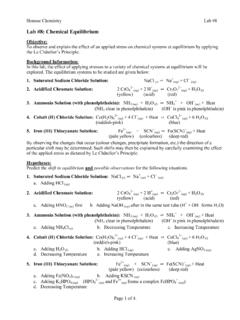
Lab 08 Chemical Equilibrium - doctortang.com
www.doctortang.comHonour Chemistry Lab #8 Page 1 of 4. Lab #8: Chemical Equilibrium Objective: To observe and explain the effect of an applied stress on chemical systems at equilibrium by applying

Chapter 09 Stoichiometry Notes (answers) - doctortang.com
www.doctortang.com9.3: Stoichiometry of Cars Air-Bag Chemistry: - solid sodium azide (NaN3), an unstable substance, can decompose given enough initial energy into sodium metal and nitrogen gas. Hence allowing the airbag to inflate quickly. ... Chapter 09 Stoichiometry Notes (answers)
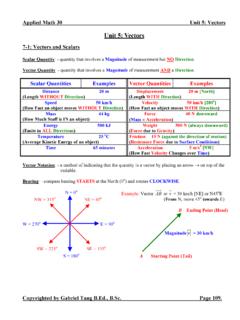
Unit 5: Vectors - doctortang.com
www.doctortang.comUnit 5: Vectors Applied Math 30 Page 110. Copyrighted by Gabriel Tang B.Ed., B.Sc.

Lab 09 Weak Acid and Strong Base Titration - doctortang.com
www.doctortang.comHonour Chemistry Lab #9 Page 2 of 4. Aspirin as a Weak Acid Aspirin is a weak acid with a Ka = 3.27 × 10 −4.The chemical structures of the acid and its conjugate base are as

HONOUR CHEMISTRY (Semester 1): FINAL EXAM (Practice Test)
www.doctortang.comPage 4 of 9. I. 0.20 mol of solute in 5.0 L of solution II. 0.50 mol of solute in 2.0 L of solution III. 3.0 mol of solute in 15 L of solution IV. 1.0 mol of solute in 3.0 L of solution The most dilute solution is A. III B. IV C. I D. II 29. Materials used in the titration between a known concentration acid and an unknown concentration of
Related documents
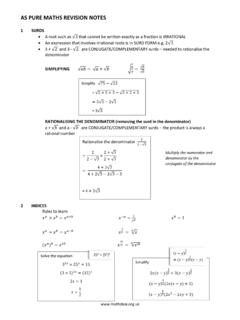
AS PURE MATHS REVISION NOTES
www.mathsbox.org.ukMultiplying or Dividing by a negative value reverses the inequality Quadratic Inequality – always a good idea to sketch the graph! Solve 10 – 3x < 4 -3x < -6 x > 2 ... 9 POLYNOMIALS • A polynomial is an expression which can be written in the form ...

3.2 The Factor Theorem and The Remainder Theorem
www.shsu.eduTheorem 3.4.Polynomial Division: Suppose d(x) and p(x) are nonzero polynomials where the degree of pis greater than or equal to the degree of d. There exist two unique polynomials, q(x) and r(x), such that p(x) = d(x)q(x) + r(x); where either r(x) = 0 or the degree of ris strictly less than the degree of d.
1 Vector spaces and dimensionality
ocw.mit.eduLet us show that the vector space of all polynomials p(z) considered in Example 4 is an infinite dimensional vector space. Indeed, consider any list of polynomials. In this list there is a polynomial of maximum degree (recall the list is finite). Thus polynomials of higher degree are not in the span of the list.

Solving Cubic Polynomials - SHSU
www.shsu.eduSolving Cubic Polynomials 1.1 The general solution to the quadratic equation There are four steps to nding the zeroes of a quadratic polynomial. 1.First divide by the leading term, making the polynomial monic. 2.Then, given x2 + a 1x+ a 0, substitute x= y a 1 2 to obtain an equation without the linear term. (This is the \depressed" equation.)

Arithmetic and Algebra Worksheets - CIRCLE
circle.adventist.orgEssentials to Mathematics . Arithmetic and Algebra Worksheets . Shirleen Luttrell . 2012 . circle.adventist.org
complex numbers - Iowa State University
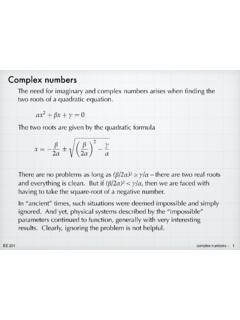
tuttle.merc.iastate.edumultiplying polynomials — just make sure that every term is multiplied by every other term. The result will be a mixing of the reals and imaginaries from the two factors, and these will need to be sorted out for the final result. z 1 · z 2 = (a + jb)·(c + jd) = ac + jad + jbc + (j)2bd
Adding and Subtracting Polynomials Date Period
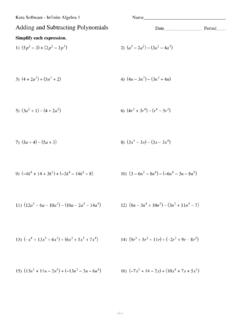
www.kutasoftware.com©a 62L0N1 c2t oK 9u tJaT lS GomfNtYwRadr9e a oLLfCY.x l gADlhlH vrEi Lgzh zt6s0 ZrheqsDeerjv FeidP. U 5 BM maGdJef ewpiotmh4 JI tn OfZi9nCi2tZeA FA8l0g7e fb IrHaX b1 M.q Worksheet by Kuta Software LLC

Performance Based Learning and Assessment Task Polynomial …
www.radford.eduThe students should be familiar with adding, subtracting, multiplying, and dividing polynomials. The student should have prior knowledge of how to factor first- and second-degree binomials and trinomials in one variable. Additionally, students must be able to communicate their mathematical processes in an organized and legible way.

Introduction to Perturbation Theory
www.reed.edu31.1. PERTURBATION { POLYNOMIALS Lecture 31 We can see how the = 0 equation (31.5) plays a role here, it is the 0 equation that starts o the process by allowing us to solve for x 0. Notice the cascade here, knowing x 0 = i p c a, we can solve for x 1 (we don’t actually need x 0 to nd x 1 in the current case, but in general, we have a