UNIT 61: ENGINEERING THERMODYNAMICS
A quantity of energy transferred as heat is given the symbol Q and it's basic unit is the Joule. The quantity transferred in one second is the heat transfer rate and this has the symbol and the unit is the Watt. An example of this is when heat passes from the furnace of a steam boiler through the walls separating the
Download UNIT 61: ENGINEERING THERMODYNAMICS

Information
Domain:
Source:
Link to this page:
Documents from same domain
UNIT 22: PROGRAMMABLE LOGIC CONTROLLERS …
www.freestudy.co.ukD.J.DUNN 1 UNIT 22: PROGRAMMABLE LOGIC CONTROLLERS Unit code: A/601/1625 QCF level: 4 Credit value: 15 TUTORIAL – OUTCOME 2 Part 2 This work covers part of outcome 2 of the Edexcel standard module.
UNIT 22: PROGRAMMABLE LOGIC CONTROLLERS …
www.freestudy.co.ukD.J.DUNN 2 1. INTRODUCTION Programming a PLC is helped by various aids such as LOGIC CIRCUITS, LADDER DIAGRAMS, TRUTH TABLES and …
INTRODUCTION TO BEAMS - FREE STUDY
www.freestudy.co.uk© D.J.DUNN freestudy.co.uk 2 1 TYPES OF BEAMS A beam is a structure, which is loaded transversely (sideways). The loads may be …
EDEXCEL NATIONAL CERTIFICATE/DIPLOMA …
www.freestudy.co.uk© d.j.dunn www.freestudy.co.uk 1 edexcel national certificate/diploma further mechanical principles and applications unit 11 - nqf level 3 outcome 3 - rotating systems
EDEXCEL NATIONAL CERTIFICATE UNIT 10: …
www.freestudy.co.uk© d.j.dunn www.freestudy.co.uk 1 edexcel national certificate unit 10: properties and applications of engineering materials nqf level 3 outcome 1 - tutorial 1
INSTRUMENTATION AND CONTROL TUTORIAL 2 - …
www.freestudy.co.ukINSTRUMENTATION AND CONTROL TUTORIAL 2 – ELECTRIC ACTUATORS This is a stand alone tutorial on electric motors and actuators. The tutorial is of interest to
UNIT 61: ENGINEERING THERMODYNAMICS - FREE …
www.freestudy.co.uk© D.J.Dunn www.freestudy.co.uk 1 UNIT 61: ENGINEERING THERMODYNAMICS Unit code: D/601/1410 QCF level: 5 Credit value: 15 OUTCOME 4 STEAM AND GAS TURBINE POWER PLANT
Unit 24: Applications of Pneumatics and Hydraulics
www.freestudy.co.uk© D.J.DUNN 2 DIRECTIONAL VALVES 1. INTRODUCTION Valves are necessary to control the pressure, flow rate and direction of the fluid. Hydraulic valves are made
DYNAMICS TUTORIAL DAMPED VIBRATIONS Exam …
www.freestudy.co.ukSOLID MECHANICS DYNAMICS TUTORIAL – DAMPED VIBRATIONS This work covers elements of the syllabus for the Engineering Council Exam D225 – Dynamics of Mechanical Systems, C105 Mechanical and
SOLID MECHANICS DYNAMICS TUTORIAL …
www.freestudy.co.uk1.2 FREE VIBRATIONS- EXAMPLES A free vibration is one that occurs naturally with no energy being added to the vibrating system. The vibration is started by some input of energy but the vibrations die away with time as the energy
Related documents
THERMODYNAMICS TUTORIAL 5 HEAT PUMPS AND …
www.freestudy.co.ukThe second law of thermodynamics tells us that no heat engine may be 100% efficient. In the reversed cycle, the reverse logic applies and it will be found that more energy is given out at the condenser and more absorbed in the evaporator, than is needed to drive the compressor.
THERMODYNAMICS, HEAT TRANSFER, AND FLUID FLOW, …
sites.ntc.doe.govSeveral properties of fluids were discussed in the Thermodynamics section of this text. These included temperature, pressure, mass, specific volume and density. Temperature was defined as the relative measure of how hot or cold a material is. It can be used to predict the direction that heat will be transferred.
Second Law of Thermodynamics
www.sfu.caM. Bahrami ENSC 388 (F09) 2nd Law of Thermodynamics 1 The Second Law of Thermodynamics The second law of thermodynamics asserts that processes occur in a certain direction and ... Heat transfer between a reservoir and a system is an externally ...
THERMODYNAMICS, HEAT TRANSFER, AND FLUID FLOW …
sites.ntc.doe.gov1.23 Given a heat exchanger, PERFORM an energy balance across the two sides of the heat exchanger. 1.24 IDENTIFY the path(s) on a T-s diagram that …
The Ideal Gas Law Lecture 2: Atmospheric Thermodynamics
www.ess.uci.eduEnergy (Heat) The first law of thermodynamics ESS55 Prof. Jin-Yi Yu Heat and Energy Energy is the capacity to do work. Heat is one form of energy. Heat is one form of internal energy which is associated with the random, disordered motion of molecules and atoms. Internal kinetic/potential energy are different from the macroscopic kinetic/potential

ENSC 388: Engineering Thermodynamics and Heat Transfer
www.sfu.caThe Second Law of Thermodynamics states that heat will not pass from a cold region to a warm one without spending energy or work. Therefore, a refrigerator requires energy input for its operation. It should be noted that heat pump and refrigeration cycles are the same, but in the . 5
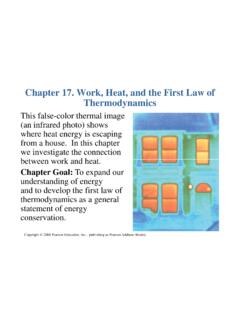
Chapter 17. Work, Heat, and the First Law of Thermodynamics
physics.gsu.eduThe First Law of Thermodynamics Work and heat are two ways of transfering energy between a system and the environment, causing the system’s energy to change. If the system as a whole is at rest, so that the bulk mechanical energy due to translational or rotational motion is …
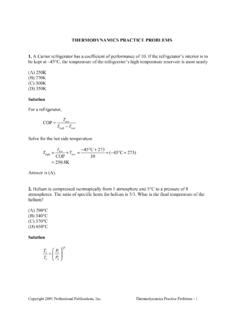
THERMODYNAMICS PRACTICE PROBLEMS 1.
faculty.utrgv.eduA Carnot refrigeration cycle is used to keep a freezer at –5°C. Heat is rejected at 20°C. If the heat removal rate is 30 kW, the COP of the refrigeration cycle is most nearly (A) 9 (B) 10 (C) 11 (D) 12 Solution Thigh =°+ =20 C 273 293K Tlow =− ° + =5 C 273 268K

THE APPLICATION OF THERMODYNAMICS TO PUMP SYSTEMS
www.pumpfundamentals.comC is the quantity of heat absorbed by the fluid from the source and Q E is the heat loss of the fluid to the environment. The internal energy has changed from its level at instant 1 to another level at instant 2 (after heat is applied). The internal energy (U) is a thermodynamic property. 2.2 CLOSED SYSTEMS, INTERNAL ENERGY AND WORK