Unit Present continuous and present simple 1
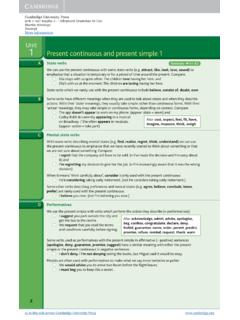
Some verbs used as performatives with the present simple in affi rmative (= positive) sentences (apologise, deny, guarantee, promise, suggest) have a similar meaning with either the present simple or the present continuous in negative sentences: I don’t deny / I’m not denying taking the books, but Miguel said it would be okay.
Download Unit Present continuous and present simple 1

Information
Domain:
Source:
Link to this page:
Documents from same domain
Wireless Communications: Networking and …
assets.cambridge.org1 Wireless Communications and Networking 1.1 Communications Networks Communications by voice and physical signaling are common means of interaction between human beings. In the simplest forms, there is an emitting entity of information
Unit Present continuous and present simple 1 - …
assets.cambridge.orgCambridge University Press 978-1-107-69989-2 – Advanced Grammar in Use Martin Hewings Excerpt More information, / / / / This /. (/
1 Introduction: What is language? - Cambridge …
assets.cambridge.org1 Introduction: What is language? Key terms Idiolect Language community Language Language conventions Arbitrary sign Iconic sign Fluency Communicative competence
Cambridge IELTS 4
assets.cambridge.orgCambridge IELTS 4 Examination papers from University of Cambridge ESOL Examinations: English for Speakers of Other Languages
Types and components of computer systems Chapter 1
assets.cambridge.orgChapter 1: Types and components ... Information and communication technology (ICT) is used ... (CU), to manage the various components of the computer; the control ...
Cambridge Preliminary English Test 3
assets.cambridge.orgCambridge Preliminary English Test 3 TEACHER’S BOOK Examination papers from University of Cambridge ESOL Examinations: English for Speakers of Other Languages
Introduction: a multilevel approach to international …
assets.cambridge.orgIntroduction: a multilevel approach to international human resource management Mustafa F. O¨zbilgin, Dimitria Groutsis and William S. Harvey 1 …
International Human Resource Management - Assets
assets.cambridge.orgInternational Human Resource Management International Human Resource Management offers a contemporary and multilayered introduction to international and comparative human resource management for
IntroductiontoConservationGenetics - Assets
assets.cambridge.orgIntroductiontoConservationGenetics The biological diversity of the planet is being rapidly depleted due to the direct and indirect consequences of human activity.
English Phrasal Verbs - Cambridge University Press
assets.cambridge.orgEnglish Phrasal Verbs 70 units of vocabulary reference and practice Self-study and classroom use Michael McCarthy Felici ty O'Dell
Related documents

Basic English Grammar for ESL Students
2qdocg2za8g336a8w21fo83z-wpengine.netdna-ssl.comPresent Simple: Positive Use the present simple for things that happen regularly or things that are generally true. I / you / we / they work he / she / it works Examples: • I work in a bank. • He works at the university. • We work every day. • My sister works at the hospital. Special Case #1 For verbs that end in consonant + –y, we ...
Process Approach to Teaching Writing Applied in Different ...
files.eric.ed.govThe verb forms or structures used (present perfect, present simple, active or passive) Ways in which the writer has made the writing more ex citing (use of adverb, adjectives, variety of lexis) Or Give the students the following headline:
How to form the Present Perfect - Espresso English
www.espressoenglish.netFor regular verbs, the past participle is the same as the simple past: • I worked (simple past) all day yesterday. • I’ve worked (past participle) here since August. This is also the case for many irregular verbs: • He sold (simple past) his car last week. • …

Reporting Verbs Reference Sheet - University of Technology ...
www.uts.edu.auReporting verbs are a way for you, the writer, to show your attitude towards the source of information you are citing. These attitudes are either ‘positive’, ‘negative’ or ‘neutral’. Do you agree with what the author has said? If so, use reporting verbs with a positive meaning to them.

SUMMER HOMEWORK EXTENSION 4 ESO
agora.xtec.cat4 Complete the text using the verbs in brackets. Use the Past Perfect Simple or Past Simple. Use the Past Perfect Simple or Past Simple. On 10th December, 1968, a car filled with a large amount of money was on its way to a Japanese bank.

Present Perfect Tense - Past Participles
cubictalk.comPresent Perfect Tense - Negative A. Choose the correct verb from the list below to complete the following sentences. Put the verb in the negative form of the present prefect tense. fix / begin / arrive / be / see / stop / speak / buy / read / visit 1.

2018 national curriculum assessment Key stage 1 - GOV.UK
assets.publishing.service.gov.uk• use present and past tense mostly correctly and consistently • use co-ordination (e.g. or / and / but) and some subordination (e.g. when / if / that / because) to join clauses • segment spoken words into phonemes and represent these by graphemes, spelling many of these words correctly and making phonically-plausible attempts at others