
Unsupervised Visual Representation Learning by Context ...
high-resolution natural images. Unsupervisedrepresentation learning can also be formu-lated as learning an embedding (i.e. a feature vector for each image) where images that are semantically similar are close, while semantically different ones are far apart. One way to build such a representation is to create a supervised
Download Unsupervised Visual Representation Learning by Context ...

Information
Domain:
Source:
Link to this page:
Documents from same domain

Predicting the Future Behavior of a Time-Varying ...
www.cv-foundation.orgPredicting the Future Behavior of a Time-Varying Probability Distribution Christoph H. Lampert IST Austria chl@ist.ac.at Abstract We study the problem of predicting the future, though
Deep Convolutional Neural Fields for Depth Estimation From ...
www.cv-foundation.orgvolutional neural networks (CNN). CNN features have been setting new records for a wide variety of vision applica-tions [13]. Despite all the successes in classification prob-
Image Style Transfer Using Convolutional Neural Networks
www.cv-foundation.orgImage Style Transfer Using Convolutional Neural Networks Leon A. Gatys Centre for Integrative Neuroscience, University of Tubingen, Germany¨ Bernstein Center for Computational Neuroscience, Tubingen, Germany¨
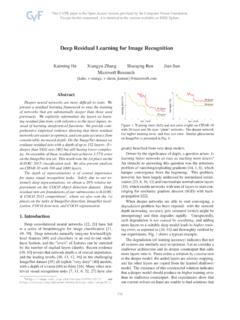
Deep Residual Learning for Image Recognition
www.cv-foundation.orgthe residual learning principle is generic, and we expect that it is applicable in other vision and non-vision problems. 2. Related Work Residual Representations. In image recognition, VLAD [18] is a representation that encodes by the residual vectors with respect to a dictionary, and Fisher Vector [30] can be

NTU RGB+D: A Large Scale Dataset for 3D Human Activity ...
www.cv-foundation.orgMultiview 3D event [43] and Northwestern-UCLA [40] datasets used more than one Kincect cameras at the same time to collect multi-view representations of the same ac-tion, and scale up the number of samples. It is worth mentioning, there are more than 40 datasets specifically for 3D human action recognition [47]. Al-
Single-Image Crowd Counting via Multi-Column …
www.cv-foundation.orgSingle-Image Crowd Counting via Multi-Column Convolutional Neural Network Yingying Zhang Desen Zhou Siqin Chen Shenghua Gao Yi Ma Shanghaitech University {zhangyy2,zhouds,chensq,gaoshh,mayi}@shanghaitech.edu.cn Abstract ... column CNN is adaptive to (hence the overall network

Hierarchical Convolutional Features for Visual Tracking
www.cv-foundation.orgVisual representations are of great importance for object tracking. Numerous hand-crafted features have been used to represent the target appear-ance such as subspace representation [24] and color his-tograms [37]. The recent years have witnessed significant

Learning Spatiotemporal Features With 3D Convolutional ...
www.cv-foundation.orgthe networks lose their input’s temporal signal after the first convolution layer. Only the Slow Fusion model in [18] uses 3D convolutions and averaging pooling in its first 3convo-lution layers. We believe this is the key reason why it per-forms best …

Convolutional Neural Networks at Constrained Time Cost
www.cv-foundation.orgConvolutional neural networks (CNNs) [15, 14] have re-cently brought in revolutions to the computer vision area. Deep CNNs not only have been continuously advancing the image classification accuracy [14, 21, 24, 1, 9, 22, 23], but also play as generic feature extractors for various recogni-tion tasks such as object detection [6, 9], semantic ...

Fully Convolutional Networks for Semantic Segmentation
www.cv-foundation.orgConvolutional networks are powerful visual models that yield hierarchies of features. We show that convolu-tional networks by themselves, trained end-to-end, pixels-to-pixels, exceed the state-of-the-art in semantic segmen-tation. Our key insight is to build “fully convolutional” networks that take input of arbitrary size and produce
Related documents

Deep Bilateral Learning for Real-Time Image Enhancement
groups.csail.mit.eduan intermediate representation, a local affine color transformation that will be applied to the input through a new multiplicative node. 3) While most of our learning and inference is performed at low resolution, the loss function used during training is evaluated at full resolution, which causes the low-resolution transformations we

Abstract
arxiv.orglearning: modeling high-level representations from raw observations remains elusive. Further, it is not always clear what the ideal representation is and if it is possible that one can learn such a representation without additional supervision or specialization to a particular data modality.
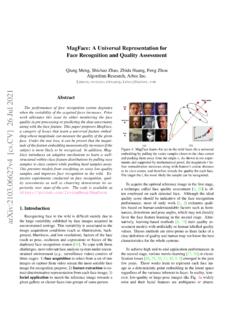
MagFace: A Universal Representation for Face Recognition ...
arxiv.orgnatively, learning-based methods [4,15] train quality as-sessment models with artificially or human labelled quality values. Theses methods are error-prone as there lacks of a clear definition of quality and human may not know the best characteristics for the whole systems. To achieve high end-to-end application performances in

Deep High-Resolution Representation Learning for Human ...
openaccess.thecvf.comDeep High-Resolution Representation Learning for Human Pose Estimation Ke Sun1,2∗† Bin Xiao2∗ Dong Liu1 Jingdong Wang2‡ 1University of Science and Technology of China 2Microsoft Research Asia sunk@mail.ustc.edu.cn, dongleiu@ustc.edu.cn, {Bin.Xiao,jingdw}@microsoft.com Abstract In this paper, we are interested in the human pose es-

Dual Super-Resolution Learning for Semantic Segmentation
openaccess.thecvf.comDual Super-Resolution Learning for Semantic Segmentation Li Wang1, ∗, Dong Li1, Yousong Zhu2, Lu Tian1, Yi Shan1 1 Xilinx Inc., Beijing, China. 2 Institute of Automation, Chinese Academy of Sciences, Beijing, China. {liwa, dongl, lutian, yishan}@xilinx.com, yousong.zhu@nlpr.ia.ac.cn Abstract Current state-of-the-art semantic segmentation method-

Knowledge Representation and Reasoning
web.stanford.edu– Knowledge Representation & Reasoning by Brachman & Levesque (available online) • Lectures – Tuesday and Thursday, 12:50-2:05, 300-300 • Grades – Four Assignments (40%), Mid-term (25%), Final (35%) • Prerequisites – First order logic and Resolution (at the level of CS157) • There will be two tutorial sections to cover this material

Introduction - Deep Learning
www.deeplearningbook.orghuman time and e ffort; it can take decades for an entire community of researchers. The quintessential example of a representation learning algorithm is the au-toencoder. An autoencoder is the combination of an encoder function that converts the input data into a different representation, and a decoder function

Natural Language Processing - Tutorialspoint
www.tutorialspoint.comlearning algorithms for language processing. Study of Human Languages Language is a crucial component for human lives and also the most fundamental aspect of our behavior. We can experience it in mainly two forms – written and spoken. In the written form, it is a way to pass our knowledge from one generation to the next. In the