Example: marketing
Deep High-Resolution Representation Learning for Human ...
Deep High-Resolution Representation Learning for Human Pose Estimation Ke Sun1,2∗† Bin Xiao2∗ Dong Liu1 Jingdong Wang2‡ 1University of Science and Technology of China 2Microsoft Research Asia sunk@mail.ustc.edu.cn, dongleiu@ustc.edu.cn, {Bin.Xiao,jingdw}@microsoft.com Abstract In this paper, we are interested in the human pose es-
Tags:
Information
Domain:
Source:
Link to this page:
Documents from same domain
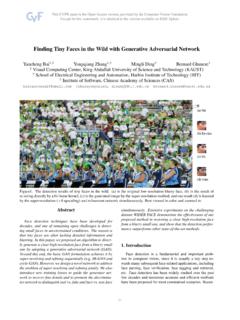
Finding Tiny Faces in the Wild With Generative Adversarial ...
openaccess.thecvf.comfaces, which are unfriendly for the face classifier. Toward-s this end, we design a refinement sub-network to recover some detailed information. In the discriminator network, the basic GAN [17, 12, 8] is trained to distinguish the real and fake high resolution images. To classify faces or non-
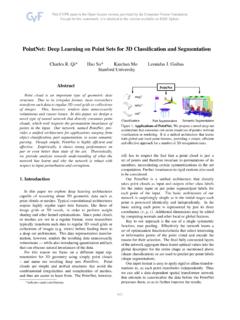
PointNet: Deep Learning on Point Sets ... - CVF Open Access
openaccess.thecvf.comPointNet: Deep Learning on Point Sets for 3D Classification and Segmentation Charles R. Qi* Hao Su* Kaichun Mo Leonidas J. Guibas Stanford University
ESRGAN: Enhanced Super-Resolution Generative Adversarial ...
openaccess.thecvf.comESRGAN: EnhancedSuper-Resolution Generative Adversarial Networks Xintao Wang 1, Ke Yu , Shixiang Wu2, Jinjin Gu3, Yihao Liu4, Chao Dong 2, Yu Qiao , and Chen Change Loy5 1 CUHK-SenseTime Joint Lab, The Chinese University of Hong Kong 2 Shenzhen Institutes of Advanced Technology, Chinese Academy of Sciences 3 The Chinese University of Hong Kong, …
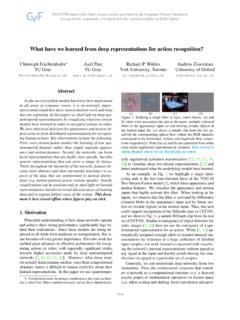
What Have We Learned From Deep Representations for …
openaccess.thecvf.comwhat these powerful models actually have learned. In this paper we shed light on deep spatiotemporal net-works by visualizing what excites the learned models us-ing activation maximization by backpropagating on the in-put. We are the first to visualize the hierarchical features
Squeeze-and-Excitation Networks - openaccess.thecvf.com
openaccess.thecvf.comSqueeze-and-Excitation Networks Jie Hu1∗ Li Shen2∗ Gang Sun1 hujie@momenta.ai lishen@robots.ox.ac.uk sungang@momenta.ai 1 Momenta 2 Department of Engineering Science, University of Oxford Abstract Convolutional neural networks are built upon the con-
RegularFace: Deep Face Recognition via Exclusive ...
openaccess.thecvf.comRegularFace: Deep Face Recognition via Exclusive Regularization Kai Zhao Jingyi Xu Ming-Ming Cheng ∗ TKLNDST, CS, Nankai University kaiz.xyz@gmail.com cmm@nankai.edu.cn
Protecting World Leaders Against Deep Fakes
openaccess.thecvf.comProtecting World Leaders Against Deep Fakes Shruti Agarwal and Hany Farid University of California, Berkeley Berkeley CA, USA {shrutiagarwal, hfarid}@berkeley.edu
Auto-DeepLab: Hierarchical Neural Architecture Search for ...
openaccess.thecvf.comAuto-DeepLab: Hierarchical Neural Architecture Search for Semantic Image Segmentation Chenxi Liu1∗, Liang-Chieh Chen 2, Florian Schroff2, Hartwig Adam2, Wei Hua2, Alan Yuille1, Li Fei-Fei3 1Johns Hopkins University 2Google 3Stanford University Abstract Recently, NeuralArchitectureSearch(NAS)hassuccess-
Frustum PointNets for 3D Object Detection From RGB-D Data
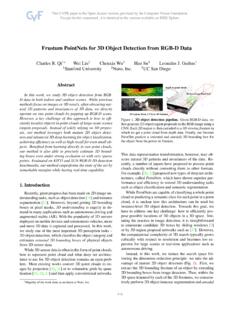
openaccess.thecvf.comFrustum PointNets for 3D Object Detection from RGB-D Data Charles R. Qi1∗ Wei Liu2 Chenxia Wu2 Hao Su3 Leonidas J. Guibas1 1Stanford University 2Nuro, Inc. 3UC San Diego Abstract In this work, we study 3D object detection from RGB-D data in both indoor and outdoor scenes.
Class-Balanced Loss Based on Effective Number of Samples
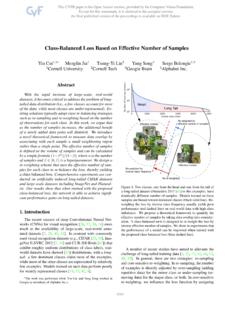
openaccess.thecvf.comand large-scale datasets including ImageNet and iNatural-ist. Our results show that when trained with the proposed class-balanced loss, the network is able to achieve signifi-cant performance gains on long-tailed datasets. 1. Introduction The recent success of deep Convolutional Neural Net-works (CNNs) for visual recognition [26, 37, 38, 16] owes
Related documents

Unsupervised Visual Representation Learning by Context ...
www.cv-foundation.orghigh-resolution natural images. Unsupervisedrepresentation learning can also be formu-lated as learning an embedding (i.e. a feature vector for each image) where images that are semantically similar are close, while semantically different ones are far apart. One way to build such a representation is to create a supervised
MagFace: A Universal Representation for Face Recognition ...
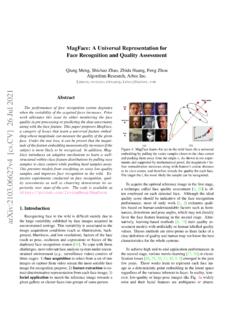
arxiv.orgnatively, learning-based methods [4,15] train quality as-sessment models with artificially or human labelled quality values. Theses methods are error-prone as there lacks of a clear definition of quality and human may not know the best characteristics for the whole systems. To achieve high end-to-end application performances in

Deep Bilateral Learning for Real-Time Image Enhancement
groups.csail.mit.eduan intermediate representation, a local affine color transformation that will be applied to the input through a new multiplicative node. 3) While most of our learning and inference is performed at low resolution, the loss function used during training is evaluated at full resolution, which causes the low-resolution transformations we

Abstract
arxiv.orglearning: modeling high-level representations from raw observations remains elusive. Further, it is not always clear what the ideal representation is and if it is possible that one can learn such a representation without additional supervision or specialization to a particular data modality.

Introduction - Deep Learning
www.deeplearningbook.orghuman time and e ffort; it can take decades for an entire community of researchers. The quintessential example of a representation learning algorithm is the au-toencoder. An autoencoder is the combination of an encoder function that converts the input data into a different representation, and a decoder function

Dual Super-Resolution Learning for Semantic Segmentation
openaccess.thecvf.comDual Super-Resolution Learning for Semantic Segmentation Li Wang1, ∗, Dong Li1, Yousong Zhu2, Lu Tian1, Yi Shan1 1 Xilinx Inc., Beijing, China. 2 Institute of Automation, Chinese Academy of Sciences, Beijing, China. {liwa, dongl, lutian, yishan}@xilinx.com, yousong.zhu@nlpr.ia.ac.cn Abstract Current state-of-the-art semantic segmentation method-

Knowledge Representation and Reasoning
web.stanford.edu– Knowledge Representation & Reasoning by Brachman & Levesque (available online) • Lectures – Tuesday and Thursday, 12:50-2:05, 300-300 • Grades – Four Assignments (40%), Mid-term (25%), Final (35%) • Prerequisites – First order logic and Resolution (at the level of CS157) • There will be two tutorial sections to cover this material

Natural Language Processing - Tutorialspoint
www.tutorialspoint.comlearning algorithms for language processing. Study of Human Languages Language is a crucial component for human lives and also the most fundamental aspect of our behavior. We can experience it in mainly two forms – written and spoken. In the written form, it is a way to pass our knowledge from one generation to the next. In the