
Upper Body: Thera Band Exercise Program - Basic
Hold the band with one hand at center of waist. Use other hand to hold the band out to the side, keeping elbow straight. Diagonal Pull . Start Position . Imagine the face of a clock to help you position arms properly. Begin by holding the band in your right hand at 4 o’clock. Hold the other end of the band in your left hand at 10 o’clock.
Download Upper Body: Thera Band Exercise Program - Basic

Information
Domain:
Source:
Link to this page:
Documents from same domain

Upper Body: Range of Motion Exercises for the Arms ...
www.sralab.orgScapular Exercises . Up/Down (elevation/depression) – seated or sidelying Hand/Start positions #1: Place one hand on the back, so that fingers line up with the

Upper Body: Arm Strengthening Exercises with Tabletop …
www.sralab.orgUpper Body: Arm Strengthening Exercises with Tabletop Support Author: Sarah Housman, MS, OTR/L These exercises for the joints of the arm can help: Strengthen weak arm muscles; Improve range of motion; Minimize stiffness and pain. Instructions Use the muscles of your weak arm as much as possible.
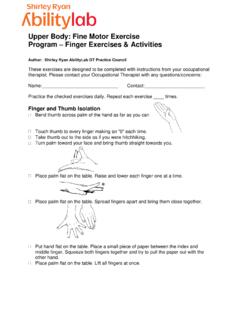
Upper Body: Fine Motor Exercise Program Finger Exercises ...
www.sralab.orgUpper Body: Fine Motor Exercise Program – Finger Exercises & Activities . Author: Shirley Ryan AbilityLab. OT Practice Council . These exercises are designed to be completed with instructions from your occupational
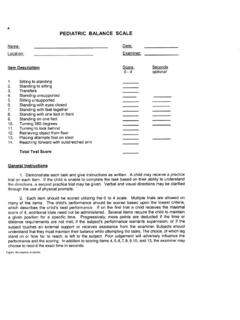
AbilityLab Home | Shirley Ryan AbilityLab
www.sralab.orgstationary foot. A taped line and/or footprints may be placed on the floor to help the child maintain a stationary foot position. In addition to a visual demonstration, a single physical prompt (assistance with placement) may be given. The child may be engaged in non-stressful conversation to maintain his/her attention span for 30 seconds.
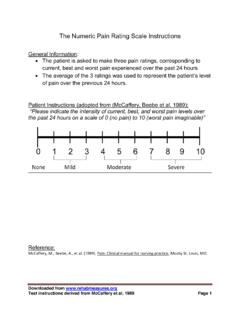
The Numeric Pain Rating Scale Instructions
www.sralab.orgThe Numeric Pain Rating Scale Instructions General Information: The patient is asked to make three pain ratings, corresponding to current, best and worst pain experienced over the past 24 hours. The average of the 3 ratings was used to represent the patient’s level of pain over the previous 24 hours.
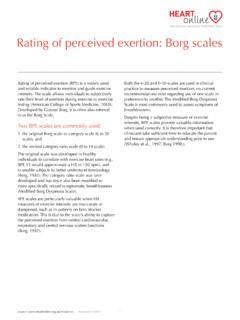
Rating of perceived exertion: Borg scales
www.sralab.orgRating of perceived exertion: Borg scales Rating of perceived exertion (RPE) is a widely used and reliable indicator to monitor and guide exercise intensity. The scale allows individuals to subjectively rate their level of exertion during exercise or exercise testing (American College of Sports Medicine, 2010).

CHEDOKE-McMASTER STROKE ASSESSMENT
www.sralab.orga clinical or research setting. ... If a client becomes excessively fatigued or apprehensive it is advisable to end the assessment. Client Comprehension of Instructions A therapist’s instruction, whether words or gestures, should be clear and concise. ... external rotation less than 60 ...
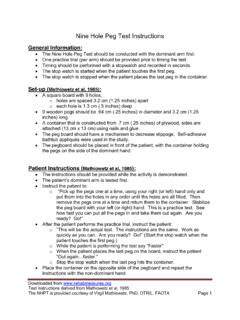
Nine Hole Peg Test Instructions - Shirley Ryan AbilityLab
www.sralab.orgNine Hole Peg Test Instructions General Information: The Nine Hole Peg Test should be conducted with the dominant arm first. One practice trial (per arm) should be provided prior to timing the test. Timing should be performed with a stopwatch and recorded in seconds. The stop watch is started when the patient touches the first peg.
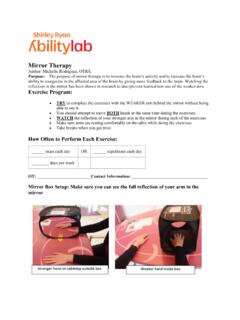
Mirror Therapy - Shirley Ryan AbilityLab
www.sralab.orgYun G., Chun M., Park J., Kim B. (2011) The synergic effect of mirror therapy and neuromuscular electrical stimulation for hand function in stroke patients. Annals of …

JFK Coma Recovery Scale-Revised - AbilityLab Home
www.sralab.orgNov 01, 2005 · COMA RECOVERY SCALE-REVISED ©2004 Administration and Scoring Guidelines Joseph T. Giacino, Ph.D. and Kathleen Kalmar, Ph.D. Center for Head Injuries Edison, New Jersey Johnson Rehabilitation Institution Affiliated with JFK Medical Center Updated 11-1-05
Related documents
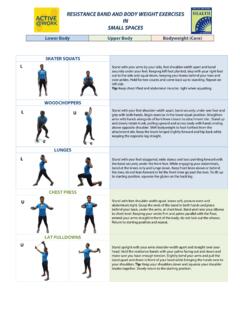
RESISTANCE BAND AND BODY WEIGHT EXERCISES IN …
uhs.berkeley.eduband directly in front of you with your arms straight. Stop once you reach the level of your shoulders. Keeping your core muscles tight, return the bands to the starting position. LATERAL RAISE : U Stand with your feet staggered and resistance band securely under your front foot. Hold the ends of the band with your palms facing inward.
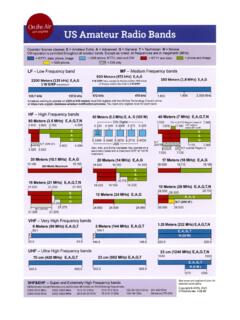
ARRL - Home
www.arrl.orgI-F — Low Frequency band 2200 Meters (135 kHz) 1 W EIRP maximum = cw only MF — Medium Frequency bands 630 Meters (472 kHz) 5 W EIRP max, except in Alaska within 496 miles of Russia where the limit is 1 W EIRP 479 kHz 472 kHz 160 Meters (1.8 MHz) 1.900 2.000 MHz 1.800 135.7 kHz 137.8 kHz
User Manual for Amazfit Band 5 - B&H Photo
www.bhphotovideo.comWhen the band is properly placed in the charging base, a charging icon appears on the band screen to indicate charging is in process. You can view the time, incoming call alerts, and app notifications while charging. We recommend charging the band with a mainstream phone charger or through a PC USB port.

Guide to Watch Band Sizing - Kohl's
www.kohls.comBand size is the combined length of the two straps. Standard lengths for women are 165mm-180mm; men are 184mm-197mm. To determine the length of your watch band follow these 4 steps. 1. Cut out the length chart below along the dotted lines. 2. Measure your wrist. 3. Measure the case size of the watch.

Upper and Lower Extremity: Resistance Band Exercise Program
www.med.umich.edub) Loop the band around the ball of your foot. c) Push down against the band like a gas pedal. d) Slowly return to starting position. Repeat on the other side. Standing Hip Exercises (8a-8d): Tie the band so it makes a loop. Open a door and place the knot of the band in the door jam. Close the door and make sure the band is secure.

GOES-16 Band Reference Guide - National Weather Service
www.weather.govABI Band #1 0.47 microns Visible (“Blue Band”) Primary Uses: Monitoring aerosols (smoke, haze, dust) Air quality monitoring through measurements of aerosol optical depth ABI Band #2 0.64 microns Visible (“Red Band”) Primary Uses: Daytime monitoring of clouds (0.5-km spatial res-olution) Volcanic ash monitoring ABI Band #3