Vector, Matrix, and Tensor Derivatives
taking the dot product between the 3rd row of W and the vector ~x: ~y 3 = XD j=1 W 3;j ~x j: (2) At this point, we have reduced the original matrix equation (Equation 1) to a scalar equation. This makes it much easier to compute the desired derivatives. 1.2 Removing summation notation
Download Vector, Matrix, and Tensor Derivatives

Information
Domain:
Source:
Link to this page:
Documents from same domain
NaveenAppiah SagarVare - Stanford University
cs231n.stanford.eduNaveenAppiah Mechanical Engineering nappiahb@stanford.edu SagarVare Stanford ICME svare@stanford.edu ... the popular mobile game - Flappy Bird. It involves navi-gating a bird through a bunch of obstacles. Though, this ... the game emulator and learns to make good decisions over time. It is this simple learning framework and their

Fei-Fei Li & Justin Johnson & Serena Yeung Lecture 2 ...
cs231n.stanford.eduFei-Fei Li & Justin Johnson & Serena Yeung Lecture 2 - April 6, 2017 Administrative: Piazza For questions about midterm, poster session, projects,

Lecture 9: CNN Architectures
cs231n.stanford.eduLecture 9 - 22 May 2, 2017 ImageNet Large Scale Visual Recognition Challenge (ILSVRC) winners First CNN-based winner. Fei-Fei Li & Justin Johnson & Serena Yeung Lecture 9 - 23 May 2, 2017 ImageNet Large Scale Visual Recognition Challenge (ILSVRC) winners ZFNet: Improved hyperparameters over AlexNet. Fei-Fei Li & Justin Johnson & Serena Yeung ...

Attention and Transformers Lecture 11
cs231n.stanford.edugraph with shared weights h 0 f W h 1 f W h 2 f W h 3 x 3 y T ... Extract spatial features from a pretrained CNN Image Captioning using spatial features 11 CNN Features: H x W x D h 0 [START] Xu et al, “Show, Attend and Tell: Neural Image Caption Generation with Visual Attention”, ICML 2015 z 0,0 z 0,1 z 0,2 z 1,0 z 1,1 z 1,2 z 2,0 z 2,1 z ...

CNNs for Face Detection and Recognition
cs231n.stanford.edudevelopment of object classification, localization and detec-tion techniques. 2.1. Sliding Window In the early development of face detection, researchers tended to treat it as a repetitive task of object classifica-tion, by imposing sliding windows and performing object classification with the neural networks on the window re-gion.
Lecture 14: Reinforcement Learning
cs231n.stanford.eduFei-Fei Li & Justin Johnson & Serena Yeung Lecture 14 - May 23, 2017 Markov Decision Process 19 - Mathematical formulation of the RL problem - Markov property: Current state completely characterises the state of the

Convolutional Neural Networks for Visual Recognition
cs231n.stanford.eduProgressive GAN, Karras 2018. Models from Single RGB Images”, ECCV 2018 Beyond recognition: Segmentation, 2D/3D Generation. Fei-Fei Li, Ranjay Krishna, Danfei Xu Lecture 1 - 15 March 30, 2021 Scene Graphs Krishna et al., Visual Genome: Connecting Vision and Language using Crowdsourced Image Annotations, IJCV 2017

Lecture 11: Detection and Segmentation
cs231n.stanford.eduFei-Fei Li & Justin Johnson & Serena Yeung Lecture 11 - 1 May 10, 2017 Lecture 11: Detection and Segmentation

Lecture 13: Generative Models
cs231n.stanford.eduFei-Fei Li & Justin Johnson & Serena Yeung Lecture 13 - May 18, 2017 Generative Models 17 Training data ~ p data (x) Generated samples ~ p model (x) Want to learn p

Lecture 10: Recurrent Neural Networks
cs231n.stanford.eduimage -> sequence of words. Fei-Fei Li & Justin Johnson & Serena Yeung Lecture 10 - 13 May 4, 2017 Recurrent Neural Networks: Process Sequences e.g. Sentiment Classification sequence of words -> sentiment. Fei-Fei Li & Justin Johnson & Serena Yeung Lecture 10 - 14 May 4, 2017
Related documents
Introduction to Matrix Algebra - Institute for Behavioral ...
ibgwww.colorado.eduIn scalar algebra, the inverse of a number is that number which, when multiplied by the original number, gives a product of 1. Hence, the inverse of x is simple 1/x. or, in slightly different notation, x− 1. In matrix algebra, the inverse of a matrix is that matrix which, when multiplied by the original matrix, gives an identity matrix.
Vector Algebra and Calculus - University of Oxford
www.robots.ox.ac.ukGeometrical interpretation of scalar triple product 2.4 •The scalar triple product gives the volume of the parallelopiped whose sides are represented by the vectors a, b, and c. a b c β ccosβ •Vector product (a×b) has magnitude equal to the area of …

Cross Product - Illinois Institute of Technology
web.iit.eduCross Product Note the result is a vector and NOT a scalar value. For this reason, it is also called the vector product. To make this definition easer to remember, we usually use determinants to calculate the cross product.
Vectors and Vector Spaces - Texas A&M University
www.math.tamu.eduthe inrner product of x and w by x · w = x1w1 + x2w2 + x3w3. Then U w = {x ∈R3 | x · w =0} is a subpace of R3. To prove this it is neces-sary to prove closure under vector addition and scalar multiplication. The latter is easy to see because the inner product is homogeneous in α, that is, (αx) · w = αx1w1 + αx2w2 + αx3w3 = α(x·w ...
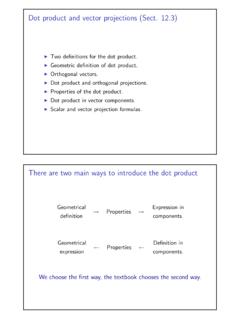
Dot product and vector projections (Sect. 12.3) There are ...
users.math.msu.eduDot product and vector projections (Sect. 12.3) I Two definitions for the dot product. I Geometric definition of dot product. I Orthogonal vectors. I Dot product and orthogonal projections. I Properties of the dot product. I Dot product in vector components. I Scalar and vector projection formulas. There are two main ways to introduce the dot product Geometrical
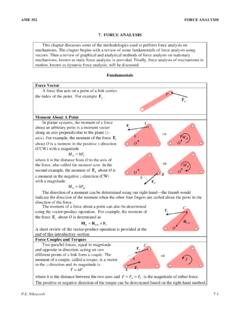
7. FORCE ANALYSIS Fundamentals - University of Arizona
www.u.arizona.eduThe analytical scalar product can be computed in two ways depending on how the vectors are defined: (a) The magnitudes of the vectors are known as F and V, and the angle between the two vectors is known as θ. The scalar product is computed as FŁV = FV cosθ The angle can be measured from F to V or vice versa.

Cross product - Massachusetts Institute of Technology
math.mit.eduscalar product is (~u ~v) w~. The triple scalar product is the signed volume of the parallelepiped formed using the three vectors, ~u, ~vand w~. Indeed, the volume of the parallelepiped is the area of the base times the height. For the base, we take the parallelogram with sides ~uand ~v. The magnitude of ~u ~v
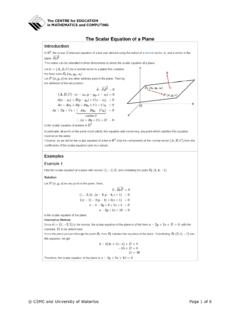
The Scalar Equation of a Plane - University of Waterloo
courseware.cemc.uwaterloo.caThe cross product of these two vectors gives a vector that is perpendicular to both, and hence perpendicular to the plane (that is, a normal to the plane). (—7, 25, —2) Thus, the scalar equation of the plane is of the form —7m + 25y — 2z + D Substituting the point (1, 1, 0), we get o o The scalar equation of the plane is
Math 110: Worksheet 1 Solutions
math.berkeley.eduthat V is closed under the addtion and scalar multiplication operations: for 1 a b 1 ; 1 c d 1 2V and k 2R, we have 1 a b 1 1 c d 1 = 1 a+ c b+ d 1 2V and k 1 a b 1 = 1 ka kb 1 2V: 1. VS 1: Observe that 1 a b 1 1 c ... product ee0. By thinking of e as an identity, we have ee0= e0. Likewise, thinking of