
Water - NCERT
form huge waves. These may cause tremendous destruction. An earthquake, a volcanic eruption or underwater landslides can shift large amounts of ocean water. As a r esult a huge tidal wave called tsunami , that may be as high as 15m., is formed. The largest tsunami ever measured was 150m. high. These waves travel at a speed of more than 700 km ...
Download Water - NCERT

Information
Domain:
Source:
Link to this page:
Documents from same domain
ntse exam notification - National Council Of …
ncert.nic.inExamination: The tentative pattern of written examination will be as follows: Stage-I & Il : examination at the State/UT level will comprise of three papers i.e.
14 Effects Electric Current and Its - National …
ncert.nic.in76 EXEMPLAR PROBLEMS 3. Three bulbs A, B, C are connected in a circuit as shown in Figure 14.2. When the switch is ‘ON’ (a) bulb C will glow first. (b) bulb B and C will glow simulaneously and bulb A will

SEMICONDUCTOR AND SIMPLE CIRCUITSnot to be …
ncert.nic.in469 Semiconductor Electronics: Materials, Devices and Simple Circuits semiconductors. However , after 1990, a few semiconductor devices using organic semiconductors and semiconducting polymers have been
ENVIRONMENTAL CHEMISTRY - National Council …
ncert.nic.in400 CHEMISTRY (c) Hydrocarbons: Hydrocarbons are composed of hydrogen and carbon only and are formed by incomplete combustion of fuel …
LAWS OF MOTION
ncert.nic.inLAWS OF MOTION 91 In practice, the ball does come to a stop after moving a finite distance on the horizontal plane, because of the opposing force of friction which
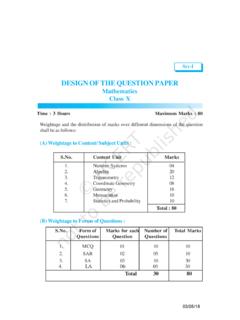
DESIGN OF THE QUESTION PAPER Mathematics …
ncert.nic.inDESIGN OF THE QUESTION PAPER, SET-I 207 (A) 18 5 (B) 17 5 (C) 17 8 (D) 1 7. In the adjoining figure, PA and PB are tangents from a point P to a circle with centre O.
CHAPTER 10
ncert.nic.in(A) Main Concepts and Results Circle, radius, diameter , chord, segment, cyclic quadrilateral. • Equal chords of a circle (or of congruent circles) subtend equal angles at the
INDIA : CLIMATE, VEGETATION AND WILDLIFE
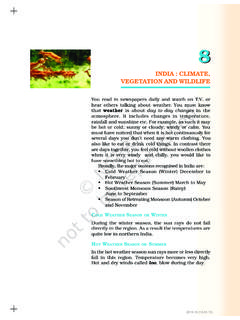
ncert.nic.inINDIA : CLIMATE, VEGETATION AND WILDLIFE 59 year. Therefore, they always appear gr een and are called evergreen forest as you may notice in Figure
Objectives Polymers - National Council of …
ncert.nic.in427 Polymers C:\Chemistry-12\Unit-15.pmd 28.02.07 Polymers can also be classified on the basis of mode of polymerisation into two sub groups.
TEXTBOOK IN GEOGRAPHY FOR CLASS IX
ncert.nic.inFOREWORD The National Curriculum Framework, (NCF) 2005, recommends that children’s life at school must be linked to their life outside the school. This principle
Related documents
Waves in the Ocean - FCIT
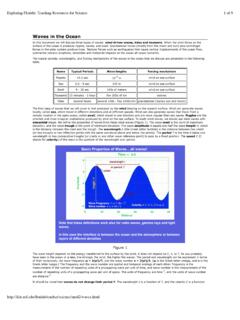
fcit.usf.eduWaves in the Ocean In this document we will discuss three types of waves: wind-driven waves, tides and tsunamis. When the wind blows on the surface of the ocean it produces ripples, waves, and swell. Gravitational forces (mostly from the moon and sun) plus centrifugal
The 1964 Great Alaska Earthquake and Tsunamis—A …
pubs.usgs.govthe uplifts and tsunamis produced by the 1964 earthquake were greater than those generated by displacement in the subduction zone itself. These secondary ruptures were commonly located closer to shore, reducing the travel and warning times of the waves. After the 1964 earthquake, vertical uplifts of 36 feet were mapped along splay faults on ...

Introduction To Physical Oceanography
earthweb.ess.washington.eduProfessor Fred Schlemmer at Texas A&M Galveston who, after using the book for his classes, has provided extensive comments about the material. I also wish to thank many colleagues for providing figures, comments, and helpful information. I especially wish to thank Aanderaa Instruments, Kevin
All About Tsunamis: The Science Behind Tsunamis
nhmu.utah.eduTsunamis, also known as seismic sea waves (mistakenly called “tidal waves”), are a series of enormous waves created by an underwater disturbance such as an earthquake, landslide, volcanic eruption, or meteorite. A tsunami can move hundreds of miles per hour in the open ocean and smash into land with waves as high as 100 feet or more.
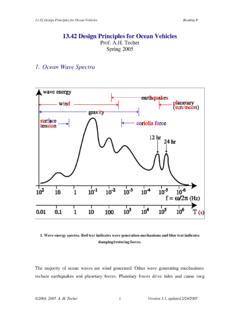
1. Ocean Wave Spectra - MIT OpenCourseWare
ocw.mit.eduFeb 24, 2005 · Earthquakes are the major cause of tsunamis which, while rare, can be catastrophic if the earthquake occurs near or on the coast. Waves also encounter forces that tend to restore them to a flat surface. For small wavelength (high frequency) waves surface tension plays a large role in damping out these ... M o , which may be defined in terms of ...
Geological Hazards: Earthquakes, Landslides and Tsunamis
www.eolss.netUNESCO – EOLSS SAMPLE CHAPTERS NATURAL AND HUMAN INDUCED HAZARDS – Vol. I - Geological Hazards: Earthquakes, Landslides and Tsunamis - Li Juan and Chen Yong ©Encyclopedia of Life Support Systems (EOLSS) magnitude m=5.5 (which is the same as that released by the explosion of the atomic bomb in Hiroshima in 1945), and the seismic energy …
![Natural Disasters | 5E Lesson Plan for Grades 3-5 [PDF]](/cache/preview/8/0/9/c/e/7/2/f/thumb-809ce72f931e610fe94c698182f94da5.jpg)
Natural Disasters | 5E Lesson Plan for Grades 3-5 [PDF]
www.generationgenius.comdangerous the waves of tsunamis are. Station 3 demonstrated the role plate boundaries play in causing earthquakes, subduction, creating volcanoes, and forming mountains. Station 4 provided an opportunity for students to discuss what happens to organisms and the environment when volcanoes erupt.
Effects of the December 2004 Indian Ocean Tsunami on the ...
www.iitk.ac.inhas experienced tsunamis earlier. The earliest record dates back to 31 December 1881, when a tsunami 1mhigh was recorded in Chennai. It was caused by an earthquake of M=7.9 below Car Nicobar Island.TheAugust 1883 eruption of the Krakatoa volcano in Indonesia caused 2-m-high tsunami waves in Chennai. On 26 June 1941, an M=8.1
Mangroves for coastal defence - The Nature Conservancy
www.nature.orgTsunamis These are rare events and local knowledge or memory may be misleading. Data on seismic activity and proximity to seismically active regions, along with long-term historical data and geomorphological data (seabed, coastal profile), can help to assess the risk and potential intensity of tsunami waves. Wind and swell waves