
Waves - physicsclassroom.com
5. As mechanical waves move through a medium, particles of the medium undergo a periodic and repeated vibration about a fixed position. 6. Describe how a wave is different than a pulse. 7. Mechanical waves propagate or move through a medium because _____. a. the particles of the medium are able to move along the curved wavelike pathway b.
Download Waves - physicsclassroom.com

Information
Domain:
Source:
Link to this page:
Documents from same domain

Electrical Power and Energy - The Physics Classroom
www.physicsclassroom.comElectric Circuits Name: © The Physics Classroom, 2009 Page 1 Electrical Power and Energy Read from Lessons 2 and 3 of the Current Electricity chapter at The Physics …

Electrical Power and Energy - Physics
www.physicsclassroom.comElectric Circuits Name: © The Physics Classroom, 2009 Page 1 Electrical Power and Energy Read from Lessons 2 and 3 of the Current Electricity chapter at The Physics …
Lesson 1 Sound and Music The Physics Classroom
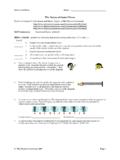
www.physicsclassroom.comSound and Music Name: © The Physics Classroom, 2009 Page 1 The Nature of Sound Waves Read from Lesson 1 of the Sound and Music chapter at The Physics Classroom…

Sound and Music Notebook - Scoring Rubric - …
www.physicsclassroom.comSound and Music Notebook - Scoring Rubric Your notebook will be collected at the end of class on _____, _____ _____. The following items should be in your notebook.
r (m) I (W/m2 Table 1 I r Table 2 - The Physics …
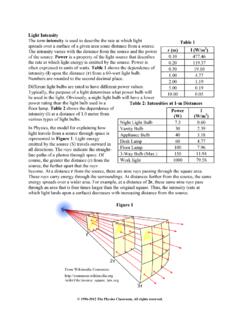
www.physicsclassroom.com© 1996-2012 The Physics Classroom, All rights reserved. Questions: 1. Which one of these statements describes the dependence of intensity upon distance from the

Table 1 Figure 2 - The Physics Classroom
www.physicsclassroom.com© 1996-2012 The Physics Classroom, All rights reserved. Questions: 1. Which statement describes the relationship between the angle of incidence (Θ
Describing Motion Verbally with Distance and …
www.physicsclassroom.com7. You run from your house to a friend's house that is 3 miles away. You then walk home. a. What distance did you travel? _____ b.
r (m) I (W/m2 Table 1 I r Table 2
www.physicsclassroom.com© 1996-2012 The Physics Classroom, All rights reserved. Questions: 1. Which one of these statements describes the dependence of intensity upon distance from the
Describing Motion Verbally with Distance and …
www.physicsclassroom.comDescribing Motion Verbally with Distance and Displacement Read from Lesson 1 of the 1-D Kinematics chapter at The Physics Classroom: http://www.physicsclassroom.com/Class/1DKin/U1L1a.html

The Lens Equation Lab - The Physics Classroom
www.physicsclassroom.comThe Laboratory © The Physics Classroom, 2009 The Lens Equation Lab Teacher’s Guide Topic: Refraction and
Related documents
Waves and Sound - bowlesphysics.com
bowlesphysics.comWaves and Sound AP Physics B. ... A MEDIUM is the substance that all SOUND WAVES travel through and need to have in order to move. Two types of Waves The first type of wave is called Longitudinal. Longitudinal Wave - A fixed point will move parallel with the wave motion 2 areas
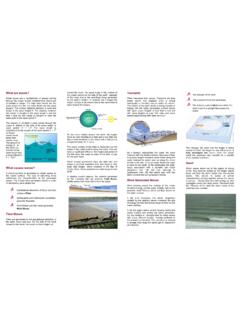
What are waves? Tsunamis m - COSEE NOW
coseenow.netwaves move faster than shorter ones. The amount of energy, E, in the wave is a function of the wave height and is proportional to: E ~ 1/8 H2. What causes waves? w A disturbing force is necessary to create waves on the ocean surface. The type of disturbing force determines the characteristics of the generated waves.

Waves - cstephenmurray.com
cstephenmurray.comwaves it is the water molecules. The water is compressed and expanded to cause the up and down (oscillating) motion. All waves do this with molecules they travel through. Two Types of Waves Speed and Wavelength Waves can go through things: waves go through water; light waves can go through your skin; sound waves can goes through walls.

Lecture 11 Chapter 16 Waves I - people.Virginia.EDU
people.virginia.eduTraveling waves Waves propagate from one place to another: From source to detector Sound from an instrument to ear Cell phone to cell tower and vice versa - E/M waves Water waves - a disturbance in the water moves outward. y(x,t)=y m sin(kx−ωt) A traveling wave can be represented as any function of kx-wt such that kx-wt is a constant.

Waves in Water Waves and Sound - phys.unm.edu
phys.unm.eduWaves and Sound What is a wave? What are the main properties of waves? What two things do all waves transport? Waves in Water Vibration What sets waves into motion? How does the vibration frequency relate to the frequency of the wave created? DEMO - Harmonic Oscillator Waves are a type of disturbance that can propagate or travel.

The Electromagnetic Spectrum—Answer Key - uwyo.edu
physics.uwyo.eduThe Electromagnetic Spectrum—Answer Key Radio Waves • Longest wavelength lowest frequency • Wavelength range: 106m to 1m • Usually described by their frequency • Different types of radio waves (from high f to low f are: RADAR, CB (Citizen’s Band), FM, …

Chapter II-5 - WaveMetrics
wavemetrics.netChapter II-5 — Waves II-58 An array in a standard language has a name (array0 in this case) and a number of values.We can reference a particular value using an index. A wave also has a name (wave0 in this case) and data values.It differs from the array in that it has two indi- ces.
MECHANICAL WAVES AND SOUND - UCSB Physics
web.physics.ucsb.eduTransverse vs. Longitudinal Waves Two different motions to describe in a wave: – Motion of the wave's energy – Motion of individual molecules of the wave Transverse waves → Two motions are perpendicular – Waves on a string, water surface waves Longitudinal waves → Two motions are parallel – Sound waves Waves can have both transverse and longitudinal motion

AP1 Waves - APlusPhysics
www.aplusphysics.comAP1 Waves Difficulty: 1 Page 3 3. A transverse wave travels in medium X with a speed of 800 m/s and a wavelength of 4 m. The wave then moves into medium Y, traveling with a speed of 1600 m/s.

Unit 2 Worksheet 5 - Aurora High School
www.aurora-schools.orgKey for Waves Unit 2, Worksheet 5 1. The illustration below shows a series of transverse waves. Label each part in the space provided. a. crest b. wavelength c. amplitude d. trough e. amplitude f f. wavelength g. equilibrium position Fill in the blanks: 2. Waves carry energy from one place to another.