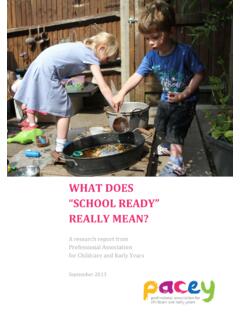
WHAT DOES “SCHOOL READY” REALLY MEAN?
based approach of the Foundation Phase in Wales which supports children from 3 to 7 years. 4) Almost half of all respondents – childcare professionals, parents and teachers alike –identified a lack of communication and common expectation between each other as a barrier to preparing a child for school. Starting school is a time of transition.
Download WHAT DOES “SCHOOL READY” REALLY MEAN?

Information
Domain:
Source:
Link to this page:
Documents from same domain
Working Together to Safeguard Children - Guide
www.pacey.org.uktogether by placing new duties on the police, clinical commissioning groups and the local authority to make arrangements to work together and with other partners locally to safeguard and promote the welfare of all children in their area.
Supporting members to provide the highest standards of ...
www.pacey.org.ukPG04 ST/dev/TJ/v5/180416 © Professional Association for Childcare and Early Years 2016 2. Why is reflective practice important? Reflection is an important part of ...
The role of childcare professionals in supporting mental ...
www.pacey.org.uk“At present, 1 in ten children and young people suffer from mental health problems. Evidence of symptoms are demonstrated through depression, anxiety and behavioral disorders. Positive mental health enables children to develop their resilience and grow into well-rounded adults. Recent research suggests that children are more likely to suffer from
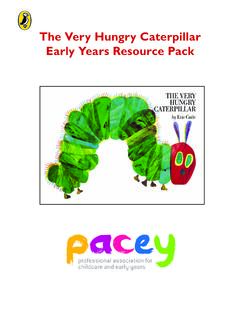
The Very Hungry Caterpillar Early Years Resource Pack
www.pacey.org.ukEarly years and childcare professionals play a key role in identifying these differences and supporting individual children to learn. Where children have English as an additional language, it’s important to share stories in their home language as well. A richly visual book, such as .

PreParing your child for starting school
www.pacey.org.ukwith other adults, taking some responsibility for tidying up after themselves and looking after their own belongings. Don’t worry if your child hasn’t attended a childcare setting or preschool. Playing with other children, whether friends and family members, …
Supporting members to provide the highest standards of ...
www.pacey.org.uk• Numbers • Shape, Space and Measures The aspect of Numbers includes numbers as labels and for counting and calculating. Evidence from EYFS profiles demonstrated that children were able to recognise numbers but struggled to use any numerical understanding to solve problems or calculate. The aspects aim to encourage children to develop

Coronavirus (COVID-19) risk assessment
www.pacey.org.ukmeal times, either by staggering groups (cleaning in between) or by spreading the chairs further apart. Make a consistent plan with families about which children come on which days. Look at thespace in setting to see if anything can be rearranged to create different areas for the to play in. Review garden and outdoor space
Theories of Child Development - PACEY
www.pacey.org.ukThe theories that we will consider in this practice guide have been developed from observational research. In the most part the theorist has made an attempt to explain certain ... interests and learning styles and then provide suitable learning opportunities. Wales In the Foundation Phase by observing children while they are involved in activities,
Child Observations - PACEY
www.pacey.org.uk“Assessment should not entail prolonged breaks from interaction with children, nor require excessive paperwork.” (EYFS 2.2, P13, EYFS 2014) Elements of a good observation Carried out when the child is engaged in a freely chosen activity You will learn much more about a child’s interests, their characteristics of learning, and their

Early years: working in partnership
www.pacey.org.ukEarly years settings, including nurseries, pre-schools and childminders, met with teaching staff to talk through a shared plan for transition, including shared goals and expectations. School staff and early years representatives from ... Karen Jeffries Childminder, Cambridgeshire Through Starting School Together, we saw heightened levels of ...
Related documents
What challenges do foundation phase teachers experience ...
www.scielo.org.zaWhat challenges do foundation phase teachers experience when teaching writing in rural multigrade classes? Abstract A one-size-fits-all curriculum cannot address the issues faced by rural multigrade teachers and learners. In South Africa, …

(PDF) Thinking Skills in the Early Years
www.nicurriculum.org.ukis owed to the teachers, principals and above all the children who combined so agreeably to make the study a most interesting and enjoyable experience and, ... Thinking Skills and Personal Capabil ities is an integral feature of the Foundation Stage Curriculum (CCEA, 2007), which is to become a requirement in all Year 1 ... • Tuning in phase ...

MEMORY - American Psychological Association
www.apa.orgories, while those with frontal lobe damage may experience deficits in working memory. 2. explicit memory is measured with explicit memory tests, such as recall and recognition, in which an individual is fully aware that he or she is being tested. 3. it generally declines with age. b. examples include recalling the name of an old friend, remember-

English as an Additional Language or Dialect: Teacher Resource
docs.acara.edu.auphase are new to written English, although they may have some experience in another language. In this phase, they begin to copy writing from the school environment and use beginning knowledge of English sounds and symbols to write and understand the concept of a word, and that speech can be written down, read and reread. • Students: •

Foundation Phase Outdoor Learning Handbook
hwb.gov.walesFoundation Phase Outdoor Learning Handbook The Forest School approach to children’s development and learning complements the Foundation Phase pedagogy. A number of settings/schools have developed their own Forest School areas, while others visit designated areas in the community. The sessions are led by a qualified forest school

STUDENT TEACHERS EXPERIENCES OF TEACHING PRACTICE …
files.eric.ed.govteaching, student teachers experience a learning situation that is unique and different from campus-based learning as they are called upon to respond to new circumstances. In ... Foundation Phase, the Intermediate and Senior Phase, and the Senior and Further ...

COGNITIVE LEVELS OF ASSESSMENT
www.shuters.co.za• Baseline assessment – is usually used at the beginning of a phase, grade or learning experience to establish what learners already know or what they can do. It assists teachers with the planning of learning activities or programmes. • Formative assessment – is developmental. It is used by teachers to provide

Teacher Retention: Problems and Solutions
files.eric.ed.govteachers, induction programs for beginning teachers, and replacement do to attrition (Darling-Hammond, L.,2003). According to Darling-Hammond (2003) the five year teacher education program is a solution that could possibly decrease the large amounts of teachers fleeing the field. Another contributing factor of early departure of educators is due to
Letters and Sounds: Phase Four - Foundation Years
foundationyears.org.ukPhase Four 0 Summary Children entering Phase Four will be able to represent each of 42 phonemes by a grapheme, and be able to blend phonemes to read CVC words and segment CVC words for spelling. They will have some experience in reading simple two-syllable words and captions. They will know letter names and be able to read and spell some tricky ...
Related search queries
Do foundation phase teachers experience, Do foundation phase teachers experience when teaching writing, Teachers, Experience, Foundation, Phase, American Psychological Association, Foundation Phase Outdoor Learning, Foundation Phase, Teachers experience, COGNITIVE LEVELS OF ASSESSMENT, Teacher Retention: Problems and Solutions, Letters and Sounds: Phase Four