
Working Safely with Electricity
Power Lines Overhead and buried power lines are especially hazardous because they carry dangerously high voltage. Fatal electrocution is the main risk, but burns and falls are also hazards. • Look for overhead power lines and buried power line indicators. • Stay at least 10 feet away from overhead power lines and assume they are energized.
Download Working Safely with Electricity

Information
Domain:
Source:
Link to this page:
Documents from same domain

Motor Vehicles Safe Driving Practices for Employees
www.osha.govMotor Vehicles Safe Driving Practices for Employees You are your employer’s most valuable asset! The way that you drive says everything about you and your
U. S. Department of Labor Occupational Safety and …
www.osha.govU. S. Department of Labor Occupational Safety and Health Administration Notice of Alleged Safety or Health Hazards . For the General Public: This form is provided for the assistance of any complainant and is not intended to constitute the exclusive means by

Controlling Hazardous Fume and - osha.gov
www.osha.govFactSheet Controlling Hazardous Fume and Gases during Welding Welding joins materials together by melting a metal work piece along with a …

OSHA 3220-10N 2004
www.osha.govWORKER SAFETY SERIES WAREHOUSING 11 Hazards & Solutions Warehouse operations can present a wide variety of potential hazards for the worker. For warehousing establishments, the

Job Safety and Health - osha.gov
www.osha.govJob Safety and Health. IT’S THE LAW! All workers have the right to: A safe workplace. Raise a safety or health concern with your employer or OSHA, or report a work-
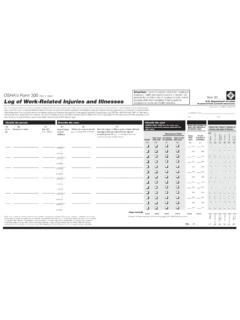
Year 20 Log of Work-Related Injuries and Illnesses
www.osha.govU.S. Department of Labor Occupational Safety and Health Administration OSHA’s Form 300 (Rev. 01/2004) Year 20__ __ Log of Work-Related Injuries and Illnesses You must record information about every work-related death and about every work-related injury or illness that involves loss of consciousness, restricted work activity or job transfer,
DEPARTMENT OF LABOR 29 CFR Part 1904
www.osha.gov2 The final rule also revises the requirements for reporting work-related fatality, injury, and illness information to OSHA. The current regulation requires employers to report …
CRANES AND DERRICKS IN CONSTRUCTION FINAL …
www.osha.govOSHA is making this document, the regulatory text, available for informational purposes only. This action does not affect the effective date of the final rule on Cranes and Derricks in Construction, which will be 90

Preventing Mold-Related Problems in the Indoor …
www.osha.govIntroduction This guide provides basic information about mold, mold sources, and building-related illnesses. Brief discussions are included on building design considerations for healthy indoor air,
HazardCommunicationGuidancefor CombustibleDusts
www.osha.govU.S.DepartmentofLabor OccupationalSafetyandHealthAdministration OSHA3371-08 2009 HazardCommunicationGuidancefor CombustibleDusts Occupational Safety and Health Act of 1970
Related documents
The Electricity Act 2003 - Ministry of Power
powermin.gov.inTHE ELECTRICITY ACT, 2003 [No. 36 OF 2003] An Act to consolidate the laws relating to generation, transmission, distribution, trading and use of electricity and generally for taking measures conducive to ... transmission lines or distribution system or associated facilities with

Planning and amenity aspects of high voltage electricity ...
www.nationalgrid.comelectricity, and the stations are generally sited to be close to fuel and cooling water rather than to be near centres of demand. Electricity is then transmitted from the power stations through a national network of electricity lines which operate at high voltage. National Grid owns the electricity transmission network in England

MINISTRY OF LAW AND JUSTICE (Legislative Department)
cercind.gov.inpurpose of receiving electricity with the works of a licensee, the Government or such other person, as the case may be; (16) “dedicated transmission lines" means any electric supply-line for point to point transmission which are required for the purpose of connecting electric lines or electric plants of a captive generating plant referred to

ELECTRICITY & MAGNETISM Lecture notes for Phys 121
web.njit.eduJan 11, 2022 · 1. Representation of a field; field lines 10 2. Properties of field lines and related definitions 10 II. Electric Charge 12 A. Notations and units 12 B. Superposition of charges 12 C. Quantization of charge 12 D. Charge conservation 12 E. The Coulomb’s Law 14 F. Superposition of forces 15 G. Reaction of a charge to electrostatic and other ...

Undergrounding high voltage electricity transmission lines
www.nationalgrid.comelectricity lines, compared with installing overhead lines. Overall, there are a number of issues that make the undergrounding option more technically challenging and expensive. However, despite the costs and technical challenges, there are circumstances in which underground cables are a more preferable option than overhead cables.

Electricity Entity Requirements - Working Near Overhead ...
www.energex.com.auThis guide to working near the Electricity Entity network is designed to assist any person working, contemplating work or operating plant near any Electricity Entity overhead or underground electric lines to meet their duties under the Work Health and Safety Act 2011, Electrical Safety Act 2002,

U.S. Scouting Service Project
www.usscouts.orgWhen using ladders, watch out for overhead wires and power lines. Stay at least 10 feet from all overhead lines. Lightning During an electrical storm, do not use appliances (i.e., hairdryers, toasters and radios) or telephones (except in an emergency); do not take a bath or shower;

Working safely near overhead electricity power lines AIS8
www.hse.gov.ukelectricity power lines Introduction This information sheet is aimed at everyone in agriculture who may work near overhead electricity power lines (OHPLs) and outlines what you can do to reduce the risks of electric shock when working near them. If a machine or other conductive item of equipment comes into contact with a live OHPL, electricity will