
WRITING TOTAL AND NET IONIC EQUATIONS
4. For the total ionic equations, write insoluble substances as the total compound (in their molecular form). Unstable substances are written in their decomposed forms. These substances include (with examples): (a) precipitates or insoluble reactants (b) gases (c) derived from unstable substances CaCO 32 (s) CO (g) If NH 4 OH, write NH 3 (aq ...
Download WRITING TOTAL AND NET IONIC EQUATIONS

Information
Domain:
Source:
Link to this page:
Documents from same domain

CHAPTER Classification and Assessment of …
www.csun.eduCHAPTER Classification and Assessment of Abnormal Behavior CHAPTER OUTLINE HOW ARE ABNORMAL BEHAVIOR PATTERNS CLASSIFIED? 70–77 The DSM and Models of Abnormal Behavior STANDARDS OF ASSESSMENT 77–80 Reliability Validity Cognitive Assessment

Dissociative and Somatoform Disorders
www.csun.edu212 Chapter 7 In early versions of the DSM, dissociative and somatoform disorders were classified with the anxiety disorders under the general category of …
Chapter 3: Solutions of Homework Problems …
www.csun.edu3 – 1 Chapter 3: Solutions of Homework Problems Vectors in Physics 12. as drawn at Picture the Problem: The given vector components correspond to the vector r & right.
PRIMARY CONTENT MODULE Algebra - Linear …
www.csun.eduPRIMARY CONTENT MODULE Algebra - Linear Equations & Inequalities T-37/H-37 © 1999, CISC: Curriculum and Instruction Steering Committee The WINNING EQUATION
Chapter 8: Quantitative Sampling
www.csun.edu22 Chapter 8: Quantitative Sampling I. Introduction to Sampling a. The primary goal of sampling is to get a representative sample, or a small collection of units
th - csun.edu
www.csun.eduRunning head: APA FORMAT EXAMPLE 1 How to Do that Annoying APA Format Stuff: A Brief Overview of the 6th Edition Scott W. Plunkett California State University, Northridge
Calculations and Occupational Exposure Limits
www.csun.eduCalculations Evaluation Control 3 5 OELs • Time-weighted average (TWA) • Ceiling value (C) • Short-Term Exposure Limit (STEL) • Immediately Dangerous to Life and Health
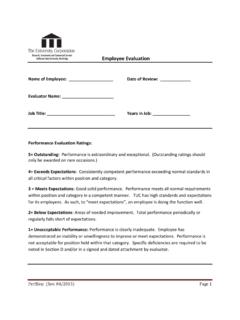
Employee Evaluation - California State University, …
www.csun.eduPerfEval (Rev. 04/2013) Page 3 Performance Categories Rating Ethics/Fraud/Integrity Practices excellent work ethics. Properly handles confidential information.

The Great Depression: California in the Thirties
www.csun.eduThe Great Depression: California in the Thirties . California was hit hard by the economic collapse of the 1930s. Businesses failed, workers lost …
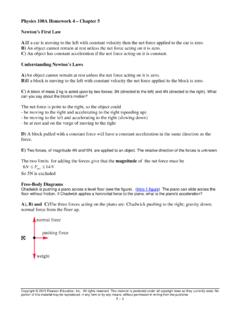
Physics 100A Homework 4 – Chapter 5 Newton’s …
www.csun.eduChapter 5: Newton’s Laws of Motion thJames S. Walker, Physics, 4 Edition C) and D) Magnitude and direction of the acceleration
Related documents

Ionic Compound Formula Writing Worksheet
msbunney.weebly.comIonic Compound Naming – Chilton Honors Chemistry Chemical Formula Writing Worksheet Solutions Write chemical formulas for the compounds in each box. The names are found by finding the intersection between the cations and anions. Example: The first box is the
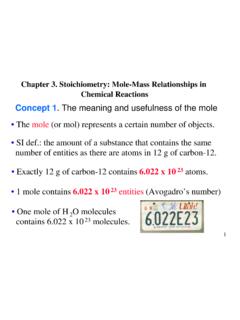
Chapter 3. Stoichiometry: Mole-Mass Relationships in ...
www.uh.eduSkill 3-4 : Analysis of a sample of ionic compound gave: 2.82 g Na, 4.35 g Cl, and 7.83 g O. What is the empirical formula and name of the compound? 17 Plan: Solution: Find moles of elements: From the moles of each element, construct a …

WORKSHEET: Chemical Bonding – Ionic & Covalent!
www.johnbowne.orgDec 18, 2015 · PART 2: Use Lewis dot structures to show the ionic bonding in the following pairs of elements.Show the transfer of electrons using arrows. Write the correct chemical formula for the ionic compound that forms. 1) barium oxide (Ba and O) 4) sodium oxide (Na and O)
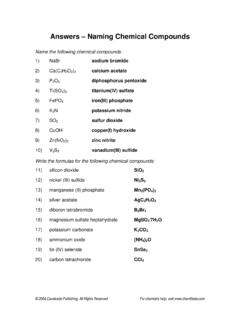
Answers – Naming Chemical Compounds
www.npsd.k12.nj.usIonic/Covalent Compound Naming Solutions . For each of the following questions, determine whether the compound is ionic or covalent and name it appropriately. 1) Na2CO3 sodium carbonate. 2) P2O5 diphosphorus pentoxide. 3) NH3 ammonia. 4) FeSO4 iron (II) sulfate. 5) SiO2 silicon dioxide. 6) GaCl3 gallium chloride. 7) CoBr2 cobalt (II) bromide. 8 ...

List the four major differences between ionic and covalent ...
homework.sdmesa.eduList the four major differences between ionic and covalent compounds. 1. Ionic bonds result from transfer of electrons, whereas covalent bonds are formed by sharing. 2. Ionic bonds are electrostatic in nature, resulting from that attraction of positive and negative ions that
Identifying and Comparing Properties of Ionic and Covalent ...
www.sas.upenn.edua molecular compound. This aspect of the lab activity allows the student to observe the properties of both ionic and molecular compounds in solution and requires that the student interpret results to make a determination about the type of …

Chapter 7 Electron Configuration and the Periodic Table
www1.udel.edu7.6 Ionic Radius •When an atom gains or loses electrons, the radius changes •Cations are always smaller than their parent atoms (often losing an energy level) •Anions are always larger than their parent atoms (increased e repulsions)
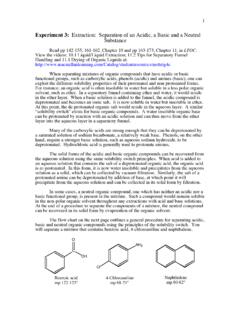
Experiment 3: Extraction: Separation of an Acidic, a Basic ...
www.bc.eduin the ether layer. When a basic solution is added to the funnel, the acidic compound is deprotonated and becomes an ionic salt. It is now soluble in water but insoluble in ether. At this point, the de-protonated organic salt would reside in the aqueous layer. A similar “solubility switch” exists for basic organic compounds.

Ionic Compound Formula Writing Worksheet
www.mrspage.comIonic Compound Naming – Chilton Honors Chemistry Chemical Formula Writing Worksheet Solutions Write chemical formulas for the compounds in each box. The names are found by finding the intersection between the cations and anions. Example: The first box is the
Strong, Weak, or Non-Electrolyte?
ocw.umb.edu1. All ionic compounds are strong electrolytes, because they mostly break up into ions as they dissolve in water. Even insoluble ionic compounds (e.g., AgCl, PbSO 4, CaCO 3) are strong electrolytes, because the small amounts that do dissolve in water do so principally as ions; i.e., there is virtually no undissociated form of the compound in ...