YOLACT: Real-Time Instance Segmentation
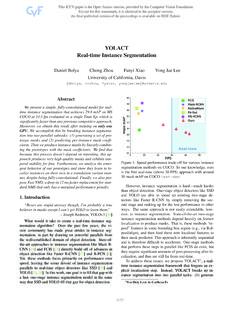
segmentation methods on COCO. To our knowledge, ours is the first real-time (above 30 FPS) approach with around 30 mask mAP on COCO test-dev. However, instance segmentation is hard—much harder than object detection. One-stage object detectors like SSD and YOLO are able to speed up existing two-stage de-
Download YOLACT: Real-Time Instance Segmentation

Information
Domain:
Source:
Link to this page:
Documents from same domain
What Have We Learned From Deep Representations for …
openaccess.thecvf.comwhat these powerful models actually have learned. In this paper we shed light on deep spatiotemporal net-works by visualizing what excites the learned models us-ing activation maximization by backpropagating on the in-put. We are the first to visualize the hierarchical features
Finding Tiny Faces in the Wild With Generative Adversarial ...
openaccess.thecvf.comfaces, which are unfriendly for the face classifier. Toward-s this end, we design a refinement sub-network to recover some detailed information. In the discriminator network, the basic GAN [17, 12, 8] is trained to distinguish the real and fake high resolution images. To classify faces or non-
Squeeze-and-Excitation Networks - openaccess.thecvf.com
openaccess.thecvf.comSqueeze-and-Excitation Networks Jie Hu1∗ Li Shen2∗ Gang Sun1 hujie@momenta.ai lishen@robots.ox.ac.uk sungang@momenta.ai 1 Momenta 2 Department of Engineering Science, University of Oxford Abstract Convolutional neural networks are built upon the con-
RegularFace: Deep Face Recognition via Exclusive ...
openaccess.thecvf.comRegularFace: Deep Face Recognition via Exclusive Regularization Kai Zhao Jingyi Xu Ming-Ming Cheng ∗ TKLNDST, CS, Nankai University kaiz.xyz@gmail.com cmm@nankai.edu.cn
Protecting World Leaders Against Deep Fakes
openaccess.thecvf.comProtecting World Leaders Against Deep Fakes Shruti Agarwal and Hany Farid University of California, Berkeley Berkeley CA, USA {shrutiagarwal, hfarid}@berkeley.edu
Auto-DeepLab: Hierarchical Neural Architecture Search for ...
openaccess.thecvf.comAuto-DeepLab: Hierarchical Neural Architecture Search for Semantic Image Segmentation Chenxi Liu1∗, Liang-Chieh Chen 2, Florian Schroff2, Hartwig Adam2, Wei Hua2, Alan Yuille1, Li Fei-Fei3 1Johns Hopkins University 2Google 3Stanford University Abstract Recently, NeuralArchitectureSearch(NAS)hassuccess-
PointNet: Deep Learning on Point Sets ... - CVF Open Access
openaccess.thecvf.comPointNet: Deep Learning on Point Sets for 3D Classification and Segmentation Charles R. Qi* Hao Su* Kaichun Mo Leonidas J. Guibas Stanford University
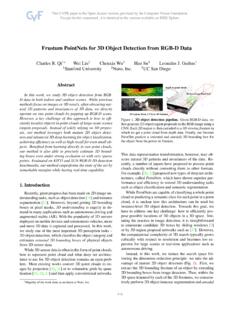
Frustum PointNets for 3D Object Detection From RGB-D Data
openaccess.thecvf.comFrustum PointNets for 3D Object Detection from RGB-D Data Charles R. Qi1∗ Wei Liu2 Chenxia Wu2 Hao Su3 Leonidas J. Guibas1 1Stanford University 2Nuro, Inc. 3UC San Diego Abstract In this work, we study 3D object detection from RGB-D data in both indoor and outdoor scenes.
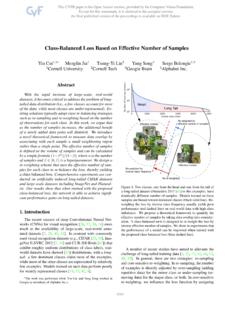
Class-Balanced Loss Based on Effective Number of Samples
openaccess.thecvf.comand large-scale datasets including ImageNet and iNatural-ist. Our results show that when trained with the proposed class-balanced loss, the network is able to achieve signifi-cant performance gains on long-tailed datasets. 1. Introduction The recent success of deep Convolutional Neural Net-works (CNNs) for visual recognition [26, 37, 38, 16] owes
ESRGAN: Enhanced Super-Resolution Generative Adversarial ...
openaccess.thecvf.comESRGAN: EnhancedSuper-Resolution Generative Adversarial Networks Xintao Wang 1, Ke Yu , Shixiang Wu2, Jinjin Gu3, Yihao Liu4, Chao Dong 2, Yu Qiao , and Chen Change Loy5 1 CUHK-SenseTime Joint Lab, The Chinese University of Hong Kong 2 Shenzhen Institutes of Advanced Technology, Chinese Academy of Sciences 3 The Chinese University of Hong Kong, …
Related documents
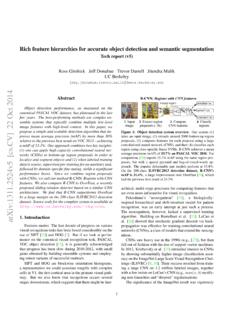
Tech report (v5) - arXiv
arxiv.orgsemantic segmentation [5]. At test time, our method gener-ates around 2000 category-independent region proposals for the input image, extracts a fixed-length feature vector from each proposal using a CNN, and then classifies each region with category-specific linear SVMs. We use a simple tech-nique (affine image warping) to compute a fixed ...
![Abstract arXiv:1411.4038v2 [cs.CV] 8 Mar 2015](/cache/preview/e/8/a/1/0/5/9/a/thumb-e8a1059a2748cde7ba3d756f44e4ca34.jpg)
Abstract arXiv:1411.4038v2 [cs.CV] 8 Mar 2015
arxiv.orgby fine-tuning [4] to the segmentation task. We then de-fine a novel architecture that combines semantic informa-tion from a deep, coarse layer with appearance information from a shallow, fine layer to produce accurate and detailed segmentations. Our fully convolutional network achieves state-of-the-art segmentation of PASCAL VOC (20% rela-
![arXiv:1606.06650v1 [cs.CV] 21 Jun 2016](/cache/preview/9/9/5/1/0/0/c/5/thumb-995100c57fe8174f42671da99a165261.jpg)
arXiv:1606.06650v1 [cs.CV] 21 Jun 2016
arxiv.orgric Image Segmentation, Xenopus Kidney, Semi-automated, Fully-automated, Sparse Annotation 1 Introduction Volumetric data is abundant in biomedical data analysis. Annotation of such data with segmentation labels causes di culties, since only 2D slices can be shown on a computer screen. Thus, annotation of large volumes in a slice-by-slice

End-to-End Video Instance Segmentation With Transformers
openaccess.thecvf.comthe VIS task as a direct end-to-end parallel sequence de-coding/prediction problem. Given a video clip consisting of multiple image frames as input, VisTR outputs the sequence of masks for each instance in the video in order directly. At the core is a new, effective instance sequence matching and segmentation strategy, which supervises and segments