Transcription of UNIT 2: Natural Resources - UGC
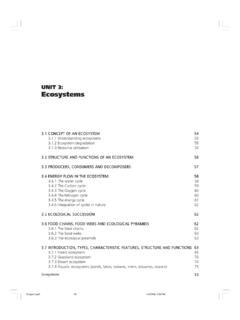
1 unit 2: Natural Resources INTRODUCTION 16. RENEWABLE AND NON-RENEWABLE Resources 20. Natural Resources and associated problems 20. Non-renewable Resources 22. Renewable Resources 22. a. Forest Resources : Use and over-exploitation, deforestation, case studies. 23. Timber extraction, mining, dams and their effects on forests and tribal people b. Water Resources : Use and over-utilisation of surface and ground water, 26. floods, drought, conflicts over water, dams benefits and problems. c. Mineral Resources : Use and exploitation, environmental effects of extracting 30. and using mineral Resources , case studies.
2 D. Food Resources : World food problems, Changes in landuse by agriculture and 32. grazing, Effects of modern agriculture, Fertilizer/ pesticide problems, Water logging and salinity e. Energy Resources : Increasing energy needs, Renewable/ non renewable, 35. Use of Alternate energy sources, Case studies f. Land Resources : Land as a resource , land degradation, man-induced land-slides, 48. soil erosion and desertification. ROLE OF AN INDIVIDUAL IN CONSERVATION OF Natural Resources 50. EQUITABLE USE OF Resources FOR SUSTAINABLE LIFESTYLES 51. Natural Resources 15. 15 4/9/2004, 5:07 PM.
3 INTRODUCTION History of our global environment: About ten thousand years ago, when mankind changed Our environment provides us with a variety of from a hunter-gatherer, living in wilderness ar- goods and services necessary for our day to day eas such as forests and grasslands, into an agri- lives. These Natural Resources include, air, wa- culturalist and pastoralist, we began to change ter, soil, minerals, along with the climate and the environment to suit our own requirements. solar energy, which form the non-living or abi- As our ability to grow food and use domestic otic' part of nature.
4 The biotic' or living parts animals grew, these Natural ' ecosystems were of nature consists of plants and animals, includ- developed into agricultural land. Most traditional ing microbes. Plants and animals can only sur- agriculturists depended extensively on rain, vive as communities of different organisms, all streams and rivers for water. Later they began closely linked to each in their own habitat, and to use wells to tap underground water sources requiring specific abiotic conditions. Thus, for- and to impound water and created irrigated land ests, grasslands, deserts, mountains, rivers, lakes by building dams.
5 Recently we began to use fer- and the marine environment all form habitats tilizers and pesticides to further boost the pro- for specialised communities of plants and ani- duction of food from the same amount of land. mals to live in. Interactions between the abiotic However we now realize that all this has led to aspects of nature and specific living organisms several undesirable changes in our environment. together form ecosystems of various types. Mankind has been overusing and depleting Many of these living organisms are used as our Natural Resources . The over-intensive use of land food Resources .
6 Others are linked to our food has been found to exhaust the capability of the less directly, such as pollinators and dispersers ecosystem to support the growing demands of of plants, soil animals like worms, which recycle more and more people, all requiring more in- nutrients for plant growth, and fungi and ter- tensive use of Resources . Industrial growth, mites that break up dead plant material so that urbanisation, population growth and the enor- micro-organisms can act on the detritus to re- mous increase in the use of consumer goods, form soil nutrients. have all put further stresses on the environment.
7 They create great quantities of solid waste. Pol- lution of air, water and soil have begun to seri- ously affect human health. Changes in land and resource use: During the last 100 years, a better health care delivery system and an improved nutritional status has led to rapid population growth, especially in the develop- ing countries. This phe- nomenal rise in human numbers has, in the recent past, placed great de- mands on the earth's Natural Resources . Large stretches of land such as forests, grasslands and wetlands have been converted into intensive ag- riculture. Land has been taken for industry and 16 Environmental Studies for Undergraduate Courses 16 4/9/2004, 5:07 PM.
8 The urban sectors. These changes have brought Earth's Resources and Man: The Resources on about dramatic alterations in land-use patterns which mankind is dependent are provided by and rapid disappearance of valuable Natural eco- various sources or spheres'. systems. The need for more water, more food, more energy, more consumer goods, is not only 1) Atmosphere the result of a greater population, but also the Oxygen for human respiration (metabolic re- result of over-utilization of Resources by people quirements). from the more affluent societies, and the afflu- Oxygen for wild fauna in Natural ecosystems ent sections of our own.
9 And domestic animals used by man as food. Industrial development is aimed at meeting Oxygen as a part of carbon dioxide, used growing demands for all consumer items. How- for the growth of plants (in turn are used ever, these consumer goods also generate waste by man). in ever larger quantities. The growth of indus- trial complexes has led to a shift of people from The atmosphere forms a protective shell over their traditional, sustainable, rural way of life to the earth. The lowest layer, the troposphere, urban centers that developed around industry. the only part warm enough for us to survive in, During the last few decades, several small ur- is only 12 kilometers thick.
10 The stratosphere is ban centers have become large cities, some have 50 kilometers thick and contains a layer of even become giant mega-cities. This has in- sulphates which is important for the formation creased the disparity between what the sur- of rain. It also contains a layer of ozone, which rounding land can produce and what the large absorbs ultra-violet light known to cause can- number of increasingly consumer-oriented cer and without which, no life could exist on people in these areas of high population den- earth. The atmosphere is not uniformly warmed sity consume.