Transcription of Protocol for the Examination of Specimens From Patients ...
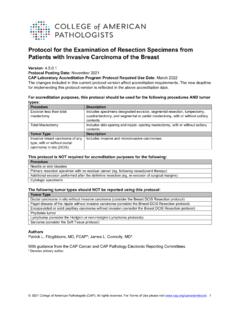
1 2018 College of American Pathologists (CAP). All rights reserved. For Terms of Use please visit Protocol for the Examination of Specimens From Patients With invasive Carcinoma of the breast Version: InvasiveBreast Protocol Posting Date: January 2018 Includes pTNM requirements from the 8th Edition, AJCC Staging Manual For accreditation purposes, this Protocol should be used for the following procedures AND tumor types: Procedure Description Excision less than total mastectomy Includes Specimens designated excision, segmental resection, lumpectomy, quadrantectomy, and segmental or partial mastectomy, with or without axillary contents Total Mastectomy Includes skin-sparing and nipple sparing mastectomy, with or without axillary contents Tumor Type Description invasive breast carcinoma of any type, with or without ductal carcinoma in situ (DCIS) Includes microinvasive carcinoma and carcinoma with neuroendocrine features This Protocol is NOT required for accreditation purposes for the following.
2 Procedure Needle, incisional or skin biopsies Primary resection specimen with no residual cancer (eg, following neoadjuvant therapy) Additional excision performed after the definitive resection (eg, re-excision of surgical margins) Cytologic Specimens The following tumor types should NOT be reported using this Protocol : Tumor Type Ductal carcinoma in situ (consider the breast DCIS Protocol ) Paget disease of the nipple not associated with invasive breast carcinoma (consider the breast DCIS Protocol ) Encapsulated (solid) papillary carcinoma (consider the breast DCIS Protocol ) Phyllodes tumor Lymphoma (consider the Hodgkin or non-Hodgkin Lymphoma protocols) Sarcoma (consider the Soft Tissue Protocol ) Authors Patrick L.
3 Fitzgibbons, MD*; Shikha Bose, MD; Yunn-Yi Chen, MD, PhD; James L. Connolly, MD; Monica E. de Baca, MD; Mary Edgerton, MD; Daniel F. Hayes, MD; Kalisha A. Hill, MD; Celina Kleer, MD; Susan C. Lester, MD, PhD; Frances P. O Malley, MD; David L. Page, MD; Jean F. Simpson, MD; Ross Simpson, MD; Barbara L. Smith, MD, PhD; Lee K. Tan, MD; Donald L. Weaver, MD; Eric Winer MD With guidance from the CAP Cancer and CAP Pathology Electronic Reporting Committees. * Denotes primary author. All other contributing authors are listed alphabetically. breast invasive Carcinoma of the breast InvasiveBreast 0 2 Accreditation Requirements This Protocol can be utilized for a variety of procedures and tumor types for clinical care purposes.
4 For accreditation purposes, only the definitive primary cancer resection specimen is required to have the core and conditional data elements reported in a synoptic format. Core data elements are required in reports to adequately describe appropriate malignancies. For accreditation purposes, essential data elements must be reported in all instances, even if the response is not applicable or cannot be determined . Conditional data elements are only required to be reported if applicable as delineated in the Protocol . For instance, the total number of lymph nodes examined must be reported, but only if nodes are present in the specimen.
5 Optional data elements are identified with + and although not required for CAP accreditation purposes, may be considered for reporting as determined by local practice standards. The use of this Protocol is not required for recurrent tumors or for metastatic tumors that are resected at a different time than the primary tumor. Use of this Protocol is also not required for pathology reviews performed at a second institution (ie, secondary consultation, second opinion, or review of outside case at second institution). Synoptic Reporting All core and conditionally required data elements outlined on the surgical case summary from this cancer Protocol must be displayed in synoptic report format.
6 Synoptic format is defined as: Data element: followed by its answer (response), outline format without the paired "Data element: Response" format is NOT considered synoptic. The data element should be represented in the report as it is listed in the case summary. The response for any data element may be modified from those listed in the case summary, including Cannot be determined if appropriate. Each diagnostic parameter pair (Data element: Response) is listed on a separate line or in a tabular format to achieve visual separation. The following exceptions are allowed to be listed on one line: o Anatomic site or specimen, laterality, and procedure o Pathologic Stage Classification (pTNM) elements o Negative margins, as long as all negative margins are specifically enumerated where applicable The synoptic portion of the report can appear in the diagnosis section of the pathology report, at the end of the report or in a separate section, but all Data element.
7 Responses must be listed together in one location Organizations and pathologists may choose to list the required elements in any order, use additional methods in order to enhance or achieve visual separation, or add optional items within the synoptic report. The report may have required elements in a summary format elsewhere in the report IN ADDITION TO but not as replacement for the synoptic report all required elements must be in the synoptic portion of the report in the format defined above. CAP Laboratory Accreditation Program Protocol Required Use Date: October 2018 CAP breast invasive Protocol Summary of Changes 0 The following data elements were modified: Tumor Site: revise format O clock DCIS response terms Regional Lymph Nodes CAP Approved breast invasive Carcinoma of the breast InvasiveBreast 0 + Data elements preceded by this symbol are not required for accreditation purposes.
8 These optional elements may be clinically important but are not yet validated or regularly used in patient management. 3 Surgical Pathology Cancer Case Summary Protocol posting date: January 2018 invasive CARCINOMA OF THE breast : Select a single response unless otherwise indicated. Specimen Identification The following 3 elements identifying the specimen may be listed separately or on 1 line: Procedure (Note A) ___ Excision (less than total mastectomy) ___ Total mastectomy (including nipple-sparing and skin-sparing mastectomy) ___ Other (specify): _____ ___ Not specified Specimen Laterality ___ Right ___ Left ___ Not specified + Tumor Site: invasive Carcinoma (select all that apply) (Note C) + ___ Upper outer quadrant + ___ Lower outer quadrant + ___ Upper inner quadrant + ___ Lower inner quadrant + ___ Central + ___ Nipple + ___ Position (specify).
9 ___ o clock + ___ Other (specify): _____ + ___ Not specified Tumor Size (Note D) ___ Microinvasion only ( 1 mm) ___ Greatest dimension of largest invasive focus >1 mm (specify exact measurement) (millimeters): ___ mm + Additional dimensions: ___ x ___ mm ___ No residual invasive carcinoma ___ Size of largest invasive focus cannot be determined (explain): _____ Note: The size of the invasive carcinoma should take into consideration the gross findings correlated with the microscopic Examination . If multiple foci of invasion are present, the size listed is the size of the largest contiguous area of invasion.
10 The size of multiple invasive carcinomas should not be added together. The size does not include adjacent ductal carcinoma in situ (DCIS). For any carcinoma larger than mm but less than mm, the size should not be rounded down to mm, but rather rounded up to mm, to ensure that the tumor is not miscategorized as pT1mi. If there has been a prior core needle biopsy or incisional biopsy showing a larger area of invasion than in the excisional specimen, the largest dimension of the invasive carcinoma in the prior specimen should be used for T classification, if known. This also applies if the entire tumor has been removed by prior biopsy.