Transcription of Triathlon Strength & Conditioning Guide (PPT working file)
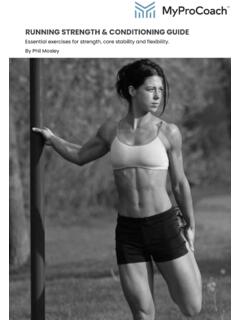
1 Triathlon Strength & Conditioning Guide . Essential exercises for Strength , core stability and flexibility. By Phil Mosley 1. Strength and Conditioning for Triathletes Using This Guide Your training plan includes one or two Strength sessions per week. Click each session to see which exercises you should do on a given day. You can refer to this PDF, if you need guidance. New to Strength work, or unfamiliar with the exercises? We recommend booking a session or two with a personal trainer to check your technique and help you get the best from the workouts.
2 Exercise Instruction This Guide provides written descriptions of each exercise. Which muscles you are targeting and why. As well as tips, how to progress and alternatives. There are useful videos and images that show you what you need to do. You can adapt and progress sessions gradually according ability and experience. Click to view all the Strength and Conditioning Videos included in this PDF. (Save the playlist to your YouTube library for future reference). Why Do Strength And Conditioning ? We have chosen specific Strength and flexibility exercises to support your swim, bike and run training.
3 They are designed to increase power, range of movement, coordination, flexibility, agility, Strength and stability providing you with a solid internal scaffold' to support all aspects of your training. You will improve your efficiency and boost your performance. Injury Prevention Including Strength and Conditioning will help minimize the risks of injury through improved Strength , stability and by matching imbalances that can be created by repetitive overuse. What Equipment Do I Need? All exercises (or alternatives) can be done at home with a mat, dumbbells and/or band.
4 Or in the gym using machines (where given as an alternative) and/or the free weights area. When Should I Do Strength Workouts? There are one or two Strength workouts each week. If you have another workout scheduled on your Strength day you should do the Triathlon specific discipline first. When switching things around in your calendar be conscious of workouts that follow your Strength sessions. How Will Strength Sessions Fit With My Triathlon Plan? Prep Phase: Develop neuromuscular efficiency, stability and functional Strength .
5 Base Phase: Build a foundation that can be used for power development. The goal is to translate Strength training into sport-specific activity. Build Phase: Develop power, balance and neuromuscular control. Form is key, reduce the intensity if you cannot hold your form. Peak Phase: Allows you to focus on sport-specific training. This means decreasing the stress of a Strength and Conditioning training session by reducing intensity and volume. Flexibility There are six key flexibility exercises included. Select stretches that are specific to your requirements, the ones described within this document are a Guide .
6 You may have some favorites that work well for you. 2. Strength and Conditioning for Triathletes 1. SQUAT. Works: Glutes, hamstrings and quads. Why: Generates Strength , power and stability for pedaling and running. 1. Stand with your feet shoulder-width apart and pointing straight ahead, arms at your sides. 2. Initiating the move with your hips, squat back and down until your thighs are parallel to the floor. 3. Return to a standing position by pushing through your hips. Tips: Keep your chest up, back flat, and do not let your knees collapse to the inside.
7 Progressions: Add weights, squat jumps. Alternatives: Smith machine, leg press machine, goblet squat. 2. SQUAT JUMP. Works: Glutes, hamstrings and quads. Why: Boosts explosive power, for running and cycling. 1. Stand with feet just outside of shoulders. 2. Sit back and down into squat position, keeping knees behind toes. 3. Immediately jump vertically by extending through hips and swinging arms for propulsion. 4. Land softly in squat position with hips back and down. Immediately repeat the same movement.
8 Tips: Keep chest up during the jump. Extend hips completely during jump. Progressions: Increase reps, reduce rests. Alternatives: Any low impact weighted squat variations, leg press, box jumps. 3. Strength and Conditioning for Triathletes 3. SINGLE LEG SQUAT. Works: Glutes, hips, hamstrings, calves and quads. Why: Strengthen your force producing muscles and improve power for the run and bike. 1. Stand on one foot with your other leg bent at the knee. 2. Once you're balanced on one leg, squat down as low as you can without losing your form (or toppling over).
9 Don't let your standing knee go past the front of your toes while you squat. 3. Pause at the bottom of the squat for a second, then push back up through your heel, squeezing your glutes as you go. Tips: Hold both arms out in front of you during the exercise to help keep your balance. Progression: Hold raised leg straight out in front (pistol squat), increase reps. Alternatives: Bulgarian squat, alternate lunges. 4. BULGARIAN SQUAT. Works: Glutes, hamstrings and quads. Why: Strength , balance and core control.
10 1. Find yourself anything stable that you can rest a foot on, it needs to be about knee height. 2. Get into a forward lunge position with torso upright, core braced and hips square to your body, with your back foot elevated on bench . Your leading leg should be about half a metre in front. 3. Lower until your front thigh is almost horizontal, keeping your knee in line with your foot. 4. Drive up through your front heel back to the starting position, keep your movements measured. Repeat your reps on one leg before switching sides.