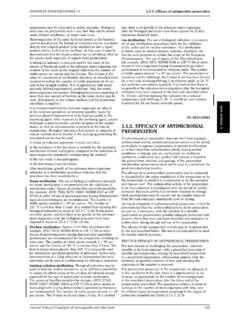
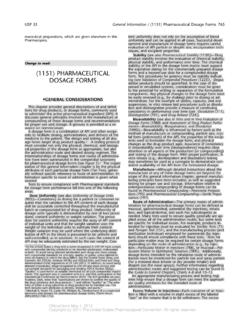
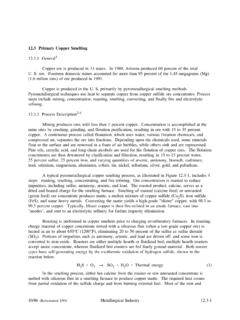
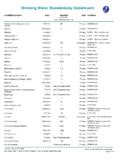
Transcription of 4.2. VOLUMETRIC ANALYSIS 4.2.1. PRIMARY STANDARDS …
1 VOLUMETRIC analysisEUROPEAN PHARMACOPOEIA ammonia R. Dilute to mL withdistilled water R(solution C). Mix equal volumes of solution A,B, ammonia VOLUMETRIC ANALYSIS04/2010 PRIMARY STANDARDS FORVOLUMETRIC SOLUTIONSP rimary STANDARDS for VOLUMETRIC solutions are indicated by thesuffix RV. PRIMARY STANDARDS of suitable quality may be obtainedfrom commercial sources or prepared by the following ( ).2000100.[1327-53-3].Sublimearsenious trioxide Rin a suitable :overanhydrous silica gel ( ).2000200.[65-85-0].Sublimebenzoic acid Rin a suitable ( ).2000300.[7758-01-2].Crystallisepotassi um bromate Rfrom boilingwater R. Collectthecrystalsanddrytoconstantmassat 180 hydrogen ( ).2000400.[877-24-7].Recrystallisepotass ium hydrogen phthalate Rfrom boilingwater R, collect the crystals at a temperature above 35 C anddrytoconstantmassat110 ( ).2000500.[497-19-8].Filter at room temperature a saturated solution ofsodiumcarbonate R. Introduce slowly into the filtrate a stream ofcarbon dioxide Rwith constant cooling and stirring.
2 Afterabout 2 h, collect the precipitate on a sintered-glass filter ( ).Wash the filter with icedwater Rcontaining carbon drying at 100 C to 105 C, heat to constant mass at270-300 C, stirring from time to ( ).2000600.[7647-14-5].To 1 volume of thesaturated solution of sodium chloride Radd2 volumes ofhydrochloric acid R. Collect the crystals formedand wash withhydrochloric acid by heating on a water-bath and dry the crystals to constantmass at 300 ( ).2000700.[121-57-3].Recrystallisesulfan ilic acid Rfrom boilingwater to constant mass at 100-105 ( ).2000800.[7440-66-6].Content: minimum per VOLUMETRIC SOLUTIONSV olumetric solutions are prepared according to the usualchemical analytical methods. The accuracy of the apparatusused is verified to ensure that it is appropriate for the concentration of VOLUMETRIC solutions is indicated in termsof molarity. Molarity expresses, as the number of moles, theamount of substance dissolved in 1 L of solution.
3 A solutionwhich containsxmoles of substance per litre is said to solutions do not differ from the prescribed strengthby more than 10 per cent. The molarity of the volumetricsolutions is determined by an appropriate number of repeatability does not exceed per cent (relative standarddeviation). VOLUMETRIC solutions are standardised by the methods describedbelow. When a VOLUMETRIC solution is to be used in an assayin which the end-point is determined by an electrochemicalprocess (for example, amperometry or potentiometry) the medium in which a VOLUMETRIC solution is standardisedshould be the same as that in which it is to be more dilute than those described are obtainedby dilution withcarbon dioxide-free water Rof theleast-concentrated solution that describes a which the dilutions were M Acetic g ofglacial acetic acid Rto mL withwater To mL of acetic acid add mL ofphenolphthalein solution Rand titrate M M Ammonium and cerium for 2 min a solution containing 56 mL of sulfuric acid Rand g ofammonium and cerium nitrate R,addfivesuccessive quantities, each of 100 mL, ofwater R,shakingaftereach addition.
4 Dilute the clear solution to mL withwater R. Standardise the solution after 10 mL of the ammonium and ceriumnitrate solution add g ofpotassium iodide Rand 150 mLofwater R. Titrate immediately M sodium thiosulfate,using 1 mL ofstarch solution Ras : protected from M Ammonium and cerium mL M ammonium and cerium nitrateadd,with cooling, 30 mL of sulfuric acid R and dilute to mLwithwater M Ammonium and cerium g ofammonium and cerium sulfate Rin amixture of 500 mL ofwater to cool and dilute to mL withwater mL of the ammonium and ceriumsulfate solution add g ofpotassium iodide Rand 150 mLofwater R. Titrate immediately M sodium thiosulfate,using 1 mL ofstarch solution Ras M Ammonium and cerium mL M ammonium and cerium sulfateadd,with cooling, 30 mL of sulfuric acid R and dilute to mLwithwater M Ammonium g ofammonium thiocyanate Rinwater Randdilute to mL with the same mL M silver nitrateadd 25 mLofwater R, 2 mL ofdilute nitric acid Rand 2 mL offerricammonium sulfate solution R2.
5 Titrate with the ammoniumthiocyanate solution until a reddish-yellow colour is M Barium g ofbarium chloride Rinwater Rand dilute mL with the same mL of the barium chloride solutionadd 60 mL ofwater R, 3 mL ofconcentrated ammonia mg ofphthalein purple M sodiumedetate. When the solution begins to decolorise, add 50 mLofethanol (96 per cent) Rand continue the titration until theblue-violet colour the information section on general monographs (cover pages)EUROPEAN PHARMACOPOEIA VOLUMETRIC M Barium g ofbarium hydroxide Rin a mixture of mL ofperchloric acid Rand 75 mL ofwater R, adjust the solution topH 3 by addingperchloric acid Rand filter if necessary. Add150 mL ofethanol (96 per cent) Rand dilute to 250 mL withwater R. Dilute to mL withbuffer solution pH mL M sulfuric acidadd 5 mLofwater R,50mLofbuffer solution pH Rand mLofalizarin s solution R. Titrate with the barium perchloratesolution until an orange-red colour appears. Standardiseimmediately before M Barium mL M barium perchlorateto mLwithbuffer solution pH M Benzethonium inwater g ofbenzethonium chloride R,previously dried to constant mass at 100-105 C, and dilute mL with the same the molarity of the solution fromthe content of C27H42 ClNO2in the dried benzethonium chloridedetermined as follows.
6 Dissolve g of the dried substancein 30 mL ofanhydrous acetic acid Rand add 6 mL ofmercuricacetate solution M perchloric acid, mL ofcrystal violet solution Ras indicator. Carry out ablank M perchloric acidis equivalent to mg M Bismuth g ofbismuth nitrate pentahydrate Rin 60 mL ofdilute nitric acid Rand dilute to mL withwater To mL of the bismuth nitrate solution,add 50 mL ofwater Rand titrate M sodium edetateusing mL of a 1 g/L solution ofxylenol orange M g ofpotassium bromate RVand 13 g ofpotassium bromide Rinwater Rand dilute to mL M Cerium g ofcerium sulfate Rin a mixture of 500 mL ofwater mL withwater To mL of the cerium sulfate solution, g ofpotassium iodide R,100mLofwater Rand 40 mL ofdilute sulfuric acid R. Titrate immediately M sodiumthiosulfateusing mL ofstarch solution Ras M copper g ofcopper sulfate Rinwater Rand dilute mL with the same mL of the copper sulfate solution add2gofsodium acetate Rand mL ofpyridylazonaphtholsolution M sodium edetateuntil the colourchanges from violet-blue to bright green.
7 Titrate slowly towardsthe end of the M Ferric ammonium g offerric ammonium sulfate Rin a mixture of6mLofsulfuricacidRand300mLofwater Rand dilute mL withwater mL of the ferric ammonium sulfatesolution, add 3 mL ofhydrochloric acid Rand 2 g ofpotassiumiodide R. Allow to stand for 10 min. Titrate M sodiumthiosulfate,using1mLofstarch solution Ras M sodium thiosulfateis equivalent to mgof FeNH4(SO4)2, M Ferrous g offerrous sulfate Rin 500 mL ofdilute sulfuricacid Rand dilute to mL withwater mL of the ferrous sulfate solution add3mLofphosphoric acid Rand titrate immediately Mpotassium permanganate. Standardise immediately before M Hydrochloric g ofhydrochloric acid Rto mL withwater g ofsodium carbonate RVin 50 mL ofwater R, orange solution Rand titrate with the hydrochloric acid until the solution justbecomes yellowish-red. Boil for 2 min. The solution reverts toyellow. Cool and continue the titration until a yellowish-redcolour is M hydrochloric acidis equivalent to mg M Hydrochloric mL of1 M hydrochloric acidto mL withwater out the titration described for1 Mhydrochloric acidusing g ofsodium carbonate RVdissolved in 20 mL ofwater M hydrochloric acidis equivalent to mg M Hydrochloric acid, mL ofhydrochloric acid Rto mL withaldehyde-free alcohol M 127 g ofiodine Rand 200 g ofpotassium iodide Rinwater Rand dilute to mL with the same To mL of the iodine solution add 1 mL ofdilute acetic acid Rand 50 mL ofwater Msodium thiosulfate,usingstarch solution Ras : protected from M g ofiodine Rand 20 g ofpotassium iodide Rinwater Rand dilute to mL with the same mL of the iodine solution add 1 mL ofdilute acetic acid Rand 30 mL ofwater Msodium thiosulfate,usingstarch solution Ras.
8 Protected from M g ofpotassium iodide Rto mL M iodineand dilute to mL withwater M Lanthanum g oflanthanum nitrate Rinwater Rand diluteto mL with the same To 20 mL of the lanthanum nitrate solution,add 15 mL ofwater Rand 25 mL M sodium about 50 mg ofxylenol orange triturate Rand about 2 gofhexamethylenetetramine M zinc sulfateuntil the colour changes from yellow to M sodium edetateis equivalent to mg ofLa(NO3)3, M Lead 33 g oflead nitrate Rinwater Rand dilute mL with the same Take mL of the lead nitrate solution andcarry out the determination of lead by complexometry ( ). M Lead mL M Lead nitrateto mL withwater Notices (1) apply to all monographs and other VOLUMETRIC solutionsEUROPEAN PHARMACOPOEIA M Lithium g oflithium Rin 150 mL ofanhydrousmethanol Rand dilute to mL withtoluene 10 mL ofdimethylformamide mL of a 3 g/L solution ofthymol blue Rinmethanol Rand titrate with the lithium methoxide solution until a pure bluecolour is obtained.
9 Immediately add g ofbenzoic acid to effect solution and titrate with the lithium methoxidesolution until the pure blue colour is again obtained. Protectthe solution from atmospheric carbon dioxide throughout thetitration. From the volume of titrant used in the second titrationascertain the exact strength of the lithium methoxide immediately before M lithium methoxideis equivalent to mg M Magnesium g ofmagnesium chloride Rinwater Randdilute to mL with the same out the determination of magnesium bycomplexometry ( ).1 M Nitric g ofnitric acid Rto mL withwater g ofsodium carbonate RVin 50 mL ofwater R, orange solution Rand titrate with the nitric acid until the solution just becomesreddish-yellow; boil for 2 min. The solution reverts to and continue the titration until a reddish-yellow colour M nitric acidis equivalent to mg of M Perchloric mL ofperchloric acid Rin a VOLUMETRIC flaskcontaining about 900 mL ofglacial acetic acid Rand mix.
10 Add30 mL ofacetic anhydride R, dilute to mL withglacialacetic acid R, mix and allow to stand for 24 h. Determine thewater content ( ) without addition of methanol and, ifnecessary, adjust the water content to per cent by addingeitheracetic anhydride Rorwater g ofpotassium hydrogenphthalate RVin 50 mL ofanhydrous acetic acid R,warminggently if necessary. Allow to cool protected from the air, andtitrate with the perchloric acid solution, using mL ofcrystal violet solution Ras indicator. Note the temperature ofthe perchloric acid solution at the time of the titration. If thetemperature at which an assay is carried out is different fromthat at which M perchloric acidhas been standardised,thevolumeusedintheassaybeco mes:t1=temperature during standardisation,t2=temperature during the assay,Vc=corrected volume,V=observed M perchloric acidis equivalent to mgof M Perchloric mL M perchloric acidto mL withanhydrous acetic acid M Perchloric mL M perchloric acidto mL withanhydrous acetic acid M Potassium g ofpotassium bromate RVinwater Randdilute to mL with the same M Potassium g ofpotassium bromate RVinwater Randdilute to mL with the same M Potassium by M Potassium M Potassium by M Potassium M Potassium g ofpotassium dichromate Rinwater Randdilute to mL with the same mL of the potassium dichromatesolution add 1 g ofpotassium iodide Rand 7 mL ofdilutehydrochloric acid Rand titrate M sodium thiosulfate,using3mLofstarch solution Rasindicator, until the colour changes from blue to light M Potassium hydrogen a conical flask containing about 800 mL ofanhydrous aceticacid R.