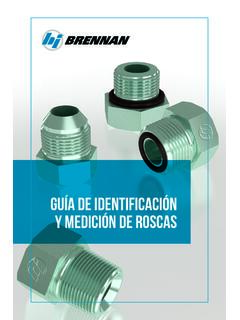
Transcription of 5 things you should know about O-ring face seal fittings ...
1 5 things you should know about O-ring face seal fittings (ORFS) 25 things YOU should know about O-ring FACE seal fittings (ORFS)5 things you should know abouto- ring face seal fitting (orfs) O-ring face seal (ORFS) fittings are a highly popular and reliable choice in hydraulic and tube connections. Well designed ORFS connections provide a seal that is highly reliable due to its elastomeric seal and is one of the best choices for a leak-free the name implies, O-ring Face seal (ORFS) fittings incorporate an O-ring at the face of the fitting and are designed to eliminate leaks in high pressure hydraulic systems.
2 Made to SAE J1453 standard, ORFS connections typically use Buna-N or Viton, 90 Durometer O-rings that seat into a grove in the face of the fitting . These elastomeric seals provide a leak-proof, drop-in replacement for SAE 37 flared tube fittings , literally eliminating hydraulic leaks when used properly. When the connection is tightened the O-ring compresses against a flat face sleeve, which has been brazed onto the end of a tube. This makes a metal-to-metal seal with a leak barrier provided by the O-ring . The flat face sleeve also eliminates twisting of the tube and provides support during face seal fittings can eliminate leaks in hydraulic systems at operating pressures as high as 6,000 PSI.
3 They are designed specifically for applications where elastomeric seals are acceptable to overcome leakage and variations in assembly procedures. The fittings can be easily connected to a range of tubing grades by silver brazing. In addition, ORFS fittings can be disassembled and reassembled in the field to facilitate replacement of the O-ring or the entire ensure leak free connections, here are 5 things you should know about O-ring face seal fittings : nORFS fittings Help Prevent Component FailureMany severe conditions can contribute to hydraulic component failure.
4 fittings and component assemblies are frequently required to work in very harsh environments, from corrosive off-shore applications to extreme heat and cold or frequent high pressure fluctuations. These are a few applications where ORFS fittings can provide leak tight connections to prevent failures. 35 things YOU should know about O-ring FACE seal fittings (ORFS) O-ring face seal fittings are used in the majority of applications where there are very high pressures that are subject to flexing or pressure surges in construction equipment, agricultural equipment, oil and gas, mining and the high performance industrial markets.
5 They are also the preferred connection in high vibration systems because the soft O-ring seal absorbs shock better than any metal-to-metal sealed fittings . SAE J1453 ORFS fittings were first designed for off-road construction equipment and are now predominant in other transportation applications from CNG & LPG vehicles to material handling equipment and other industrial applications. oCauses of Hydraulic Systems Leakage While hydraulic connections that incorporate an O-ring face seal are the most reliable against leakage, it can still happen.
6 Yet the cause is rarely the fitting itself. The primary contributors to system leaks and how often they occur include: Improper installation: 60% Poor system design : 20% Quality of components: 15% System abuse: 5%While causes of leakage are usually distinguishable after the fact, the result can be costly. Not just to equipment and downtime, but the loss of fluid can be significant. Consider an operation running 24-hours-a-day and hydraulic oil at $25 per gallon, the cost of leaking fluid alone can add up: 1 drop every 1 minute = 50 gallons per year = $1,250 1 drop every 10 seconds = 300 gallons per year = $7,500 1 drop every 5 seconds = 600 gallons per year = $15,000 1 drop every second = 3,000 gallons per year = $75,000 ORFS fittings are the best line of defense against costly fluid leaks.
7 PApplicationsO- ring face seal SAE J1453 fittings are popular in hydraulic lines onboard off road vehicles such as tractors, combines and other heavy equipment used in construction. Due to the frequent vibration and actuation of components in off-road vehicles, it is extremely important to reduce or eliminate the number of potential leak points and incidences of leakage. The SAE J1453 standard for ORFS fittings covers dimensions, threads, fitting and O-ring materials, and performance requirements of for use in hydraulic applications, as well as the interface of the O-ring face and nut portion of hose stem common, yet critical application for SAE J1453 ORFS fittings is with turbine flow meters in 4hydraulic fluid applications.
8 A turbine flow meter is used for volumetric total flow and flow rate measurement. When the fluid flows through the meter it moves turbine blades that are free to rotate about an axis along the center line of the turbine housing, monitoring flow rate. Turbine flow meters play an important role in many hydraulic and pneumatic applications, including: Auxiliary systems in turbine hydraulic controls, liquid fuel control systems, jacking/leveling and lube oil skids Chemical plants Electrohydraulic controls (EHC)
9 General industrial equipment Generators and transformers Hydraulic fracturing operations Lube auxiliary systems in hydroelectric plants Off-road, construction and agricultural equipment Water treatment equipment Wellheads in oil & gas Wind power turbinesFlow meters that incorporate NPT end- fittings require adapters and can experience a number of leak points. However, units utilizing O-ring face seal fittings do not require adapters, need less space for meter installation and ensure fewer possible leak important factor in many applications that use ORFS fittings versus traditional metal- seal fittings is that manufacturers can extend warranty periods in equipment because of the reduction of possible leak points.
10 QSystem design Where it all startsSystem design is the first consideration for leak prevention in hydraulic systems. The right components must be selected to reduce the incidences of leaks and connection failures. Typically O-ring face seal fittings are the best or sometimes only practical choice. The following are attributes that should be taken in consideration when selecting system connections in the design environment will determine fitting design and selection. The use of stainless steel or a protective coating on steel fittings extends the service life in corrosive environments.