Transcription of INTERNATIONAL ISO STANDARD 14001 - un-ihe.org
1 INTERNATIONALSTANDARDISO14001 Second edition2004-11-15 Reference numberISO 14001 :2004(E) ISO 2004 environmental management systems Requirements with guidance for useSyst mes de management environnemental Exigences et lignes directrices pour son utilisation ISO 14001 :2004(E)ii ISO 2004 All rights reservedPDF disclaimerThis PDF file may contain embedded typefaces. In accordance with Adobe's licensing policy, this file may be printed or viewed but shallnot be edited unless the typefaces which are embedded are licensed to and installed on the computer performing the editing.
2 Indownloading this file, parties accept therein the responsibility of not infringing Adobe's licensing policy. The ISO Central Secretariataccepts no liability in this is a trademark of Adobe Systems of the software products used to create this PDF file can be found in the General Info relative to the file; the PDF-creationparameters were optimized for printing. Every care has been taken to ensure that the file is suitable for use by ISO member bodies. In theunlikely event that a problem relating to it is found, please inform the Central Secretariat at the address given below.
3 ISO 2004 All rights reserved. Unless otherwise specified, no part of this publication may be reproduced or utilized in any form or by any means,electronic or mechanical, including photocopying and microfilm, without permission in writing from either ISO at the address below orISO's member body in the country of the copyright officeCase postale 56 CH-1211 Geneva 20 Tel. + 41 22 749 01 11 Fax + 41 22 749 09 47E-mail in SwitzerlandISO 14001 :2004(E) ISO 2004 All rights reservediiiContents Page1 Scope.
4 12 Normative references .. 13 Terms and definitions .. 14 environmental management system requirements .. General requirements .. environmental policy .. Planning .. Implementation and operation .. Checking .. management review .. 9 Annex A(informative)Guidance on the use of this INTERNATIONAL STANDARD .. 10 Annex B(informative)Correspondence between ISO 14001 :2004 and ISO 9001:2000 .. 19 Bibliography .. 23 ISO 14001 :2004(E)iv ISO 2004 All rights reservedForewordISO (the INTERNATIONAL Organization for Standardization) is a worldwide federation of national standards bodies(ISO member bodies).
5 The work of preparing INTERNATIONAL Standards is normally carried out through ISOtechnical committees. Each member body interested in a subject for which a technical committee has beenestablished has the right to be represented on that committee. INTERNATIONAL organizations, governmental andnon-governmental, in liaison with ISO, also take part in the work. ISO collaborates closely with the InternationalElectrotechnical Commission (IEC) on all matters of electrotechnical Standards are drafted in accordance with the rules given in the ISO/IEC Directives, Part main task of technical committees is to prepare INTERNATIONAL Standards.
6 Draft INTERNATIONAL Standardsadopted by the technical committees are circulated to the member bodies for voting. Publication as anInternational STANDARD requires approval by at least 75 % of the member bodies casting a is drawn to the possibility that some of the elements of this document may be the subject of patentrights. ISO shall not be held responsible for identifying any or all such patent 14001 was prepared by Technical Committee ISO/TC 207, environmental management , SubcommitteeSC 1, environmental management second edition cancels and replaces the first edition (ISO 14001 :1996), which has been 14001 .
7 2004(E) ISO 2004 All rights reservedvIntroductionOrganizations of all kinds are increasingly concerned with achieving and demonstrating sound environmentalperformance by controlling the impacts of their activities, products and services on the environment, consistentwith their environmental policy and objectives. They do so in the context of increasingly stringent legislation, thedevelopment of economic policies and other measures that foster environmental protection, and increasedconcern expressed by interested parties about environmental matters and sustainable organizations have undertaken environmental reviews or audits to assess their environmentalperformance.
8 On their own, however, these reviews and audits may not be sufficient to provide anorganization with the assurance that its performance not only meets, but will continue to meet, its legal andpolicy requirements. To be effective, they need to be conducted within a structured management system that isintegrated within the Standards covering environmental management are intended to provide organizations with theelements of an effective environmental management system (EMS) that can be integrated with othermanagement requirements and help organizations achieve environmental and economic goals.
9 Thesestandards, like other INTERNATIONAL Standards, are not intended to be used to create non-tariff trade barriers or toincrease or change an organization's legal INTERNATIONAL STANDARD specifies requirements for an environmental management system to enable anorganization to develop and implement a policy and objectives which take into account legal requirements andinformation about significant environmental aspects. It is intended to apply to all types and sizes of organizationand to accommodate diverse geographical, cultural and social conditions.
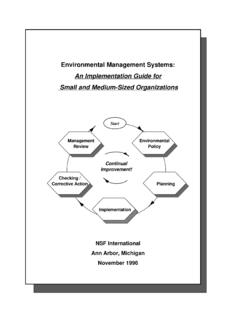
10 The basis of the approach is shownin Figure 1. The success of the system depends on commitment from all levels and functions of theorganization, and especially from top management . A system of this kind enables an organization to develop anenvironmental policy, establish objectives and processes to achieve the policy commitments, take action asneeded to improve its performance and demonstrate the conformity of the system to the requirements of thisInternational STANDARD .