Transcription of ISO 14001:2015 - NQA
1 ISO 14001:2015 environmental management system IMPLEMENTATION GUIDE50,000 GLOBALLYCERTIFICATES90 TRANSPARENTISO 14001:2015 environmental management system IMPLEMENTATION GUIDE2> ISO 14001:2015 environmental management system IMPLEMENTATION GUIDE*UK and Ireland onlyISO 14001:2015 environmental management system IMPLEMENTATION GUIDE3 ContentsIntroduction to the Standard P04 Benefits of implementation P06 PDCA cycle P07 Risk based thinking / audits P08 Annex SL P10 SECTION 1: Scope P11 SECTION 2: Normative references P12 SECTION 3: Terms of definition P13 SECTION 4: Context of organization P14 SECTION 5: Leadership P16 SECTION 6: Planning P18 SECTION 7: Support P20 SECTION 8: Operation P22 SECTION 9: Performance evaluation P24 SECTION 10: Improvement P28 Get the most from your management P30 Next steps once implemented P32 How else can we assist P33 ISO 14001:2015 environmental management system IMPLEMENTATION GUIDE4 INTRODUCTION TO THE STANDARDISO 14001:2015 environmental management system IMPLEMENTATION GUIDE4 The International Standard ISO 14001:2015 defines criteria for an environmental management system (EMS).
2 Which if implemented and maintained effectively, can provide an organization with reassurance that environmental risk is being managed and 14001 is applicable to any organization regardless of size, sector or geographical location. Whilst the Standard sets out a framework for environmental management , it has been devised to give flexibility to apply to all companies and 14001 requires effective demonstration that a systematic approach has been taken to prevent pollution and to have processes in order to manage environmental risk. Once a policy framework has been put into place along with processes to facilitate the organizations commitment, the Standard then asks an organization to audit, review and improve the system to affirm that a commitment to continuous improvement is being Standard fundamentally comes in two parts; The Standard and then Annexes which provide help and 14001:2015 environmental management system IMPLEMENTATION GUIDE5 Back in the 1970 s, 80 s and 90 s, an ever increasing worldwide concern for protecting the environment was emerging.
3 As a result of this, a number of international treaties and country specific codes of practice were published to provide organizations with a framework for environmental pollution mitigation. In 1992, the British Standards Institute published BS 7750 (based on the then quality Standard BS 5750 now ISO 9001). This provided the foundations and template as to what became ISO 14001 - environmental management systems - Specification with guidance for ISO 14001 Standard has been through a number of revisions since it was first published in 1996. ISO Standards are reviewed every five years to establish if a revision is required in order to keep them current and relevant.
4 The current Standard, ISO 14001:2015 , responds to the increasing need for management systems to be integrated by using Annex SL , a common format for management ISO s. Other key improvements in the 2015 Standard include: Asking for an appreciation of external and internal elements that may influence how environmental management is conducted. Understanding the needs of internal and external parties who may interact with the organization and the EMS. Strengthening of the leadership commitment from Top management . environmental management to be more aligned with the strategic direction of the organization. Clearer and effective communication, driven through a communications plan.
5 A life-cycle perspective of the Brief history of ISO 14001 ISO 14001:2015 environmental management system IMPLEMENTATION GUIDE6 BENEFITS OF IMPLEMENTATIONISO 14001:2015 environmental management system IMPLEMENTATION GUIDE6 Whilst there other numerous benefits to achieving ISO 14001 (and some will be more appropriate depending upon what sector an organization operates) the following benefits are likely in most cases:1. Demonstration of LeadershipBy testing environmental controls against the internationally recognized environmental Standard, an organization demonstrates ethical environmental leadership to their Stakeholders which includes customers, employees and Regulators.
6 The achievement of 14001 also provides assurance to a Board of Directors, Trustees or owners that there is management control regarding environmental risks inherent within an Economic benefitIn a global market place where all sectors have to compete in some form or other, demonstration of ethical environmental leadership through good environmental stewardship , can be the deciding factor for being selected to supply the goods or services that an organization provides. Having ISO 14001 also may give a Unique Selling Point (USP) that increasingly provides one of the fundamentals when promoting an organization. A fundamental part of the Standard is conformance to appropriate environmental regulatory requirements or other obligations that are deemed as important as a regulatory requirement.
7 A system which checks on adherence to legislation mitigates the risk of environmental liability prosecution. Whilst this is not a direct saving to an organization, the outcome of unregulated activities that deleteriously affect the environment will result in ever increasing organizations or businesses consume resources of one form or another. Whilst the Standard doesn t direct an organization to measure something specifically, examining the resources that are consumed, for example energy, together with waste produced can lead to changes in use and fundamental savings. 3. Internal audit and management ReviewISO 14001 provides the framework to check what controls have been put into place through the use of internal audit and provides a way in which to monitor and improve.
8 A management Review process then allows Top management to take a step back and determine how well the system is working within the context of the organization and whether it requires modification to meet future changes in a process, resources or regulatory framework. Internal audits and management Reviews when combined with an audit from a certification body, such as NQA, provide assurance that the EMS is meeting the requirements of the organization and the ISO 14001 Standard. All management ISO s have a similar fundamental benefit. They provide a framework of action that; if implemented appropriately, provides internal control. In the case of ISO 14001 the execution of the standard provides control for an organization s activities, products or services and the interaction with the environment.
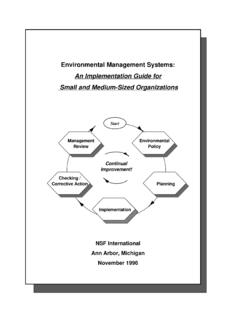
9 This, in turn can increase the long term viability of the organization and where appropriate a higher regard for its asset 14001:2015 environmental management system IMPLEMENTATION GUIDE7 PDCA CYCLEPlan:Understand the context of the organization, establish environmental objectives and processes necessary to deliver results in accordance with the organization s environmental policy, understand risk and opportunities and determine the support required to achieve the outcomes :Implement the processes as planned to include operational planning and control and emergency preparedness and :Monitor, measure and evaluate environmental performance to include internal audit and management :Take actions to continually improve to include addressing non (PDCA) is an iterative, four-stage approach for achieving continual improvement.
10 It involves systematically testing possible solutions, assessing the results, and implementing the ones that are shown to work. At the heart of this approach is leadership. The importance of leadership at all levels, but particularly by Top management , cannot be underestimated to operate an EMS successfully, to achieve performance levels required and generate continual the context of an EMS, PDCA is translated into the following:SUPPORT & OPERATION LEADERSHIPIMPROVEMENTPLANNING PERFORMANCE EVALUATION PlanDoActCheckSCOPE OF THE environmental management SYSTEMINTERNAL & EXTERNAL ISSUESINTENDED OUTCOMES OF THE environmental management SYSTEMNEEDS AND EXPECTATIONS OF RELEVANT INTERESTED PARTIESCONTEXT OF THE ORGANIZATIONISO 14001 .