Example: dental hygienist
Cervical Disc Replacement Physical Therapy Prescription
3 Aquatic Physical Therapy (more than three weeks, if available, once incision has healed • Transverse abdominis bracing during all exercises and good head position • Walking all directions, balance, lower extremity and upper extremity strengthening
Tags:
Information
Domain:
Source:
Link to this page:
Documents from same domain

Lumbar Discectomy Physical Therapy Prescription
www.orthoindy.com• Start at table (supine, prone, quadruped) 10” isometrics • Progress with upper extremity/lower extremity movements (eg. marches, straight leg raises, upper extremity lift and lowers, planks, etc.) •Continue with Proper Glute Activation Exercises

Cervical Fusion Physical Therapy Prescription - OrthoIndy
www.orthoindy.comAquatic Physical Therapy (less than four weeks if available once incision has healed) • Transverse abdominis bracing during all exercises and good head position. • Walking all directions, balance, lower extremity strengthening (no upper extremity resistance strength until six weeks). Phase II (6 to 12 Weeks): Strengthening Phase Therapy

Medial/Lateral Partial Meniscectomy Post-operative ...
www.orthoindy.com2 • eek two, 0 to 125 degreesW • eek three, 0 to 135 degreesW • eek four, 0 to 145 degreesW. Cardiovascular • Stairmaster, elliptical, treadmill (no running) and bike
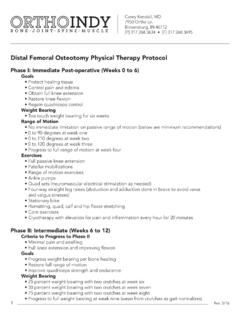
Distal Femoral Osteotomy Physical Therapy Protocol
www.orthoindy.comDistal Femoral Osteotomy Physical Therapy Protocol Phase I: Immediate Post-operative (Weeks 0 to 6) Goals • Protect healing tissue • Control pain and edema • Obtain full knee extension • Restore knee flexion • Regain quadriceps control Weight Bearing • Toe touch weight bearing for six weeks Range of Motion
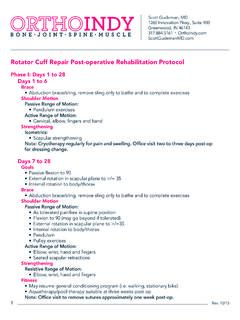
Rotator Cuff Repair Post-operative Rehabilitation Protocol
www.orthoindy.comRotator Cuff Repair Post-operative Rehabilitation Protocol. Phase I: Days 1 to 28 Days 1 to 6 . Brace • Abduction brace/sling, remove sling only to bathe and to complete exercises. Shoulder Motion. Passive Range of Motion: • Pendulum exercises Active Range of Motion: • Cervical, elbow, fingers and hand. Strengthening. Isometrics ...

Thoracic and Lumbar Spinal Fusion Surgery Guide
www.orthoindy.comThe spinal cord, which is the nerve center of the body, connects the brain to the rest of the body, and passes through the bony spine and usually ends at approximately L1 or L2. Beyond that, nerve roots are present in a fluid-filled tube. The outer layer of this tube is called the dura. At each segment, nerve roots
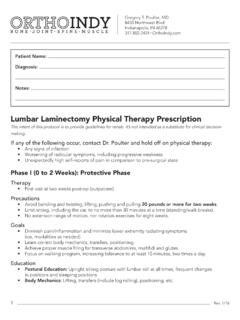
Lumbar Laminectomy Physical Therapy Prescription
www.orthoindy.comRev. 1/16 Lumbar Laminectomy Physical Therapy Prescription The intent of this protocol is to provide guidelines for rehab. It’s not intended as a substitute for clinical decision making. If any of the following occur, contact Dr. Poulter and hold off on physical therapy: • Any signs of infection

Shoulder Isometric Strengthening Program - OrthoIndy
www.orthoindy.comShoulder Isometric Strengthening Program. Isometric Shoulder Flexion at Wall. Setup. Begin in a standing upright position with . your elbow bent 90 degrees, and a small towel between your fist and a wall. Movement. Push your arm directly into the wall, then . relax and repeat. Tip. Make sure to keep your back straight during the exercise.

Posterior Cervical Decompression Surgery Guide
www.orthoindy.comfish oil, garlic tablets, ginger tablets, Ginko, Ginsen, Quilinggao, Vitamin E and Co Q10. • Insulin and Prednisone have specific instructions that may need to be adjusted prior to your surgery. Please let the anesthesiology team know all medications you are on.

Cervical Stretching and Posture - OrthoIndy
www.orthoindy.comSeated Cervical Retraction Standing Scapular Retraction. Seated Cervical Sidebending Stretch. Setup. Begin sitting in an upright position with your feet flat on the floor. Movement. Gently draw your chin in, while keeping your . eyes fixed on something in front of you. Tip. Make sure that you do not look down as you do this exercise, or bend ...
Related documents
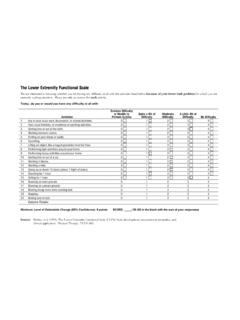
because of your lower limb problem for which you are each
rehab.msu.eduThe Lower Extremity Functional Scale We are interested in knowing whether you are having any difficulty at all with the activities listed below because of your lower limb problem for which you are currently seeking attention. Please provide an answer for each activity. Today, do you or would you have any difficulty at all with: Activities
Rehabilitation Protocol for Achilles Rupture Repair
www.massgeneral.orgo Lower Extremity Functional Tests should be ≥90% compared to contralateral side for unilateral tests. Contact Please email MGHSportsPhysicalTherapy@partners.org with questions specific to this protocol Revised 8/2021 References: 1. Baxter JR, Corrigan P, et al. Exercise Progression to Incrementally Load the Achilles Tendon.

5X Sit-to-Stand Test (5XSST)
www.thompsonhealth.comDescription: Assesses functional lower extremity strength, transitional movements, balance, and fall risk. Equipment: Stopwatch; standard height chair with straight back (16 inches high); Therapist Instructions: Have the patient sit with their back against the back of the chair. Count each stand aloud so that the patient remains oriented.
Rehabilitation of Hip Labral Tears
cme.uthscsa.edu• Begin with isometrics with lower extremity in neutral • Progress to include isotonics and core strength Gait training Balance/Proprioception exercises Surgical Rehabilitation ... •Advance functional exercises •Sport specific agility drills •Training References: Anonymous. A Patient’s Guide to Labral Tears of the Hip. (n.d.) In ...

SECTION GG: FUNCTIONAL ABILITIES AND GOALS
www.monterotherapyservices.com1. Mrs. M is a bilateral lower extremity amputee and has multiple diagnoses, including diabetes, obesity, and peripheral vascular disease. She is unable to walk and did not walk prior to the current episode of care, which started because of a pressure ulcer and respiratory infection.

CRS R COMA RECOVERY SCALE REVISED ©2004
www.tbims.orgFor upper extremity reaching, select common objects (e.g. comb, toothbrush, etc.) For lower extremity assessment, select a ball suitable for kicking. 3. Present the object approximately 8 inches to the left or right of the limb’s resting position. The object should be placed in a position that is not obstructed from view. The patient should be

Workers' Compensation Guidelines for Determining Impairment
www.wcb.ny.govNov 22, 2017 · and functional impairments. Final adjustment of a claim by a schedule award must comply with the following medical requirements: 1. There must be a permanent impairment of an extremity, permanent loss of vision or hearing, or permanent facial disfigurement, as defined by law. 2.
ACL Hamstring Tendon Autograft Reconstruction Protocol
www.brighamandwomens.org• Strength approximately 70% of uninvolved lower extremity per isokinetic evaluation • Sufficient strength and proprioception to initiate agility activities • Normal running gait Goals: • Symmetric performance of basic and sport specific agility drills • Single hop and three hop tests 85% of …
Orthotic Devices and Shoes - Cigna
static.cigna.comAn upper extremity orthotic device (HCPCS codes L3650-L3999) (i.e., non-myoelectric, non-power enhanced, non custom fitted or custom fabricated hand) is considered medically necessary for an individual requiring stabilization or support to the upper limb and who is expected to have improved function with the use of the device:

Motor Activity Log (MAL) Manual
www.uab.eduUpper Extremity Motor Activity Log (UE MAL) 1. General This instrument is a structured interview intended to examine how much and how well the subject uses their more-affected arm outside of the laboratory setting. Participants are asked standardized questions about the amount of use of their more-affected arm (Amount Scale or AS) and the quality