Transcription of CHCDIS010 Provide person-centred services to people with ...
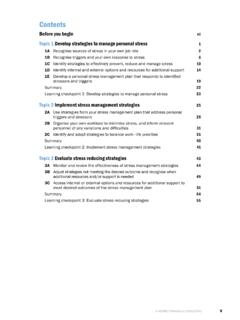
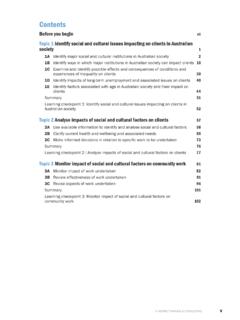
1 ASPIRE TRAINING & CONSULTING vContentsBefore you begin viiTopic 1 Evaluate and prioritise the needs of a person with complex support issues 11A Identify and prioritise the needs and coexisting issues of the person 21B Identify specific problems, issues and challenges for the person 81C Analyse and interpret data with assistance from health professionals 131D Recognise the impact of complex support issues on the person s family 161E Establish priorities for support with the person and relevant others 19 Summary 22 Learning checkpoint 1.
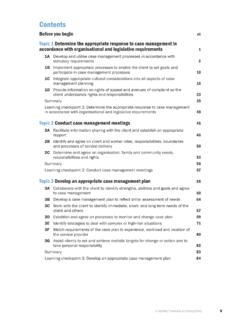
2 Evaluate and prioritise the needs of a person with complex support issues 23 Topic 2 Develop an individualised plan to achieve maximum quality of life 272A Use best practice guidelines to develop strategies to address complex and/or special needs 282B Liaise with relevant experts when developing individualised plans 332C Negotiate and establish goals 362D Access and negotiate resources to deliver identified services 382E Access community support agencies to facilitate the achievement of goals 41 Summary 43 Learning checkpoint 2: Develop an individualised plan to achieve maximum quality of life 44 Topic 3 Coordinate the delivery of the individualised plan 473A Ensure services and support activities are undertaken by appropriately skilled workers 483B Recognise when a service and/or support worker is unable to Provide the level of service required 513C Support stakeholders providing a service to understand their roles and responsibilities within the plan 53 Summary 55 Learning checkpoint 3.
3 Coordinate the delivery of the individualised plan 56 ASPIRE TRAINING & CONSULTING 1 Topic 1In this topic you will learn how to:1A Identify and prioritise the needs and coexisting issues of the person1B Identify specific problems, issues and challenges for the person1C Analyse and interpret data with assistance from health professionals1D Recognise the impact of complex support issues on the person s family1e Establish priorities for support with the person and relevant others Evaluate and prioritise the needs of a person with complex support issuesA person with complex support issues typically has a number of areas of need and various issues that need to be carefully identified and prioritised.
4 The process of prioritising means that the most important and time critical issues are assessed first, often using data that is provided by allied health professionals or medical professionals. This process may demand support and assistance from other professionals as well as from family members or caregivers and from the person. Prioritising issues and areas of need allows for the development of an appropriate plan that takes into account individual requirements and available resources and support services . It is important, during the process of evaluating and prioritising the needs of a person with complex support issues, to recognise the impact these issues may have upon family Provide person-centred services TO people with disability with COMPLEX NEEDS4 Collect and collateCollect and collate information from the formal and informal assessments provided by and complete gaps Identify any gaps in knowledge about the person and collect further information, as needed.
5 Through formal and informal assessment Formal assessments can Provide information about many aspects of daily functioning, specific needs and health and related information. They should only be completed by people who have the necessary skills and knowledge to use the assessment tools. Many assessment tools require specific levels of qualification or experience before they can be used check your own workplace requirements for using formal are three types of formal assessments that may be used with people who have various types of disabilities or needs, or who are from specific cultural state examination (MSe)
6 XXAn MSE gives a snapshot of a person`s psychological functioning at a particular point in time and can indicate if referral or risk assessment is community care needs assessment (ACCnA)XXThe ACCNA provides a consistent tool that is used across many service types to collect and record information about the person and their carer (if relevant).indigenous risk impact screen (iriS) and brief interventionXXThe IRIS screening tool assesses risk for alcohol, drug and mental health issues in Aboriginal and Torres Strait Islander assessmentMany workers use informal assessments every day, often without even realising it.
7 The observations we make about a person and the things they tell us about their needs help create a picture of how to best Provide support and assistance. Informal assessments may be created within the workplace or they may be comprised of the notes and observations you make during an initial meeting or conversation. Elements of an informal assessment may include:XXwritten notes about what the person tells you XXobservations of their mobility and independence XXobservations of the physical assistance required to perform activities of daily living XXdiscussion of how their needs impact upon their activitiesXXdiscussion of their goals and requirementsXXinformation given to you by family members or advocatesXXanswers given to questions you ask about care and support needs.
8 ASPIRE TRAINING & CONSULTING6 ASPIRE TRAINING & CONSULTINGCHCDIS010 Provide person-centred services TO people with disability with COMPLEX NEEDSSome coexisting issues that must be considered are:XXpresence of mental/physical health conditionsXXtransport difficultiesXXsocial or geographical isolation XXfinancial considerations/level of debtXXreligious or cultural requirementsXXcarer or other family needsIt is important to prioritise needs when providing care and support for a person. Identify the needs that are most important these are the needs that must be dealt with first.
9 Care and support may be required for a short period of time, such as in response to a crisis or as part of a planned respite or short-term activity. Sometimes ongoing care is required to support daily activities or a regular schedule of tasks such as employment, recreation or personal care requirements. Establishing how urgent the needs are determine the priority of meeting a person s needs. Here is an example of how needs can be prioritised. Crisis support Crisis support can be provided to help manage a short-term crisis such as a family illness, change to living situation or a sudden change in health status or care careIntermittent care can be provided from time to time, when required.
10 For example, if a person s condition exacerbates or when they are having respite careTransition care facilitates the transition from one setting to another, such as moving from home to a residential supportOngoing support happens according to a regular planned schedule, such as weekly or daily care, to ensure the maintenance of usual life functioning and ASPIRE TRAINING & CONSULTINGCHCDIS010 Provide person-centred services TO people with disability with COMPLEX NEEDS1B Identify specific problems, issuesand challenges for the person Care and support must be provided in line with person-centred practices.