Transcription of Interpretive Report of WAIS–IV Testing
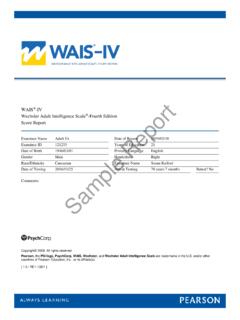
1 Copyright 2009 by NCS Pearson, Inc. All rights reserved. Printed in the United States of America. Michael Moore Page 1 of 8 Interpretive Report of wais IV Testing Examinee and Testing Information Examinee Name John Doe Date of Report 9/18/2013 Examinee ID 9172013 Years of Education 10 Date of Birth 10/3/1958 Home Language English Gender Male Handedness Right Race/Ethnicity African American Examiner Name Paul W Simpson Test Administered wais -IV (9/17/2013) Age at Testing 54 years 10 months Retest? No wais IV Comments score Summary wais IV Scale score Verbal Comprehension 66 Perceptual Reasoning 69 Working Memory 58 Processing Speed 53 Full Scale 56 Interpretation of wais IV Results General Intellectual AbilityJohn was administered 10 subtests of the Wechsler Adult Intelligence Scale Fourth Edition ( wais IV). His composite scores are derived from these subtest scores. The Full Scale IQ (FSIQ) composite score is derived from 10 subtest scores and is considered the most representative estimate of global intellectual functioning.
2 John s general cognitive ability is within the extremely low range of intellectual functioning, as measured by the FSIQ. His overall thinking and reasoning abilities exceed those of only approximately of individuals his age (FSIQ = 56; 95% confidence interval = 53-61). John may experience great difficulty in keeping up with his peers in a wide variety of situations that require thinking and reasoning abilities. His ability to reason with words is comparable to his ability to reason without the use of words. John s verbal and nonverbal reasoning abilities are in the extremely low range. Verbal ComprehensionJohn s verbal reasoning abilities as measured by the Verbal Comprehension Index (VCI) are in the extremely low range and above those of only 1% of his peers (VCI = 66; 95% confidence interval = 62-73). The VCI is designed to measure verbal reasoning and concept formation. John performed Copyright 2009 by NCS Pearson, Inc.
3 All rights reserved. Printed in the United States of America. Michael Moore Page 2 of 8 comparably on the verbal subtests contributing to the VCI, suggesting that the various verbal cognitive abilities measured by these subtests are similarly developed. However, he may experience great difficulty in keeping up with his peers in situations that require verbal skills. Perceptual ReasoningJohn s nonverbal reasoning abilities as measured by the Perceptual Reasoning Index (PRI) are in the extremely low range and above those of only 2% of his peers (PRI =69; 95% confidence interval = 64-77). The PRI is designed to measure fluid reasoning in the perceptual domain with tasks that assess nonverbal concept formation, visual perception and organization, visual-motor coordination, learning, and the ability to separate figure and ground in visual stimuli. John s performance on the perceptual reasoning subtests contributing to the PRI is somewhat variable, although the magnitude of this difference in performance is not unusual among individuals his age.
4 Examination of John s performance on individual subtests provides additional information regarding his specific nonverbal abilities. John achieved his best performance among the nonverbal reasoning tasks on the Visual Puzzles subtest and his lowest score on the Matrix Reasoning subtest. His performance across these areas differs significantly and suggest that these are the areas of most pronounced strength and weakness, respectively, in John s profile of perceptual reasoning abilities. Although better developed than his other nonverbal reasoning abilities, John s abilities on the Visual Puzzles subtest were below those of most individuals his age. His weak performance on the Matrix Reasoning subtest was far below that of most individuals his age. The Matrix Reasoning subtest required John to look at an incomplete matrix and select the missing portion from five response options. This subtest assesses fluid visual information processing and abstract reasoning skills (Matrix Reasoning scaled score = 3).
5 The Visual Puzzles subtest required John to view a completed puzzle and select three response options that, when combined, reconstruct the puzzle, and do so within a specified time limit. This subtest is designed to measure nonverbal reasoning and the ability to analyze and synthesize abstract visual stimuli. Performance on this task also may be influenced by visual perception, broad visual intelligence, fluid intelligence, simultaneous processing, spatial visualization and manipulation, and the ability to anticipate relationships among parts (Visual Puzzles scaled score = 6). Working MemoryJohn s ability to sustain attention, concentrate, and exert mental control is in the extremely low range. He performed better than approximately of his peers in this area (Working Memory Index (WMI) = 58; 95% confidence interval 54-67). John had difficulty with the two tasks that demand mental control, that is, attending and holding information in short-term memory while performing some operation or manipulation with it and then correctly producing the transformed information (Digit Span scaled score = 1; Arithmetic scaled score = 4).
6 Processing SpeedJohn s ability in processing simple or routine visual material without making errors is in the extremely low range when compared to his peers. He performed better than approximately of his peers on Copyright 2009 by NCS Pearson, Inc. All rights reserved. Printed in the United States of America. Michael Moore Page 3 of 8 the processing speed tasks (Processing Speed Index [PSI] = 53; 95% confidence interval 49-66). Processing visual material quickly is an ability that John performs poorly as compared to his nonverbal reasoning ability. Processing speed is an indication of the rapidity with which John can mentally process simple or routine information without making errors. SummaryJohn is a 54-year-old male who completed the wais IV. His general cognitive ability, as estimated by the wais IV, is in the extremely low range (FSIQ = 56). John s verbal comprehension and perceptual reasoning abilities were both in the extremely low range (VCI = 66, PRI = 69).
7 John s ability to sustain attention, concentrate, and exert mental control is in the extremely low range (WMI = 58). John s ability in processing simple or routine visual material without making errors is in the extremely low range when compared to his peers (PSI = 53). This Report is valid only if signed by a qualified professional: _____ Copyright 2009 by NCS Pearson, Inc. All rights reserved. Printed in the United States of America. Michael Moore Page 4 of 8 wais IV score Report Composite score Summary Scale Sum of Scaled Scores Composite score Percentile Rank 95% Confidence Interval Qualitative Description Verbal Comprehension 12 VCI 66 1 62-73 Extremely Low Perceptual Reasoning 14 PRI 69 2 64-77 Extremely Low Working Memory 5 WMI 58 54-67 Extremely Low Processing Speed 3 PSI 53 49-66 Extremely Low Full Scale 34 FSIQ 56 53-61 Extremely Low Confidence Intervals are based on the Overall Average SEMs.
8 Values reported in the SEM column are based on the examinee s age. Copyright 2009 by NCS Pearson, Inc. All rights reserved. Printed in the United States of America. Michael Moore Page 5 of 8 Analysis Index Level Discrepancy Comparisons Comparison score 1 score 2 Difference Critical Value .05 Significant Difference Y / N Base Rate Overall Sample VCI - PRI 66 69 -3 N VCI - WMI 66 58 8 N VCI - PSI 66 53 13 Y PRI - WMI 69 58 11 Y PRI - PSI 69 53 16 Y 15 WMI - PSI 58 53 5 N Base rate by overall sample. Statistical significance (critical value) at the .05 level. Verbal Comprehension Subtests Summary Composite Scores and Standard Error of Measurement Composite score SEM VCI 66 PRI 69 3 WMI 58 PSI 53 FSIQ 56 Composite score Profile The vertical bars represent the standard error of measurement (SEM). Copyright 2009 by NCS Pearson, Inc. All rights reserved.
9 Printed in the United States of America. Michael Moore Page 6 of 8 Subtest Raw score Scaled score Percentile Rank Reference Group Scaled score SEM Similarities 12 4 2 4 Vocabulary 12 4 2 4 Information 4 4 2 5 Perceptual Reasoning Subtests Summary Subtest Raw score Scaled score Percentile Rank Reference Group Scaled score SEM Block Design 16 5 5 4 Matrix Reasoning 4 3 1 1 Visual Puzzles 7 6 9 5 Working Memory Subtests Summary Subtest Raw score Scaled score Percentile Rank Reference Group Scaled score SEM Digit Span 8 1 1 Arithmetic 7 4 2 5 Processing Speed Subtests Summary Subtest Raw score Scaled score Percentile Rank Reference Group Scaled score SEM Symbol Search 5 1 1 Coding 22 2 1 Subtest Level Discrepancy Comparisons Subtest Comparison score 1 score 2 Difference Critical Value .05 Significant Difference Y / N Base Rate Digit Span - Arithmetic 1 4 -3 Y Symbol Search - Coding 1 2 -1 N Statistical significance (critical value) at the.
10 05 level. Copyright 2009 by NCS Pearson, Inc. All rights reserved. Printed in the United States of America. Michael Moore Page 7 of 8 Determining Strengths and Weaknesses Differences Between Subtest and Overall Mean of Subtest Scores Subtest Subtest Scaled score Mean Scaled score Difference Critical Value .05 Strength or Weakness Base Rate Block Design 5 >25% Similarities 4 >25% Digit Span 1 W 25% Matrix Reasoning 3 >25% Vocabulary 4 >25% Arithmetic 4 >25% Symbol Search 1 >25% Visual Puzzles 6 15-25% Information 4 >25% Coding 2 >25% Overall: Mean = , Scatter = 5, Base rate = Base Rate for Intersubtest Scatter is reported for 10 Full Scale Subtests. Statistical significance (critical value) at the .05 level. Subtest Scaled score Profile The vertical bars represent the standard error of measurement (SEM) Copyright 2009 by NCS Pearson, Inc.