Transcription of Unit 5 Transportation - infohub.nyced.org
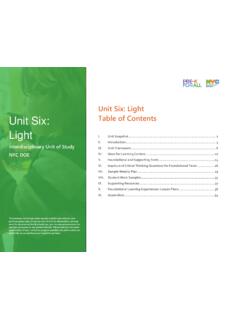
1 Unit Five: Transportation Table of Contents I. Unit Snapshot .. 2 II. Introduction .. 4 III. Unit Framework .. 6 IV. Ideas for Learning Centers .. 9 V. Foundational and Supporting Texts .. 25 VI. Inquiry and Critical Thinking Questions for Foundational Texts .. 27 VII. Sample Weekly 30 VIII. Student Work Samples .. 36 IX. Supporting Resources .. 38 X. Foundational Learning Experiences: Lesson Plans .. 39 XI. Appendices .. 57 Unit Five: Transportation Interdisciplinary Unit of Study NYC DOE The enclosed curriculum units may be used for educational, non-profit purposes only. If you are not a Pre-K for All provider, send an email to to request permission to use this curriculum or any portion thereof. Please indicate the name and location of your school or program and describe which units you would like to use and how you intend to use them.
2 UNIT SNAPSHOT 2 I. Unit Snapshot Unit Topic: Transportation Essential Question How does my community use various modes of Transportation ? Focus Questions What kinds of Transportation do I use and why? How are various modes of Transportation similar and different? Who operates the vehicles in my community? How do we stay safe when using Transportation ? Student Outcomes Enduring understandings that the student should have by the end of the unit: I use Transportation to get to pre-K and other places. We use different types of Transportation for different reasons. Vehicles move in different ways. Some vehicles are operated by community helpers such as bus drivers, conductors, firefighters, police officers and mail carriers. There are many ways to stay safe when using Transportation .
3 Connected Academic Vocabulary This list should be adapted to best fit the needs of individual programs and classrooms. accident airplane airport ambulance axle barge bicycle bridge bus car cargo cement mixer conductor crossing guard crutches drive driver emergency EMT engine engineer express fare feet ferry fire engine firefighter fly harbor helicopter helmet keys license plate local locomotive mail carrier mail truck mechanic MetroCard Motor office operator parachute pilot police car police officer property propeller ramp roll run safety scooter school bus seatbelt skateboard speed speed limit stop stroller subway tanker taxi traffic traffic jam traffic light traffic signs train train tracks transport Transportation truck tugboat tunnel van vehicle wagon walk walker wheelchair yield UNIT SNAPSHOT 3 Focus StandardsFrom the New York State Prekindergarten
4 Learning Standards (NYSPLS) Domain 1: Approaches to Learning Approaches tasks and problems with creativity, imagination and/or willingness to try new experiences Exhibits curiosity, interest, and willingness to learn new things and have new experiences Domain 2: Physical Development and Health Demonstrates eye-hand coordination and fine motor skills Demonstrates awareness and understanding of safety rules Domain 3: Social and Emotional Development Regulates responses to needs, feelings and events Domain 4: Communication, Language and Literacy English Language Arts and Literacy Reading Foundations [ ] Demonstrates an emerging understanding of spoken words, syllables, and sounds (phonemes) Reading [ ] Exhibits an interest in learning new vocabulary ( , asks questions about unfamiliar words) Language [ ] Demonstrates command of the conventions of academic English grammar and usage when writing or speaking.
5 Domain 5: Cognition and Knowledge of the World Mathematics [ ] Recognizes whether the number of objects in one group is more than, fewer than, or equal to (the same as) the number of objects in another group ( , using matching and counting strategies) [ ] Identifies measurable attributes of objects, such as length or weight, and describes them using appropriate vocabulary ( , small, big, short, tall, empty, full, heavy, light) Science [K-2-ETS1-1.] Asks questions, makes observations, and gathers information about a situation people want to change to define a simple problem that can be solved through the development of a new or improved object or tool Social Studies Demonstrates an understanding of roles, rights, and responsibilities Begins to learn basic civic and democratic principles Develops a basic understanding of economic concepts within a community The Arts [ ] Performs Theatrical Arts.
6 INTRODUCTION 4 II. Introduction Welcome to Unit 5: Transportation , Pre-K for All s fifth Interdisciplinary Unit of Study. In this unit, children move from inquiring and thinking critically about the places where animals and people live to exploring how people move from place to place using vehicles and other methods of Transportation . This unit, like all Pre-K for All units, provides opportunities for children to observe objects and phenomena in their environment with increasing complexity through hands-on activities in the classroom and in the community. In this unit, children have the opportunity to deepen their understanding of a major part of New York City life across all five boroughs. The full diversity of our city is reflected in this unit through the examination of trains, boats, cars, airplanes, buses, specialty vehicles and more!
7 There are opportunities throughout the unit for you to tailor discussions and activities to reflect the children and communities you serve. All Interdisciplinary Units of Study are structured around three to four focus questions. Each focus question is designed to take about one week to explore. Children begin the unit by considering the first focus question, What kinds of Transportation do I use and why? Children read about and may discuss what modes of Transportation they use (including motorized vehicles, non-motorized vehicles and other modes like walking) by creating a chart titled, How Did I Get to Pre-K Today? In week two, children begin to think about how different kinds of Transportation are similar and different. This is an opportunity to compare and contrast the attributes of different modes of Transportation ; children can explore the science of how vehicles move according to their interest levels.
8 This subtopic taps into children s curiosity about vehicles and how they travel and move, enabling meaningful connections to the New York State Prekindergarten Learning Standards (NYSPLS). This unit, like all Pre-K for All units, provides opportunities for children to observe objects and phenomena in their environment with increasing complexity through hands-on activities in the classroom and in the community. In the third week of the unit, children consider the question, Who operates the vehicles in my community? In this week, children observe and explore vehicle operators such as bus drivers, police officers, Emergency Medical Technicians (EMTs) and other community helpers. In this week, there are opportunities to extend learning by taking a walking field trip or having a community helper visit the classroom, which connects to NYSPLS social studies standards in Domain 5.
9 These activities culminate in the final week of the unit when children explore the question, How do we stay safe when using Transportation ? Abstract ideas such as safety, traffic and rules become more concrete when explored through games such as Red Light, Green Light. Throughout the unit, we encourage you to highlight various ways public Transportation can be accessible to people with disabilities, for example, wheelchair ramps on buses and elevators in subway stations. Children may also be familiar with the use of these accommodations for families with strollers. Opportunities to develop children s literacy skills are interwoven throughout the unit. Children will enjoy literature, engage in discussions around books, and may retell, and act out stories they have read. Additionally, there are examples of how to teach and use new academic vocabulary words throughout Section IV in Ideas for Learning Centers and in the Foundational Learning Experiences in Section X.
10 In Unit 4: Where We Live, we focused on a few key letters that came up naturally through read alouds and activities. In this unit, we encourage you to highlight specific numbers and letters that are relevant to the Transportation in your community. For example, if many children in your class take the same bus, use those letters and numbers in games, activities and conversations. In addition to a few letters and numbers that are particularly relevant for your classroom community, there are many opportunities for noticing, interpreting, and designing symbols and signs throughout this unit. Exploring signs and symbols helps children develop their emergent reading, INTRODUCTION 5 writing and drawing skills, as well as their understanding of community. Enjoy the study! As always, feel free to send questions and comments to INTRODUCTION 6 III.